Showing posts with label Meltdown. Show all posts

Monday, April 9, 2012

A Wicked Financial Storm Descends On America

By: Terresa Monroe-Hamilton – The NoisyRoom

clip_image002

Ever since 2008, this blog has been warning about economic devastation heading our way. You see it everywhere you look today, if you bother to look that is… Gas prices are at close to an average of $4 a gallon and in parts of California, it is now hitting $7, with no end in sight. Food inflation that is rising so precipitously, it takes your breath away – but the government says there is no inflation.

In the world that is America now, all things seem to be upside down and sliding full-blown out of control. This includes the Communist who is our current Commander-in-Chief. He claims he is drilling for oil, when the opposite is true. He is blocking all of it and piling so many regulations on our coal plants in lockstep with his bud, Cass Sunstein, that they are shutting down as well. Lie after lie after infernal lie.

As for unemployment, the government is manipulating the hell out of those numbers in an attempt to calm the sheep before the slaughter. They claim it has fallen to 8.2%. Take a long look at the U6 rate, which tracks not only those out of work, but those who’ve essentially given up looking for work. It currently sits at 14.5% – close to double what is being claimed by our ‘progressive’ leadership. Real unemployment stands at closer to 19.1% and is perhaps substantially higher than that.

People are giving up on finding work. A second, even more brutal wave of foreclosures is also on the horizon. Real hunger is coming to the US and hard times that will make the Great Depression seem like the good ole days are pounding on our door. A majority of states are now close to being unable to cover pensions and other entitlements as well as expenses. Bankruptcy is an understatement for what these states are facing. So, to “solve” the problem, a number of them are taxing more which makes it worse and worse. All the while, the rising flood of fuel prices surges against the levee.

When truckers cannot fill their tanks anymore because of the cost, store shelves will become barren wastelands. Real food deserts. When people get hungry, especially when their children are hungry, they get mean and desperate. Just what the Progressives had in mind. Violence, chaos and mayhem in the streets.

So, you say… the election is not far off and we can get rid of Obama then. Maybe, maybe not… I understand a company owned at least in part by Soros will be handling voting results. It doesn’t take a genius to see how that would be manipulated. Then there is a potential war with Iran. If Obama feels his reelection is in jeopardy, war with Iran will look like just the right emergency. Or, there could be any other number of emergencies, real or ginned up like the Trayvon Martin murder that is sparking racial unrest.

If nothing else, the debt we owe will literally drag us into hell all by itself. We’re broke and we aren’t going back to yesteryear anytime soon. That would take massive cuts and pain and no one with that kind of spine exists today in our government. But until the last penny is stolen and the last party is thrown by the Progressives, they will keep spending until there is nothing left but death, war, famine and blood. And they are okay with that, trust me. We face the abyss and our leaders are embracing the gulf.

From The Economic Collapse Blog:

#1 According to one new survey, approximately one-third of all Americans are not paying their bills on time at this point.

#2 The U.S. housing industry is bracing for another huge wave of foreclosures in 2012. The following is from a recent Reuters article….

“We are right back where we were two years ago. I would put money on 2012 being a bigger year for foreclosures than 2010,” said Mark Seifert, executive director of Empowering & Strengthening Ohio’s People (ESOP), a counseling group with 10 offices in Ohio.

#3 The Citigroup Economic Surprise Index, a key indicator watched by many economists, is on the verge of heading into negative territory.

#4 We are supposed to be in the middle of an economic recovery in the United States, but bad news just keeps pouring in from major companies. For example, Yahoo is firing thousands of workers and Best Buy is closing dozens of stores.

#5 Richard Russell says that the “big money” is starting to quietly exit from the financial markets….

“My guess is that this is the big money that has been holding off as long as it decently can — and then dumping their goods just before the close. I don’t think the big money likes this market, and I think they have been slowly exiting this market, as quietly as they can.”

#6 Goldman Sachs is projecting that the S&P 500 will fall by about 11 percent by the end of 2012.

#7 All over the country, local governments are going into default and we have not even entered the next recession yet.

#8 The U.S. government will add more to the national debt in 2012 than it did from the time that George Washington became president to the time that Ronald Reagan became president.

#9 The Federal Reserve is desperately trying to control interest rates. The Fed purchased approximately 61 percent of all government debt issued by the U.S. Treasury Department in 2011. This is the only thing that is keeping interest rates in the United States from soaring dramatically.

#10 German industrial production is falling at a pace that is far faster then expected.

#11 Italy’s debt-to-GDP ratio is now up to 120 percent.

#12 The Spanish government admitted on Tuesday that Spain’s debt-to-GDP ratio will rise by more than 11 percent this year alone.

#13 Yields on Spanish bonds are rising to dangerous levels.

#14 The Spanish government is projecting that the unemployment rate in Spain will exceed 24 percent by the end of the year.

#15 Unemployment in the eurozone as a whole has risen for 10 months in a row and is now at a 15 year high.

#16 In the aftermath of a 77-year-old retiree killing himself in front of the Greek parliament in protest over pension cuts, the economic rioting in Greece has flared back up dramatically.

#17 At this point, Greece is experiencing an economic depression with no end in sight. Some of the statistics coming out of Greece are really hard to believe. For example, one port town in Greece now has an unemployment rate of approximately 60 percent.

#18 The IMF is asking the United States to contribute more money for European bailouts.

#19 At this point, even some of our top scientists are projecting economic trouble. For example, researchers at MIT are projecting a “global economic collapse” by the year 2030 if current trends continue.

We don’t have till 2030… I personally don’t think we have until 2013. As the stock market (which is hideously manipulated) teeters on the edge of Armageddon and those with any money at all are running for the exits, the warnings of a wicked financial storm descending on America are blaring for all they are worth. And it would seem America is still asleep. Prepare to reap the whirlwind of an economic collapse – we are at its door.

Breitbart.com: As mention above:  Record 87,897,000 Americans Not in the Labor Force amid  disappointing unemployment numbers that fell 80,000 jobs short of projections, another number is raising eyebrows: the number of Americans not in the labor force has hit a record high 87,897,000.

This figure explains why overall unemployment dropped from 8.3% to 8.2%, as the Department of Labor's unemployment figure does not include people who have given up hope and are not actively seeking employment.

When the number of individuals who have stopped looking for a job and/or who are working part-time but desire full-time employment is included--a figure known as the "underemployment rate"--real unemployment stands at 19.1%.

Friday, January 13, 2012

Audit of the Federal Reserve Reveals $16 Trillion in Secret Bailouts

This gives a new meaning to " gov’t. corruption"!!!!

No wonder they didn't want to be Audited..

Audit of the Federal Reserve Reveals $16 Trillion in Secret Bailouts - unelected.org - Click: The Silver Bear Cafe

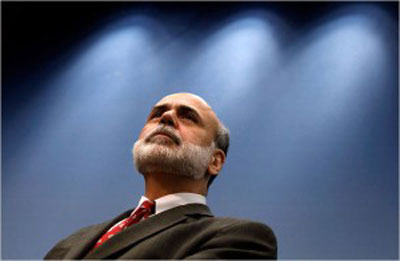
The first ever GAO (Government Accountability Office) audit of the Federal Reserve was carried out in the past few months due to the Ron Paul, Alan Grayson Amendment to the Dodd-Frank bill, which passed last year. Jim DeMint, a Republican Senator, and Bernie Sanders, an independent Senator, led the charge for a Federal Reserve audit in the Senate, but watered down the original language of the house bill (HR1207), so that a complete audit would not be carried out. Ben Bernanke(pictured to the right), Alan Greenspan, and various other bankers vehemently opposed the audit and lied to Congress about the effects an audit would have on markets. Nevertheless, the results of the first audit in the Federal Reserve’s nearly 100 year history were posted on Senator Sander’s webpage earlier this morning.

What was revealed in the audit was startling:

$16,000,000,000,000.00 had been secretly given out to US banks and corporations and foreign banks everywhere from France to Scotland. From the period between December 2007 and June 2010, the Federal Reserve had secretly bailed out many of the world’s banks, corporations, and governments. The Federal Reserve likes to refer to these secret bailouts as an all-inclusive loan program, but virtually none of the money has been returned and it was loaned out at 0% interest. Why the Federal Reserve had never been public about this or even informed the United States Congress about the $16 trillion dollar bailout is obvious - the American public would have been outraged to find out that the Federal Reserve bailed out foreign banks while Americans were struggling to find jobs.

To place $16 trillion into perspective, remember that GDP of the United States is only $14.12 trillion. The entire national debt of the United States government spanning its 200+ year history is "only" $14.5 trillion. The budget that is being debated so heavily in Congress and the Senate is "only" $3.5 trillion. Take all of the outrage and debate over the $1.5 trillion deficit into consideration, and swallow this Red pill: There was no debate about whether $16,000,000,000,000 would be given to failing banks and failing corporations around the world.

In late 2008, the TARP Bailout bill was passed and loans of $800 billion were given to failing banks and companies. That was a blatant lie considering the fact that Goldman Sachs alone received 814 billion dollars. As is turns out, the Federal Reserve donated $2.5 trillion to Citigroup, while Morgan Stanley received $2.04 trillion. The Royal Bank of Scotland and Deutsche Bank, a German bank, split about a trillion and numerous other banks received hefty chunks of the $16 trillion.

"This is a clear case of socialism for the rich and rugged, you’re-on-your-own individualism for everyone else." - Bernie Sanders (I-VT)

When you have conservative Republican stalwarts like Jim DeMint(R-SC) and Ron Paul(R-TX) as well as self identified Democratic socialists like Bernie Sanders all fighting against the Federal Reserve, you know that it is no longer an issue of Right versus Left. When you have every single member of the Republican Party in Congress and progressive Congressmen like Dennis Kucinich sponsoring a bill to audit the Federal Reserve, you realize that the Federal Reserve is an entity onto itself, which has no oversight and no accountability.

Americans should be swelled with anger and outrage at the abysmal state of affairs when an unelected group of bankers can create money out of thin air and give it out to megabanks and super-corporations like Halloween candy. If the Federal Reserve and the bankers who control it believe that they can continue to devalue the savings of Americans and continue to destroy the US economy, they will have to face the realization that their trillion dollar printing presses will eventually plunder the world economy.

The list of institutions that received the most money from the Federal Reserve can be found on page 131 of the GAO Audit and are as follows..

Citigroup: $2.5 trillion ($2,500,000,000,000)
Morgan Stanley: $2.04 trillion ($2,040,000,000,000)
Merrill Lynch: $1.949 trillion ($1,949,000,000,000)
Bank of America: $1.344 trillion ($1,344,000,000,000)
Barclays PLC (United Kingdom): $868 billion ($868,000,000,000)
Bear Sterns: $853 billion ($853,000,000,000)
Goldman Sachs: $814 billion ($814,000,000,000)
Royal Bank of Scotland (UK): $541 billion ($541,000,000,000)
JP Morgan Chase: $391 billion ($391,000,000,000)
Deutsche Bank (Germany): $354 billion ($354,000,000,000)
UBS (Switzerland): $287 billion ($287,000,000,000)
Credit Suisse (Switzerland): $262 billion ($262,000,000,000)
Lehman Brothers: $183 billion ($183,000,000,000)
Bank of Scotland (United Kingdom): $181 billion ($181,000,000,000)
BNP Paribas (France): $175 billion ($175,000,000,000)
and many many more including banks in Belgium of all places

View the 266-page GAO audit of the Federal Reserve(July 21st, 2011): http://www.scribd.com/doc/60553686/GAO-Fed-Investigation

Source: http://www.gao.gov/products/GAO-11-696
FULL PDF on GAO server: http://www.gao.gov/new.items/d11696.pdf
Senator Sander’s Article: http://sanders.senate.gov/newsroom/news/?id=9e2a4ea8-6e73-4be2-a753-62060dcbb3c3

Source: unelected.org  - Click: The Silver Bear Cafe

(The Motto of the Silver Bear Cafe is: "Serving up a heaping helping of the Truth, with a generous side of Common Sense")

Sunday, December 4, 2011

Apocalypse Nowish

clip_image001

I can’t take it any more. Did someone order an apocalypse? I know there is always one bearing down on us somewhere, but come on! Have you read the headlines lately? By Friday of last week, I was ready for a major meltdown. Looks like I wasn’t the only one:

Video on site.  Or… Here

Video on site or Here


Oh, how I can relate. (Massive screaming and hair pulling.) What the hell is wrong with us? Everything is upside down and backwards. Just the highlights:

1. Europe is melting down and about to fall into a black hole of debt which will draw us into the whirlpool right along with them. No one seems to really want to control their spending. It’s like the elite are paying all their crony friends, providing for themselves and knowingly bringing on the destruction of finances planet-wide. Screw the common man – they are taking the system for all it’s worth and then getting out before the implosion hits.

2. Our government — in secret — gave out 7.7 Trillion dollars worth of bailout money to banks – worldwide. Where the hell did they get it? I suspect, they just ‘digitized’ it and spread it around. It made NO difference, just forestalled the inevitable implosion. See #1 above. Say it with me: Weimar Republic.

Digitize me, Fred…

And it exploded…

3. Any time now, the Middle East is going to blow up and hello $200 a barrel for oil. It could be Iran and Israel (or Iran and us). It could be Syria. Hell, it could be Pakistan. WWIII is about to announce itself on the global stage and I’m not convinced we’ll be on the right side of the fight.

4. The minority inmates of the asylum are in control of our country, all the while claiming they are the 99%. (Really, does anyone in government look like a 99 percenter?)

5. Communism never went away… It has surged back thanks to the Progressives putting their comrades in positions of power throughout our nation. The red menace is back baby and it is within our own walls and halls, not to mention spreading across the globe again.

6. Hyperinflation is on it’s way as the world prints money trying to stave off a global depression. Never worked before, won’t work this time. Don’t these idiots ever learn?

7. Our government has gone rogue. They no longer fear having to pay for any transgressions from insider trading to falsifying testimony on things like, oh, I don’t know, running guns to Mexico. There are soooo many corrupt issues in our government these days, I just don’t even know where to start. Get rid of all of ‘em and start over.

8. Taxes, taxes, taxes…

9. Regulations out the wazoo. It’s Atlas Shrugged come to life. We literally can’t breath without violating one law or another.

10. God is being removed systematically from every part of our society. In it’s place, some of the most violent and horrific examples of barbarism are taking place right here in America and elsewhere that I have ever seen.

11. Antisemitism is raising is ghastly head once more. Those that stand against God’s chosen ones will surely fall from grace. Count on it.

12. The Constitution is being utterly ignored and circumvented by our politicians and elite Progressives on both sides of the aisle. I’ve just about had all I can take from these politicians. We must restore the original intent of the Constitution and the ideals our founders based this country on or we are toast.

And speaking of our current economic and political situation, this episode was badly written:

What’s happened to personal responsibility? What’s happened to independence and innovation? Where are morals and ethics any more? Maybe they are all still there, it’s just that the minority is in control and they have the morals of an alley cat and the ethics of, well, a politician. In fact, many of them are politicians. Isn’t it time America put people of character back in control of our homeland? Isn’t it time for the majority to say that’s enough, we aren’t going to take this crap any more? I really, really think so.

Can you blame people for panicking? Can you blame them for storing food, paying off debt and moving to a state that has some sanity left? Gun sales are the highest they have ever been and I personally believe that it has everything to do with what is happening in our country and worldwide today. No longer are survivalists being called crazy, everyone is at least attempting to prep. I’d say if you just read the headlines, you can’t help but think things are trending darkly – Apocalypse Nowish.

By: Terresa Monroe-Hamilton – the NoisyRoom

Tuesday, May 17, 2011

U.S. hits $14.3 TRILLION debt ceiling. Obama raids pensions to keep gov’t going! As Geithner Prepares to Blame GOP for Economy/Housing Woes

Enron execs are in prison for a long time for doing things like this.

WALL STREET JOURNAL: The U.S. government hit the $14.294 trillion debt ceiling today (Monday, May 16, 2011) and has now already exceeded it, setting in motion an uncertain, 11-week political scramble to avoid a default.

Remember last week when Geithner said that all of a sudden we had until August, instead of this week for Congress to increase the debt ceiling?  And we were all wondering where this money to cover the shortage was coming from? The Treasury Department plans to announced it will stop issuing and reinvesting government securities in certain government pension plans, part of a series of steps designed to delay a default until Aug. 2.

The Treasury’s moves buy time for the White House and congressional leaders to reach a deficit-reduction agreement that could clear the way for enough lawmakers to vote to raise the amount of money Congress allows the nation to borrow.

However most informed American people and a majority of the experts do not want the debt ceiling raised.  If for once Congress would listen and not hike the debt ceiling… what happens to these pensions?  What happens to them is exactly what happened to Social Security that is a treasure chest filled with I.O.U’s from the Federal Government instead of the funds people have paid in for generations now.  

GEORGE SANTAYANA is often quoted for the aphorism that “Those who cannot remember the past are condemned to repeat it.” Looking back on the financial crisis, we can see why the study of history is often so contentious and why revisionist histories are so easy to construct. There are always many factors that could have caused a historical event; the difficult task is to discern which, among a welter of possible causes, were the significant ones — the ones without which history would have been different.

Using this standard, I believe that the sine qua non of the financial crisis was U.S. government housing policy, which led to the creation of 27 million subprime and other risky loans — half of all mortgages in the United States — which were ready to default as soon as the massive 1997-2007 housing bubble began to deflate. If the U.S. government had not chosen this policy path — fostering the growth of a bubble of unprecedented size and an equally unprecedented number of weak and high-risk residential mortgages — the great financial crisis of 2008 would never have occurred.

It was the U.S. government’s housing policies — and nothing else — that were responsible for the 2008 financial crisis.

The inquiry has to begin with what everyone agrees was the trigger for the crisis — the so-called mortgage meltdown that occurred in 2007. That was the relatively sudden outbreak of delinquencies and defaults among mortgages, primarily in a few states — California, Arizona, Nevada, and Florida — but to a lesser degree everywhere in the country. No one disputes that the losses on these mortgages and the decline in housing values that resulted from the ensuing foreclosures weakened financial institutions in the U.S. and around the world and were the precipitating cause of the crisis.

This raised a significant question. The U.S. had experienced housing bubbles in the past. Since the Second World War, there had been two — beginning in 1979 and 1989 — but when these bubbles deflated they had triggered only local losses. Why was the deflation of the housing bubble in 2007 so destructive?

The Financial Crisis Inquiry Commission’s answer was that there were weaknesses in the financial system — failures of regulation and risk management, excessive leverage and risk-taking — that were responsible for the ensuing devastation. To establish this idea, the Commission had to show that these weaknesses were something new. It didn’t attempt to do this, although that was an essential logical step in establishing its point. And the Commission ignored a more obvious answer: the quality of the mortgages in the bubble. As I noted earlier — and as the Commission never acknowledged or disputed — by 2008, half all mortgages in the U.S. — 27 million — were subprime or otherwise risky loans. If the Commission had really been looking for the reasons that the collapsing bubble was so destructive, the poor quality of the mortgages in the bubble was a far more likely hypothesis than that there had been a previously undetected weakening in the way the U.S. financial system operated.  (Read full Article HERE at American Spectator)

With a failing and ailing housing market that Zillow predicts won’t hit bottom until 2012 *at the earliest*…, a US dollar with rapidly declining value driving prices of oil up, as well as every product down line in the transportation chain, this administration’s leadership thru the US economic woes have proven not to steer the nation towards recovery, but instead thrown us into a double dip recession.

With a new POTUS election year looming, this comes as quite the inconvenient talking point. So it comes as no surprise that Geithner decides to play politics with a crises… laying the groundwork for blaming policies that brought us to this point on on the GOPs demands for spending cuts in exchange for raising the debt ceiling.

A short-term default on government debts would do “irrevocable damage” to the American economy, according to Treasury Secretary Timothy Geithner.

In addition, failing to raise the debt limit and forcing the government to miss payments on some obligations would “likely push us into a double dip recession,” he warned Friday in one of the administration’s bluntest warnings yet on the dangers of inaction.

In a letter sent to Sen. Michael Bennet (D-Colo.), Geithner painted a bleak picture of what would happen if Congress were to fail to raise the $14.3 trillion debt limit in time. A government default would hurt an already weak housing market, drive down household wealth by hitting 401(k) accounts and pension funds, and actually increase the government’s debt burden by driving up costs.

I’m not sure if Geithner’s bothered to look closely, but with, or without, that debt ceiling, a double dip recession has already been upon us. That is if you want to focus on the economic health of anyone other than the financials, who’ve been the biggest beneficiaries of Fed’s low interest/big bucks capital gains scenario. Main Street is feeling anything but recovery as our home values continue to tumble, unemployment remains high, and costs of necessities rise unabated. And I’m sure many of will consider candle making when the inexpensive incandescent bulb is mandated out of existence thanks to a nanny “green” Congress.

Political rhetoric, in the form of the game of “chicken”, is at the foundation of this cheap fear mongering. As evenMike Shedlock at Mish’s Global Economic points out, there’s no doubt the debt ceiling will be raised. It’s just under what circumstances that it will. The GOP is using the debate as leverage for spending/cutting concessions from across the aisle, and from this big spending WH denizen.

In what is one of Mish’s more uncharacteristically harsh observations, Shedlock calls the Geithner/Bennett letter staged.

Last week Senator Michael Bennett of Colorado sent a letter to Treasury Secretary Tim Geithner asking what would happen if the debt ceiling was not raised.

Geithner’s Fear-Mongering Response to Senator Michael Bennett was quite entertaining. Here are a few select quotes from Geithner

A default would call into question, for the first time, the full faith and credit of the U. S. government. As a result, investors in the United States and around the world would demand much higher rates, reflecting the increased risk we might default on our obligations again.

A Default would not only increase borrowing costs for the Federal Government. but also for families, businesses, and local governments.

Even a short-term default could cause irrevocable damage to the American economy.

The letter goes on and on with colorful warnings about double-dip recessions.

The entire setup looks like a staged event. Michael Bennett is a Democrat from Colorado who wants the debt ceiling raised. Purposely or not, Bennett lobbed a softball to Geithner who drooled all over it.

To link the non existent housing recovery – as well as a stagnant (at best) economy in the wake of the massive government injection of taxpayer stimulus cash – to the current event of the debt ceiling is an obvious political feint, designed to mask the fiscal policy failures of the current administration and Fed Reserve. To buy into this nonsense, we would have to assume that an automatic raise of the debt ceiling, unopposed, would result in the rosy future this admin attempts to paint at every opportunity.

This deliberate mischaracterization for political gain is a dangerous game of chicken for we, the people. Our problem is less the specifics of the debt ceiling debate than it is the effect of both spending and never ending QE policies onthe stability of the US dollar. While the days and weeks bring us a yoyo effect, the dollar has been steadily losing against the Euro over the years, driven by the nation’s increasing debt.

Nor does it give me a bit of satisfaction that the dollar has risen against the yen…. Give me a break. If there’s a nation that’s never recovered fully from their “lost decade”, and now in further economic crisis by their earthquake and tsunami, it’s Japan.

Below is a chart from the St. Louis Fed site, with the weighted average of the US dollar against the Euro area, Canada, Japan, the UK, Switzerland, Australia and Sweden from 1970 to 2011. The officially recognized US recession eras are noted by the shaded grey.

There are some who see a devalued dollar as a boost… and that’s true if you only want to consider short term, immediate effects. But we’re anything but short term with our soaring debt, reduced abilities to grow the economy or our individual incomes. Playing chicken with the dollar, while never curtailing out of control spending, is the stuff currency failures are made of historically. Something that many of you may remember is the third phase of the Kevin D. Freeman “Financial Terrorism” report I wrote about in March of this year. While “financial terrorism” may not be the stated goals of the Treasury Sec’y, the Fed Reserve or this WH, one can’t help but notice they are proceeding right along the path this report warns of for the fall of the US as a superpower.

At the very least, Bernanke – riding herd on continued low rates while continuing to run the US printing presses – and Geithner are doing a delicate tightrope act without a safety net. And neither are above playing political cards with fear mongering and cheap tricks to stay balanced on that wire.

The problem with the Geithner/Bernanke circus act they aren’t telling the audience when the show is over, nor how they plan to get off that tightrope. But Geithner is going to make sure that, in the inevitable fall, it’s definitely not his fault, or that of his WH POTUS. They are already pointing that finger at the GOP, and hoping the US voter buys their storyline that the GOP, holding the debt ceiling vote hostage on spending cut negotiations, is the reason they tumbled.

ECO-Fis-0037-Stock

When is the best time to hold a fiscal crisis?

The obvious answer might seem to be: never. Crises are not much fun, can be very costly, and people tend to get hurt. Had President Obama embraced the recommendations of his own bipartisan fiscal commission, or had he put forward a budget that addressed the country's long-term fiscal imbalances, 'never' might have been an option. But he did not. Instead, the country is on an unsustainable fiscal path of borrowing and escalating debt.

As Herb Stein once aptly put it, if something cannot go on forever, it will stop. In fiscal matters, such stops can precipitate crises. When the rest of the world decides a country is not credit-worthy, interest rates can soar at the same moment that the country is trying to cut back on spending and raise taxes, thus combining contractionary fiscal and monetary policy in an ugly mix.

If that is what lies in the future for the United States, is it better to face that future sooner or later? It may depend on whom you ask. For the country as a whole, there are a number of reasons to prefer sooner.

First, the longer fiscal adjustment is postponed, the greater and more painful the ultimate fix needs to be. The debt burden rises over time and inescapable interest payments rise with it. For spending cuts, if those in and near retirement are to be shielded from major entitlement changes, the "grandfathered" populations will grow dramatically in the years ahead.

Second, crises can occur at inopportune moments. The global financial crisis that exploded in September 2008 came at a particularly bad time. The country was led by a lame duck administration that felt it had little sway over an opposition Congress. The political class was caught up in an election that was not conducive to crafting a careful, bipartisan policy response.

Portugal provides a more recent example of awkwardly-timed crisis. Its government fell just as it was negotiating a financial rescue package that required painful and contentious adjustments. It was constitutionally prohibited from holding a quick election and has thus been trying to conduct critical and difficult bailout negotiations with only a caretaker government.

So why not move quickly to address an impending fiscal crisis? If you're an incumbent politician, later can look better than sooner. You might hope that something unexpected will come along to avert the crisis, such as a global economic boom. Or, at least, you might hope that the crisis will wait until you've left office. Moreover, if you choose to address the crisis sooner and successfully avert it, there will inevitably be those who wonder whether all the painful adjustment was really necessary and whether the crisis would have taken place at all. This may be the case in Britain, which took serious steps to address its fiscal imbalance this past year.

Back in the United States, at present, commentators have heaped scorn on Republicans for daring to play chicken with the debt ceiling, calling it wildly irresponsible. Implicitly, those are arguments that it is better to hold our crisis later rather than sooner. That may be neither responsible nor right.

If U.S. political leaders do not act now to address the growing federal debt, when is the next propitious moment?  Given recent rhetoric, it seems unlikely that a bipartisan accord would spontaneously emerge during an election year. One can imagine electoral outcomes that would allow serious action in 2013, after the next vote, but that begs the question of whether global financial markets will wait that long. At the moment, U.S. debt is precariously balanced between dire analyses, such as that accompanying the recent S&P downgrade warning, and the woeful lack of attractive alternatives on the world scene. This balance could persist for years, but to assume it will is undeniably risky.

Given the president's reluctance to put forward or embrace viable fiscal solutions, the debt ceiling looks like one of the very few options for forcing an adult conversation about fiscal imbalances in the near future. Critics are correct that this approach risks a crisis, but that's really just a question of timing. If the confrontation prompts a serious approach to fiscal issues, that may be the country's best hope of avoiding a crisis altogether.

Remember Rahm Emanuel and Hillary Clinton’s famous lines:  Never let a good crisis go to waste… and perhaps create one if you need it?

Source: American Enterprise Institute for Public Policy Research

Friday, June 5, 2009

THE FAILURE OF OBAMANOMICS

The data is in for April.  Here's what happened:

1.  Household personal income (inflation adjusted) rose but every penny - and then some - went into savings or paying down debts.  Consumer spending, on which Obama is betting to stimulate the economy, actually fell. None of the stimulus money was sent.  None.

2.  Meanwhile, to pay for this stimulus spending that didn't stimulate, Obama had to borrow so much money that long term interest rates have almost doubled since he took office, forcing postponement of abandonment of business expansion and hiring across the board.

What a record!

Here are the details.  In April, personal household, inflation-adjusted income rose by $122 billion.  Of that increase, one-third or $44 billion came from the government's stimulus program. 

But while personal income was rising, household savings (which includes paying down credit card balances, mortgages, student loans, car loans, etc) rose by $132 billion -- $10 billion more than the rise in income.  So personal consumption dropped 0.1%.’

The stimulus package was a total and complete failure.  As predicted, as happened with Bush's 2008 tax cut, as happened with the Japanese stimulus packages of the 90s, fearful consumers sat on their money and wouldn't spend it.  Keynesian economics didn't work.  Again.

But the debt sure piled up.  The deficit quadrupled and is sending interest rates soaring as the government elbows aside businesses and consumers at the loan window, all in a desperate effort to borrow enough money to spend enough money to stimulate the economy which isn't happening.

As we describe in our new book (out June 23rd) Catastrophe, Keynesian economics doesn't work.  The theory for rational expectations has taken its place.  Consumers are not idiots.  They know that when their paycheck is fatter - either because of tax cuts or government spending - that it is not the beginning of nirvana but just a short term, one shot respite from hard times.  They know the difference between standing in front on an electric fan and a windy day.

Barack Obama has fatally undermined our currency, our solvency, our financial stability, and - ultimately - our economy all to spend money that has had no economic effect!

Is Obama a failure?  Not by his lights.  His goal was never to stimulate the economy.  His goal was to expand government spending and he used the recession as an excuse to do so.  And, by this standard, he is a raging success.  With the stimulus spending, the government proportion of GDP will rise from about 35% to about 40% and with health care "reform" it will go soaring into the mid-forties, bringing us to parity with Germany en route to France!

But the results are in:  None of Obama's spending is doing anything to help the economy.

Of course, the process of household savings, designed to pay down debt, is very healthy. Economists call it de-leveraging.  By the start of the recession, the debt American households owe had risen from 70% of their annual income in 1995 to 140% (excluding mortgages).  Now it is on its way back down again.  And, eventually, that will lead to a real recovery -- If Obama doesn't wreck the currency and bring on mega-inflation before then.  (But he probably will).

By DICK MORRIS & EILEEN MCGANN – Author of Catastrophe
Published on DickMorris.com on June 3, 2009

Related Resources:

Posted:  Daily Thought Pad

Sunday, March 29, 2009

Meltdown - Personal Note From Ron Paul

"There is no better book to read on the present crisis."

Many Americans are looking to the new administration to solve our economic problems. Unfortunately, that is probably a vain hope. Although we were promised "change," we are only getting a continuation of the same superficial economic fixes that have damaged so many economies in the past, and that will only delay the return of prosperity.

These fixes are based on the false belief that the free-market economy has failed. But it is not the market that has failed. It is intervention into the market that has failed. The Federal Reserve and its manipulation of money and interest rates have failed. None of this can be blamed on the free market.

That's why Meltdown, a New York Times bestseller, is so important. This book actually gets things right. It correctly identifies our problems, their causes, and what we should do about them. It treats the architects of this debacle not with the undeserved reverence they receive in Washington and on television, but with the critical eye that is so conspicuously missing from our supposedly independent thinkers in academia and the media.

In a short span, Tom introduces the layman to a range of subjects that have been excluded from our national discussion for much too long. Among many other things, Tom explains Austrian business cycle theory, which he correctly identifies as the single most important piece of economic knowledge for Americans to have right now. In so doing, Tom provides Americans with the most persuasive and rational account of how we got here. Only if we correctly assess the causes of the debacle can we hope to propose a path to recovery that might actually work and not simply prolong the agony.

Our years of living beyond our means, of buying everything on credit and on money printed out of thin air, are over. Sure, our government will carry on with its nonsensical policy of curing indebtedness with more indebtedness, inflation with more inflation, but the game is up. It's not going to work. The resources aren't there. The more we intervene and the more we prop up economic zombies, the worse off we'll be. But the sooner we understand what has happened, assess our economic situation honestly, and rebuild our economy on a sound foundation, the sooner our fortunes will be restored.

Ideas still matter, and sound economic education has rarely been as urgently necessary as it is today. There is no better book to read on the present crisis than this one, and that is why I am delighted to endorse it.

Sincerely,  Rep. Ron Paul


Friday, March 13, 2009

Broken Earmark Promises

Wednesday -- behind closed doors -- President Barack Obama signed his 2009 Omnibus spending package, calling it an "imperfect" bill. With 8,570 disclosed earmarks worth $7.7 billion "imperfect" is an understatement.

It's bad enough that our president was in an irresponsible rush to spend hundreds of billions with his "stimulus" package ($787 billion), and soon $350 million in the second half of the TARP funds, $32 billion -- at least -- for his new SCHIP program, and now $410 billion in his "imperfect" omnibus bill, but on top of that, he's been dishonest.

Just two weeks before Obama took office he told reporters that his plans would set a “new higher standard of accountability, transparency and oversight. We are going to ban all earmarks.”

On the campaign trail, ironically almost a year ago today, Obama co-sponsored an amendment that would establish a one-year earmark moratorium for 2009 (the bill failed to pass).

“We can no longer accept a process that doles out earmarks based on a member of Congress' seniority, rather than the merit of the project," Obama said. "The entire earmark process needs to be re-examined and reformed.”

“I pledge to slash earmarks by more than half when I’m president of the United States of America,” said Obama again on the trail in September.

During a debate with McCain in Mississippi, Obama famously said “Absolutely we need earmark reform, and when I’m president I will go line by line to make sure we are not spending money unwisely.”
Obama’s entire campaign was formed around the mantra of hope and change, “earmark reform” came out of his mouth almost as often as “um.”
And then, in his sort-of State of the Union address drum roll… “I’m proud that we passed a recovery plan free of earmarks” said Obama.

“There was just a roar of laughter -- because there were earmarks,” ultra liberal Sen. Claire McCaskill, (D-Mi) told reporters. Actually, there were bunches, gobs of them. 
So define earmark? The Washington Post writes that none of the items in the recovery package “are traditional earmarks -- funding for a project inserted by a lawmaker bypassing the normal budgeting process -- according to the White House and Democratic leaders.”

Though the Post did report that despite pledges, the recovery package did have pork in it. No “earmarks” but “pork.”

Republicans were responsible for stripping the bill of some of its most wasteful spending (the best definition). $1.7 million for a honey bee factory, $20 million for the removal of fish passage barriers, and $300 million for “green” golf carts, just to name a few. (Republican earmarxists were responsible for others that are arguably just as bad.)

"I know that there are a lot of folks out there who've been saying, 'Oh, this is pork, and this is money that's going to be wasted,' and et cetera, et cetera. Understand, this bill does not have a single earmark in it, which is unprecedented for a bill of this size. … There aren't individual pork projects that members of Congress are putting into this bill," said Obama.

Tomato, tomahto, “earmark” or “pork” … Let’s call the whole thing off; it’s unnecessary spending of our tax dollars.

The day after Obama’s address to the nation, the House passed another $410 billion spending bill with 8,570 disclosed earmarks, and Obama signed the bill despite all the earlier promises.

$52.1 million for Vice President Joe Biden’s earmarks as a senator from Deleware, $8.3 million for Rahm Emanuel as a House member from Illinois, and Transportation Secretary Ray LaHood, formerly a Republican congressman from Illinois, $26.5 million --  just to name a few.

So what does the Obama administration say now?

"We want to just move on. Let's get this bill done, get it into law and move forward," Budget Chief Peter Orszag told reporters.

“That's last year's business,” said Obama Chief of Staff Rahm Emanuel.

And why, precisely, do we believe that next year would be any different?

by Michelle Oddis, Assistant Managing Editor at HUMAN EVENTS

Related Articles: 

Thursday, March 12, 2009

A Personal Message from Rep. Ron Paul on "Meltdown"

"There is no better book to read on the present crisis."

Dear Reader,

Many Americans are looking to the new administration to solve our economic problems. Unfortunately, that is probably a vain hope. Although we were promised "change," we are only getting a continuation of the same superficial economic fixes that have damaged so many economies in the past, and that will only delay the return of prosperity.

These fixes are based on the false belief that the free-market economy has failed. But it is not the market that has failed. It is intervention into the market that has failed. The Federal Reserve and its manipulation of money and interest rates have failed. None of this can be blamed on the free market.

That's why Meltdown, a New York Times bestseller, is so important. This book actually gets things right. It correctly identifies our problems, their causes, and what we should do about them. It treats the architects of this debacle not with the undeserved reverence they receive in Washington and on television, but with the critical eye that is so conspicuously missing from our supposedly independent thinkers in academia and the media.

In a short span, Tom introduces the layman to a range of subjects that have been excluded from our national discussion for much too long. Among many other things, Tom explains Austrian business cycle theory, which he correctly identifies as the single most important piece of economic knowledge for Americans to have right now. In so doing, Tom provides Americans with the most persuasive and rational account of how we got here. Only if we correctly assess the causes of the debacle can we hope to propose a path to recovery that might actually work and not simply prolong the agony.

Our years of living beyond our means, of buying everything on credit and on money printed out of thin air, are over. Sure, our government will carry on with its nonsensical policy of curing indebtedness with more indebtedness, inflation with more inflation, but the game is up. It's not going to work. The resources aren't there. The more we intervene and the more we prop up economic zombies, the worse off we'll be. But the sooner we understand what has happened, assess our economic situation honestly, and rebuild our economy on a sound foundation, the sooner our fortunes will be restored.

Ideas still matter, and sound economic education has rarely been as urgently necessary as it is today. There is no better book to read on the present crisis than this one, and that is why I am delighted to endorse it.

Sincerely,

Rep. Ron Paul

Source:  Knowledge Creates Power


Meltdown: A Free-Market Look at Why the Stock Market Collapsed, the Economy Tanked, and Government Bailouts Will Make Things Worse