Showing posts with label Earmarks. Show all posts

Thursday, December 16, 2010

The Day the Dollar Died

Our Future:  If We Don’t Stop Spending and Tighten Our Belts… Everywhere!!

Video:  The Day the Dollar Died

GOP Slams 6,000 Earmarks in Trillion-Dollar Omnibus Spending Bill

By David A. Patten  -  Wednesday, 15 Dec 2010 02:14 PM

Republicans are blasting a last-ditch Democratic effort to pass a massive spending bill laden with about 6,000 earmarks as a “smack in the face to taxpayers.”

Senate Minority Leader Mitch McConnell fired away at the bill from the floor of the Senate, saying it “repeats all the mistakes voters demanded that we put an end to on Election Day.”

“Americans told Democrats last month to stop what they’ve been doing: bigger government, 2,000-page bills jammed through on Christmas Eve, wasteful spending.”

Most Democrats are rallying around the bill, however, seeing it as perhaps their last opportunity to get pet spending projects passed before the 112th Congress takes office. In both the House and Senate, incoming Republicans have agreed to ban earmark requests.
Senate Majority Leader Harry Reid of Nevada praised the 1,924-page, $1.1 trillion spending bill Tuesday as “a very good piece of legislation.” Reid hopes to bring the bill up for a vote this week. House Democrats would vote on it on Saturday.

Steve Ellis, vice president of Taxpayers for Common Sense, tells Newsmax that virtually no member of Congress has time to read the massive omnibus legislation. Even worse, he says, is that the joint explanatory statement that explains the specifics of the spending request has not yet been published, he says. That document will be more than 1,000 pages as well.

“That’s how you actually find out how the money have been sliced and diced across the various programs and accounts,” Ellis says. “It’s clearly not going to be made available to the public much before the Senate votes on it, and we’re all being asked to buy a $1.1 trillion pig in a poke.

“They had all year to get this thing done, and done in a manner that was at least partially intelligible to the public and to the budget watchers,” Ellis tells Newsmax. “Instead, we have this enormous sausage that they’re trying to stuff through, really virtually sight unseen.”

Republicans say they will push for a continuing resolution in place of the huge omnibus bill. But the GOP push to stop the bill may fall short because of  defections from within their own caucus.
Republican senators such as Kit Bond of Missouri and Bob Bennett of Utah don’t have to worry about running for re-election. Both sit on the Senate Appropriations Committee that crafted the omnibus.
“This is exactly the kind of secretive, pork-laden, massive spending bill that’s driven approval of Congress to an all-time low, and induced a voter rebellion last month,” Brian Riedl, lead budget analyst for the Heritage Foundation, tells Newsmax.
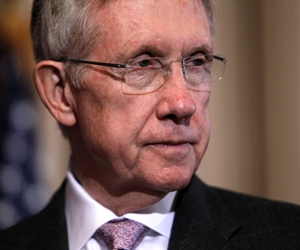
harry,reid,earmarksLegislative experts say the omnibus bill reflects the inability of Congress to fund government operations in an efficient manner.

Because the 111th Congress was unable to pass a spending bill in a timely way, Democratic strategists rolled 12 separate bills into one omnibus measure.

Keeping everything in one bill makes it more difficult to excise specific provisions that legislators find objectionable. But it also results in a mammoth piece of legislation that may go unread until months after the bill becomes law.

Unsatisfied with the simple continuing resolution the House passed that would keep the government running until the next Congress takes over in January, the Senate is proposing the earmark-laden omnibus as one last spending hurrah before legislators leave town. Grass-roots conservatives are particularly angry that the bill includes $1 billion to fund the healthcare bill that may be unconstitutional, based on a judge’s ruling in Virginia this week.

Because the authorization for government spending is expiring, Republicans could be accused of shutting down the government if they are able to block the omnibus bill. But GOP senators say they would be happy to vote for a continuing authorization such as the one already passed by the House.

Among the 6,000 earmarks the media has uncovered so far in the massive legislation the Senate is trying to push through just weeks after Democrats sustained their work landslide of the post-World War II era:

  • Literal pork: Almost $350,000 is earmarked to study the management of swine waste in North Carolina.
  • $235,000 for the management of invasive weeds in Nevada.
  • $300,000 for the Polynesian Voyaging Society in Hawaii. Founded in 1973, the society sails a “voyaging” boat throughout the Pacific, studying how ancient Polynesian people settled far-flung lands.
  • Funds are devoted to a variety of agricultural needs, including research of maple syrup in Vermont, control of potato pests in Wisconsin, the development of virus-resistant grapes in Washington state, and peanut cultivation research in Alabama.
  • $80 million for states and Indian tribes to pay for preservation of Pacific salmon.
  • $13 million for clean-water initiatives in rural villages in Alaska.
  • $450,000 for the World Food Prize.
  • $500,000 for the Edward M. Kennedy Institute.
  • $200,000 to install solar panels at a food bank in Arizona.

If the bill passes Congress, it would be up to the president to decide whether to accept it.

Incoming House Speaker John Boehner, a longtime foe of the earmark practice, signed onto a letter last week asking Obama to veto the measure. Boehner issued a statement on Tuesday blasting the bill as a “smack in the face to taxpayers.”

There are two provisions in the bill that Obama may oppose. One would effectively block civilian trials of Guantanamo Bay prisoners in the United States, while another would allocate $450 million for development of a second engine for the F-35 Joint Strike Fighter. Defense Secretary Robert Gates has said he will urge the president to veto any bill that contains money for a second engine, which the Pentagon says it does not want.

In what some saw as a statement suggesting the president would be reluctant to veto the bill, White House press secretary Robert Gibbs said Tuesday:

“Obviously one of the things that has to be done before Congress leaves is how we’re going to pay for the operation of government going forward.”
GOP Sen. Jim DeMint of South Carolina is threatening to mount a filibuster, and may insist that all 1,924 pages of the bill be read into the record before any vote is taken.

U.S. to have Highest Corporate Tax Rate in the World

Posted December 15th, 2010 at 5:00pm in

Most of the time being number one is good. But when it comes to having the highest tax rate in the world, it is much better for a country to be bringing up the rear.

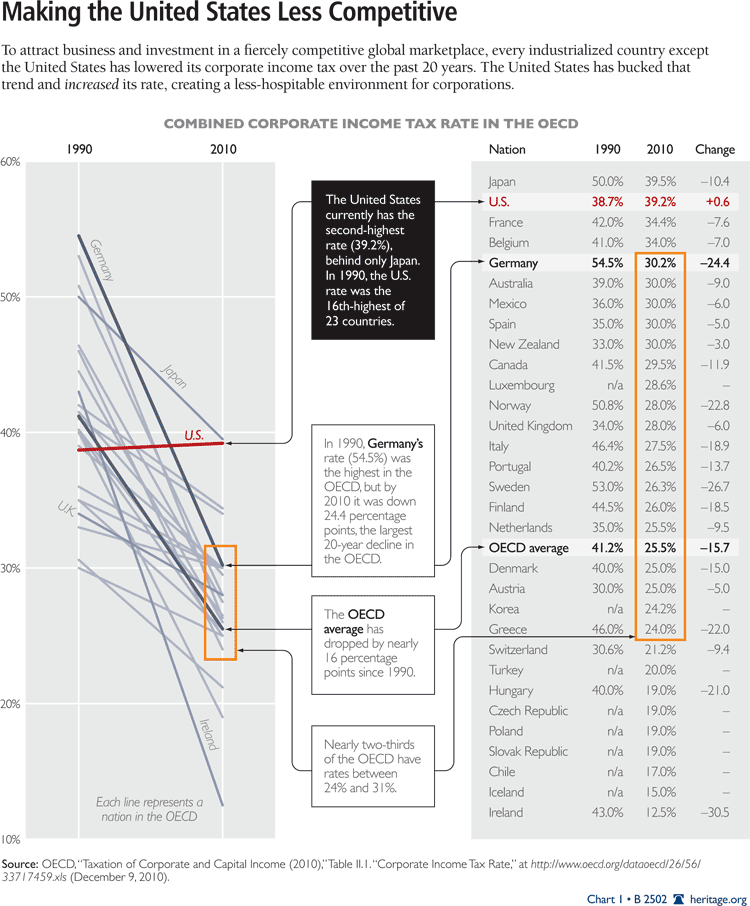
Currently Japan holds the inauspicious distinction of having the highest corporate income tax rate in the world (39.5 percent). The United States is a close second, only a few tenths-of-percentage points behind.

Japan will soon fall from the top spot because it has finally recognized what the rest of the industrialized world realized over a decade ago: A low corporate income tax rate is vital for economic growth in the global marketplace. As such, Japan just announced it will reduce its corporate income tax rate by 5 percentage points down to around 35 percent. This remains far above the 25 percent average rate of other industrialized countries, but for them it is a start.

Japan’s reduction will leave the U.S. in the uncomfortable position of having the highest corporate income tax rate in the industrialized world. Hopefully Congress will finally see fit to lower the rate now that we will hold that disreputable title.

The U.S. ended up at the top because it stood still while the rest of the world was cutting its rates. As the chart below shows, in 1990 the U.S. corporate tax rate was middle of the pack. In fact, it was lower than the global average. The years since have seen every other industrialized country aggressively lower its rate.
The top marginal corporate income tax rate is an important factor influencing economic growth and job creation, because it determines how much the tax will reduce the return the business earns from new investment. As a result, it is a large determinant when businesses decide where to locate their next venture—and where they will hire new employees.

The high rate in the U.S. is driving businesses and jobs to other countries. Those jobs will continue to flow to other countries if the U.S. insists on levying its self-defeating corporate income tax rate. It is long past time forCongress to lower the rate so it is equal or below the 25 percent average of our competitors. If it does not, businesses and jobs will continue their exodus to more friendly locales.

The Heritage Foundation  -  The Foundry

Ron Paul – Federal Reserve is a ‘Cartel’

Tuesday, December 14, 2010

New spending bill totals $575.13 million per page

Reid threatens to keep Congress into next year

** FILE ** Senate Majority Leader Harry Reid, Nevada Democrat, gestures during a news conference on Capitol Hill in Washington on Tuesday, Nov. 30, 2010. (AP Photo/Manuel Balce Ceneta)


Forget about going quietly into the night.

Senate Democrats on Tuesday unveiled a broad agenda for an end-of-session sprint that, in other years, could be a whole year's worth of activity — ranging from an arms-reduction treaty with Russia to a major immigration bill to overturning the ban on gay troops.

And that's not to mention the nearly 2,000-page, $1.1 trillion massive spending bill Senate Democrats said they'll try to push through. The bill contains hundreds of pork-barrel spending projects and new rules governing everything from airport baggage to detainees at the prison at Guantanamo Bay, Cuba.

"We're not through. Congress ends on Jan. 4," said Senate Majority Leader Harry Reid, Nevada Democrat.

The omnibus spending bill is likely to get the most attention, spanning 1,924 pages and spending an average of $575.13 million per page.

It stands in contrast to the House, which last week passed a streamlined bill freezing fiscal 2011 government spending at 2010's level. The Senate bill, though, boosts spending by $16 billion — a tough sell at a time when deficits and debt already are dominating the policy debate in Washington.

In some cases the spending bill not only rejects President Obama's proposed cuts, it actually boosts spending. For example, Mr. Obama earlier this year told Congress to cut funding for the health and welfare package targeting Mississippi's Delta region, which in 2010 received about $26 million. But the Senate bill includes funding and actually increases it to nearly $35 million in 2011.

Senators also picked up the slack for their House colleagues, whose bill was devoid of pork-barrel earmarks, by including House lawmakers' requests in the Senate's own bill. Still, earmarks total less than 1 percent of the bill's spending.

Sen. Daniel K. Inouye, Hawaii Democrat, who is Appropriations Committee chairman, said that doing a full omnibus bill will help make sure spending is targeted and appropriate.

"While I appreciate the work that the House has done in producing a full-year Continuing Resolution, I do not believe that putting the government on autopilot for a full year is in the best interest of the American people," Mr. Inouye said.

In a memo, the Appropriations Committee said the House approach fails to make $10.2 billion in cuts to wasteful military programs and also fails to increase spending for new needs that have popped up in the past year, such as more oversight of offshore oil-drilling rigs.

But the measure also takes care of smaller needs, such as specifically authorizing the secretary of health and human services to purchase six new government sedans.

The push comes as many lawmakers already are eyeing the door.

Mr. Reid, though, said Congress will stay until he tries to tackle issues he says have been unfairly stalled by the GOP.

"I hate to report all this to you — but you know, there's still Congress after Christmas," he told reporters. "So if the Republicans think that because they can stall and stall and stall that we take a break, we're through, we're not through."

Washington Times

I think this is a good time to say thank you to all those who voted for, supported or donated to the Campaigns of Harry Reid and Nancy Pelosi.

Senators from your State.  *   U.S. Government on TwitterUnited States Capitol switchboard at (202) 224-3121


It’s Official:  Our Leaders Have Lost Their Freaking Minds… or only care about their own agenda!!  A lame-duck session gone wild!

Monday, August 3, 2009

Pulling No Punches

John McCain is red in the face and hopping mad. I’m sitting in his office in the Senate Russell Office Building, and he’s just rushed in after delivering a speech on the Senate floor where he seethed about the earmarks in the Homeland Security Bill.

“Can you believe they are putting $6 million of pork into Homeland Security?” he asks with his trademark clenched-fists. “They promised they wouldn’t do that. Ben Nelson [the Democratic senator from Nebraska] just inserted a $200,000 museum in Omaha into the legislative branch appropriations bill. These earmarks are a creeping disease. First members condemn them, then they condone, then they embrace them.” Then Mr. McCain adds, “Eight or nine Republican appropriators routinely vote for this pork.” Shaking his head he says, “It’s killing our party.”

If you thought that the senior senator from Arizona would ride off into the political sunset last November, inconsolable after losing his bid for the presidency, think again. He’s over it. And he’s as energized and spry as ever I’ve known him.

I interviewed John McCain for these pages four years ago when he was just launching his presidential campaign. Now I’m here to see how he is coping with defeat, and what his priorities are this year.

Many feared he’d become the Obama administration’s ambassador to the Republican Party, cutting deals to get things done. On the contrary: He’s emerged as one of the lead critics of Obamanomics.

He says he has worked to keep his relations with President Barack Obama “cordial,” but he pulls no punches criticizing the president’s economic policies. “Never. Never have I seen such a transfer from the private enterprise system to the government of such massive scale,” he says. He goes through the list: car companies, banks, insurance firms owned by government, and he especially grimaces when he mentions the $787 billion stimulus package.

wintermoore

Terry Shoffner

Not much has improved because of the stimulus. Mr. McCain scoffs, “And now, the answer is, according to the Obama economists, we didn’t spend enough.” He’s referring to the notion that we should have a second stimulus. This is not something the senator favors.

Asked about the deficits, his response is blunt. “I think it’s the biggest problem we’ve ever faced.”

Ever? “Yep,” he replies. “The only time where we amassed greater debt was during World War II, and that was temporary spending. We won the world war and then cut back. But now . . . the spending is permanent.”

“Look, this is a very popular, attractive, and eloquent president,” he continues. “But I think he was elected to govern in a centrist fashion. And instead,” he says, the administration is “governing from the far left.” Mr. McCain thinks this approach will capsize. “They don’t get that this is a right-of-center nation. Sooner or later, it becomes increasingly clear to the American people that he’s out of sync with the majority.” The latest polls are already showing some of this slippage: Mr. Obama’s favorable rating is now just over 50%, down from 70% his first weeks in office.

Will Mr. Obama ever move to the center as President Clinton did? “He will try to, but he’s got an overwhelmingly liberal Congress and his political instincts are to move to the left. It’s not an accident that he has the most liberal voting record in the United States Senate,” he says, reciting a line from his campaign. On health-care reform, Mr. McCain calls the Pelosi bill “a fish in the sun” that smells more rotten the longer it sits. But he’s worried that this may end badly. The administration has “co-opted the hospitals, he’s co-opted the pharmacists; he’ll co-opt AMA [American Medical Association]. And by the way, if the pharmaceutical companies can save us $100 billion, why don’t they do it now? For the love of God, doesn’t this mean that they’ve been ripping us off?”

In the 2005 interview, Mr. McCain told me rather famously that “I don’t understand economics very well.” The Obama team echoed that phrase throughout the campaign. It’s still stuck in his craw, and it’s one of the first topics he brings up.

“Could I mention, Steve, that I kept hearing during the campaign the stuff about McCain being weak on economics. They obsessed about this in the media. They never said Obama is weak on economics. I came to Washington as a Reaganite limited government tax cutter.” He’s right about the media treatment. Neither candidate had a strong command of economics—certainly not Mr. Obama, as events have shown. Mr. McCain was simply being honest.

He seems perplexed that his pals in the media turned on him in 2008 after years of worshipful press treatment. “In 2000 [when he ran against George W. Bush] I used to go chat with reporters on the back of the bus, and we would have these long, pleasant conversations . . . . I was the underdog clawing my way up. But then in 2008, I noticed that it would be kind of a gotcha session with the press—a totally more hostile attitude.”

Yet conservatives had warned Mr. McCain that he would remain a media darling up until the moment he won the GOP nomination, at which time they would rip him apart. I’m only surprised that he was surprised this happened.

Mr. McCain is initially reluctant to talk about the campaign, but he provides me with snippets of what went right and wrong. He believes that he could have won the election had it not been for the market collapse in mid-September. “We were three points up on September 14. The next day the market lost 700 points and $1.2 trillion in wealth vanished, and by the end of the day we were seven points down. We lost the white college graduate voters, who became profoundly disillusioned with Republicans. And by the way, that was the way it ended up. We lost by seven points.”

He certainly was dealt a lousy hand. But I challenge him on whether he might have played that hand better. During the first days of the financial crisis, Mr. McCain looked indecisive and worse, a creature of Washington insider politics. Why did he suspend his campaign, and why did he vote for the $700 billion bank bailout plan, which was wildly unpopular with voters?

“You have no idea the pressure I was under,” he says. “I remember being on the phone with President Bush, Vice President Cheney, the Treasury secretary and [Fed Chairman Ben] Bernanke. They assure me the world financial system is going to collapse if I don’t vote for the bill. So I do the impetuous and rash thing by saying, look, I have got to go back to Washington and see how I can help. And by the way, so did Obama—but it was McCain that was the impetuous one. Obama came back to Washington.” Mr. McCain grumbles, “He was at the White House with me. But he wasn’t impetuous.” This is the only time in our interview he shows any bitterness about the campaign.

He feels he was misled by the Bush economic team. He wanted the focus of the rescue plan to be on housing and home owners under water—not the lenders or the big banks. “Paulson and Bernanke both told me on the phone, our primary focus is going to be on the housing crisis. That’s our primary focus. And then three days later they switched their whole priorities around.” Instead, the Bush administration got a $700 billion check from Congress to save banks, investment houses and eventually car companies.

Had he been president, Mr. McCain says he would have done things differently. “Small business has been ignored in this whole bailout. You know, I hate to use the word but it seems to me that the philosophy of Tim Geithner and Ben Bernanke is trickle down, you know? Save Wall Street, save these financial institutions and then maybe they’ll have enough money to loan to the small business person. Wall Street seems to be doing okay. The executive salaries are fine.”

He continues: “But I just came from driving down Central Avenue in Phoenix and saw closed up storefronts because they’re too small to save, but these giant banks are too big to fail.” This is vintage John McCain, the economic populist fighting for the little guy.

If the market crash was the low point, I ask him for his best memory from the campaign. “The high point, I think, was the convention, the selection of Sarah Palin, and the enthusiasm that was generated all over the country.” His fondness for Mrs. Palin and her family strikes me as from the heart; he believes she was a net asset for the ticket.

“Let’s face it,” he says, “she galvanized our base in a way that I couldn’t. Everywhere she went she drew enormous and enthusiastic crowds like a rock star.” He says his only regret in selecting the Alaska governor was that no one on the campaign predicted the ferocity of the assaults against her. “To the liberal left, particularly the feminists, she is their worst nightmare.”

Since Mr. McCain was the co-sponsor of the McCain-Lieberman bill last year to limit CO emissions through a cap-and-trade system, I ask him about the climate change bill that passed the House last month and he surprised me with his opposition. “I believe climate change is real . . . but this 1,400-page bill is a farce. They bought every industry off—steel mills, agriculture, utilities,” he says.

So you wouldn’t vote for the House bill? “I would not only not vote for it,” he laughs, “I am opposed to it entirely, because it does damage to those of us who believe that we need to act in a rational fashion about climate change.”

A s Mr. McCain keeps circling our discussion back to fiscal responsibility, I ask him if the trillion dollar deficits are a sign that America is an empire in decline. “I think there’s a risk of that . . . unless we change. I’m a student of history. The shift in power from the British to the United States took place when the economy and the world’s gold reserves shifted and Britain went from the world’s [creditor] to a world debtor. The same thing could be happening now. I emphasize ‘could.’”

My last question is about the possibility for a 2012 rematch against Mr. Obama. “No chance,” he says.

But the good news for those who admire this maverick is that he’s likely to stay in the Senate for years and is focusing single-mindedly on holding back Obamanomics. For now, that means trying to stop budget busters like ObamaCare, but also saving a few million dollars at a time by cancelling museums in Nebraska, turtle crossings in Florida, and the endless flow of dollars to Democratic Rep. John Murtha’s airport to nowhere in Johnstown, Pa.

And then Mr. McCain is out the door—running to vote on another anti-pork amendment.

By STEPHEN MOORE - a senior economics writer for the Wall Street Journal.

Newsmax Poll Shows Strong Support for Sarah Palin in 2012

An Internet poll sponsored by Newsmax.com reveals that nearly 4 out of 5 respondents would support Sarah Palin as the Republican nominee for president in 2012.

A slightly larger majority believe the then-Alaska governor helped John McCain in the 2008 presidential race — while only 31 percent think McCain did a good job running for president.

The poll drew more than 600,000 responses, and Newsmax will provide the results to major media and share them with radio talk-show hosts across the country.

Here are the poll questions and results:

1) What is your opinion of Sarah Palin? Favorable: 83 percent Unfavorable: 17 percent

2) Do you believe Sarah Palin as a running mate helped or hurt John McCain? Helped: 80 percent Hurt: 20 percent

3) In the election between McCain-Palin and Obama-Biden, who did you vote for? McCain-Palin: 81 percent Obama-Biden: 16 percent
Other: 3 percent

4) Would you support Sarah Palin as the Republican nominee for president in 2012? Yes: 78 percent No: 22 percent

5) Do you believe McCain did a good job running for president? Good Job: 31 percent Bad Job: 69 percent

6) Do you believe Barack Obama "bought" the White House by outspending McCain? Yes: 72 percent No: 28 percent

Posted: Daily Thought Pad

Related Resources:

Friday, May 8, 2009

A Country Gone Crazy... Is $17 Bill in Budget Cuts a Lot or a Little?


Our World News report:

-- jpt - May 08, 2009 6:40 AM

Source:  ABC News/Glenn Beck

A Country Gone Crazy... An Administration Out of Control

  • $17 Billion in Budget Cuts Is Now, That The Debt And Budgets Have Doubled And Tripled, A Substantial Amount to Save, Says Obama. During The Campaign When McCain Said He Would Cut Earmarks by $18 Billion, Obama Said It Was a Drop In The Bucket.
  • With All The Violence at the Border, The Warning Of The Swine Flu Epidemic Possibilities, On-Going Terrorist Threats, And The Flo of Drugs And Guns Across The Border, Funds for Border Security Have Been Cut From Budget
    • Border Fence Not To Be Built Even Though Money Has Been Allotted???
  • Funds For Families Of Fallen Policemen Cut
  • Tax Cheat Tim Geithner Going to Head-up Task Force To Aggressively Collect Taxes
  • Peek At New Health Plan - People Will Pay Co-Pay For Their Employer Supplied Healthcare (An Employment Benefit) And Then "Taxed" on Their Benefits to Pay For Those Who Can't Afford Healthcare
  • Evidence, From Homeland Security, Shows That Nancy Pelosi Knew About EIT, But “They” Want To Prosecute People From The Last Administration Like A Banana Republic.  
  • Hmmm… What Happened To Obama’s Promise Of Tax Cuts And No New Taxes… Cap and Trade, Healthcare Coverage Tax, Higher Taxes On The Wealthy Who Create Jobs In The United States
  • Billions In Bailouts To Save The Car Companies And Now Chrysler Will Essentially Be An Italian Company After Filing For Bankruptcy… After Getting the Bailout Money and Today It Was Announce That GM Will Be Creating More Jobs And Making More Cars… In Mexico And China
  • Former Employees Of ACORN (Part Of The Board Of Directors) Are Coming Forward And Admitting To Voter Fraud and Internal Fraud.  Say ACORN Is Getting Federal And Bailout Money Through Sub-Companies.
  • Leaders of Freddie And Fannie Were At Acorn Offices During Their Bailout Period.
  • Security At Our Nation's Ports Is One Of the Proposed Budget Cuts.
  • Bloggers Are Being Threatened With Legislation For Jail Time To Silence Them.
  • Conservative TV and Radio Are Being Threatened And Targeted By The Powers That Be.
  • And The List Goes On… And On... And On
Everyone Needs To Wake Up, Pay Attention, Read... Even If You Are Not A Reader, Listen To A Spectrum and Variety of New Coverage, And Take Part In The Process.  We Need To Insist On The Transparency That We Were Promised During Obama's Campaign.


Doug Mills/The New York Times

President Obama, with Peter R. Orszag, the director of the Office of Management and Budget, and Rob Nabors, his deputy, unveiled nearly $17 billion in additional budget cuts for the coming fiscal year.


Published: May 7, 2009

WASHINGTON — President Obama on Thursday unveiled nearly $17 billion in additional budget cuts for the coming fiscal year to underscore what he called an “ongoing” effort to find savings at a time when the government’s costs for bailouts, health care and wars are mounting far faster.

“We can no longer afford to spend as if deficits do not matter and waste is not our problem,” said Mr. Obama, who was joined at the White House by Peter R. Orszag, the director of the Office of Management and Budget, and Rob Nabors, his deputy. “We can no longer afford to leave the hard choices for the next budget, the next administration — or the next generation.”

The savings for the budget year starting Oct. 1 represent the sum of Mr. Obama’s promised “line by line” scrubbing of the federal budget, and the the proposed cuts amount to about 1.4 percent of the $1.2 trillion deficit that is projected for the fiscal year 2010.

Administration advisers called the cuts just a beginning, but some Republicans said they were less than impressed.

“While we appreciate the newfound attention to saving taxpayer dollars from this administration, we respectfully suggested that we should do far more," said RepresentativeJohn A. Boehner of Ohio, the House Republican leader.

The president’s 10-year budget outline, released in February, shows the deficit declining by his final year in office to $533 billion, mostly through assumptions about economic growth when the recession ends and which many economists consider somewhat optimistic.

The $17 billion would be saved by ending or reducing 121 federal programs.

Mr. Obama listed some of them: a long-range radio navigation system that costs $35 million but has been rendered obsolete by global positioning systems; a literacy program that spends half its financing on overhead, and will be absorbed by other Education Department efforts; and the position of education attaché to UNESCO, based in the United States Embassy in Paris.

“Participation in UNESCO is very important,” Mr. Obama said, “but we can save this money and still participate using e-mail, teleconferencing, and a small travel budget.”

The the 131-page budget document released Thursday showed spending in 2008 of $77,000 to rent living quarters for the attaché, and $21,000 for travel expenses, and the president noted that eliminating the position would save $632,000 a year.

An additional $142 million would be saved by ending a program to clean up abandoned mines. But eliminating the financing illustrates the difficulties the administration could face in Congress, where, as administration officials acknowledged, every program has its patrons. When Mr. Obama proposed cuts in the program as part of his budget outline, Western state lawmakers objected.

“None of this will be easy,” he said.

That is certainly true for about half of the savings that administration officials say will come from military programs. The savings proposals, outlined last month by Defense Secretary Robert M. Gates as part of a comprehensive reordering of military spending priorities, drew howls of protest from supporters in Congress and the arms industry.

Among Mr. Gates’s targets are missile defense programs, the Army’s costly Future Combat Systems, Navy shipbuilding, the advanced F-22 fighter jets and a state-of-the-art helicopter fleet for the president.

“This is a product of going through the budget line-by-line,” as Mr. Obama has promised since his presidential campaign, Rahm Emanuel, the White House chief of staff, said. “It’s a constant, cumulative effort on this front to find savings and find reductions.”

While the $17 billion in projected savings represents a small portion of the proposed budget, Mr. Obama insisted that “that’s a lot of money, even by Washington standards.” It was enough to pay for a $2,500 tuition tax credit for millions of students, for larger Pell education grants, he said, “with enough money left over to pay for everything we do to protect the National Parks.”

“For every dollar we seek to save there will be those who have an interest in seeing it spent,” the president said. “That’s how unnecessary programs survive year after year. That’s how budgets swell.”

But, he added, “We cannot accept business as usual.”

Brian Knowlton contributed reporting

There are objections and criticisms coming from "both sides of the aisle" on the proposed 2010 budget cuts. The White House released details of President Obama’s proposed budget for the 2010 fiscal year today. For anyone who would like to read it, the whole deal is online here; Here’s the proposed budget for Health and Human Services.

The WSJ is reporting that the budget includes a $300 million funding boost for the FDA, (this is not a good thing) the largest in the agency’s history.

"Time to take the 'red pill' so you can see past the Matrix, America!!"

Friday, March 13, 2009

Broken Earmark Promises

Wednesday -- behind closed doors -- President Barack Obama signed his 2009 Omnibus spending package, calling it an "imperfect" bill. With 8,570 disclosed earmarks worth $7.7 billion "imperfect" is an understatement.

It's bad enough that our president was in an irresponsible rush to spend hundreds of billions with his "stimulus" package ($787 billion), and soon $350 million in the second half of the TARP funds, $32 billion -- at least -- for his new SCHIP program, and now $410 billion in his "imperfect" omnibus bill, but on top of that, he's been dishonest.

Just two weeks before Obama took office he told reporters that his plans would set a “new higher standard of accountability, transparency and oversight. We are going to ban all earmarks.”

On the campaign trail, ironically almost a year ago today, Obama co-sponsored an amendment that would establish a one-year earmark moratorium for 2009 (the bill failed to pass).

“We can no longer accept a process that doles out earmarks based on a member of Congress' seniority, rather than the merit of the project," Obama said. "The entire earmark process needs to be re-examined and reformed.”

“I pledge to slash earmarks by more than half when I’m president of the United States of America,” said Obama again on the trail in September.

During a debate with McCain in Mississippi, Obama famously said “Absolutely we need earmark reform, and when I’m president I will go line by line to make sure we are not spending money unwisely.”
Obama’s entire campaign was formed around the mantra of hope and change, “earmark reform” came out of his mouth almost as often as “um.”
And then, in his sort-of State of the Union address drum roll… “I’m proud that we passed a recovery plan free of earmarks” said Obama.

“There was just a roar of laughter -- because there were earmarks,” ultra liberal Sen. Claire McCaskill, (D-Mi) told reporters. Actually, there were bunches, gobs of them. 
So define earmark? The Washington Post writes that none of the items in the recovery package “are traditional earmarks -- funding for a project inserted by a lawmaker bypassing the normal budgeting process -- according to the White House and Democratic leaders.”

Though the Post did report that despite pledges, the recovery package did have pork in it. No “earmarks” but “pork.”

Republicans were responsible for stripping the bill of some of its most wasteful spending (the best definition). $1.7 million for a honey bee factory, $20 million for the removal of fish passage barriers, and $300 million for “green” golf carts, just to name a few. (Republican earmarxists were responsible for others that are arguably just as bad.)

"I know that there are a lot of folks out there who've been saying, 'Oh, this is pork, and this is money that's going to be wasted,' and et cetera, et cetera. Understand, this bill does not have a single earmark in it, which is unprecedented for a bill of this size. … There aren't individual pork projects that members of Congress are putting into this bill," said Obama.

Tomato, tomahto, “earmark” or “pork” … Let’s call the whole thing off; it’s unnecessary spending of our tax dollars.

The day after Obama’s address to the nation, the House passed another $410 billion spending bill with 8,570 disclosed earmarks, and Obama signed the bill despite all the earlier promises.

$52.1 million for Vice President Joe Biden’s earmarks as a senator from Deleware, $8.3 million for Rahm Emanuel as a House member from Illinois, and Transportation Secretary Ray LaHood, formerly a Republican congressman from Illinois, $26.5 million --  just to name a few.

So what does the Obama administration say now?

"We want to just move on. Let's get this bill done, get it into law and move forward," Budget Chief Peter Orszag told reporters.

“That's last year's business,” said Obama Chief of Staff Rahm Emanuel.

And why, precisely, do we believe that next year would be any different?

by Michelle Oddis, Assistant Managing Editor at HUMAN EVENTS

Related Articles: 

Thursday, March 12, 2009

At What Point Does the Hope and Change Begin??

Yesterday President Obama the man who ran on the promise of being a new kind of politician who was going to change the way Washington does business including earmarks quietly signed the massive $410 billion omnibus spending bill, laden with earmarks, on the heels of the recently-passed "stimulus" package. The overall total for both bills exceeds more than $1.6 trillion of taxpayer money, including interest. After signing the bill without cameras the president gave a speech about how this was the last time this would happen; that from here on out things would change, including the earmark situation, but after he had first justified the need for earmarks in certain situations. He also repeated that this was last year’s business. Excuse me… This is a new year; he is a new president and it is this year’s money! The budget didn’t pass last year because President Bush wouldn’t sign it and it has now doubled and tripled in size and earmarked projects, but Obama had no problem signing it.

‘I will stop earmarks and review the bill next time’ and ‘this is the last time I sign a bill like this’ is like an alcoholic saying I’ll stop drinking next time and I am just taking this one final drink. If President Obama was really the type of leader and politician that he promised during the elections he needed to veto this entire bill or go through it line by line and use his power of line item veto. Instead what he did prove again is that he is not the leader that his followers had hoped for and that the signs of change that we have seen have not been for the positive.

We have a man in the White House preaching to the Average American about practicing personal restraint and responsibility during these tough times who can’t stop smoking while essentially living in a non-smoking building and who can’t stop spending long enough to breathe and take account of what is going on around him.

This is not the hope and change that Obama’s followers voted for or that the American people in general hoped he would bring.

By:  Marion Algier - Ask Marion

Wednesday, February 25, 2009

To pork, or not to pork

1,000-plus-page spending bill includes hundreds of pages of earmarks - pet spending projects inserted by lawmakers, ranging from:

$185,000 for coral reef research and preservation in Maui County, Hawaii

$55,000 in meteorological equipment for Pierce College in Woodland Hills, Calif.

$9.9 million for science enhancement at historically black colleges in South Carolina.

In addition to the basic operations of government, the new budget includes 775 pages of earmarks, funding programs that include local museums, colleges and infrastructure projects.

Among the earmarked projects in the bill are:

$764,000 for the Lake George Watershed Protection Initiative in New York, requested by Sen. Kirsten Gillibrand, New York Democrat;

$9.9 million for South Carolina's historically black colleges and universities, requested by House Majority Whip James E. Clyburn, South Carolina Democrat;

$1.1 million requested by Senate Republican Conference Chairman Lamar Alexander and Sen. Bob Corker, both of Tennessee, for water treatment plant improvements in Tennessee's Unicoi County, as well as $300,000 for a sewer extension project in another county.

Examples of Earmarks in the Omnibus:

$713,625 Woody Biomass at SUNY-ESF. Walsh and Schumer sponsors

$951,500 Sustainable Las Vegas. Berkeley and Reid sponsors.

$24,000 A+ for Abstinence. Specter is sponsor.

$300,000 Montana World Trade Center. Rehberg sponsor.

$950,000 Myrtle Beach International Trade and Convention Center. Graham sponsor.

$200,000 Oil Region Alliance. Peterson sponsor.

$190,000 Buffalo Bill Historical Center, Cody, WY for digitizing and editing the Cody collection. Barbara Cubin is the sponsor

$143,000 Las Vegas Natural History Museum, Las Vegas, NV, to expand natural history education programs. Sponsored by Harry Reid

$238,000 for the Polynesian Voyaging Society, Honolulu, HI, for educational programs. Sen. Daniel Inouye is the sponsor.

$381,000 for Jazz at Lincoln Center, New York, NY for music education programs. Jerrold Nadler is the sponsor.
Rep. Jerry Lewis of California, the top Republican on the House Appropriations Committee, would spend $3.8 million on a Needles, Calif., highway.

Sen. Thad Cochran of Mississippi, the top Republican on Senate Appropriations, backs earmarks including a $950,000 nature education center in Moss Point, Miss. He defends earmarks.

Source:  GlennBeck.com

Monday, February 23, 2009

Obama's New Spending Bill Has 9,000 Earmarks

WASHINGTON — During the 2008 presidential campaign, candidates Barack Obama and John McCain fought vigorously over who would be toughest on congressional earmarks.

"We need earmark reform," Obama said in September during a presidential debate in Oxford, Miss. "And when I'm president, I will go line by line to make sure that we are not spending money unwisely."

President Barack Obama should prepare to carve out a lot of free time and keep the coffee hot this week as Congress prepares to unveil a $410 billion omnibus spending bill that's riddled with thousands of earmarks, despite his calls for restraint and efforts on Capitol Hill to curtail the practice.

The bill will contain about 9,000 earmarks totaling $5 billion, congressional officials say. Many of the earmarks — loosely defined as local projects inserted by members of Congress — were inserted last year as the spending bills worked their way through various committees.

So while Obama and McCain were slamming earmarks on the campaign trail, House and Senate members — Democrats and Republicans — were slapping them into spending bills.

"It will be a little embarrassing for the president if he signs a bill with that many earmarks on it," said Stan Collender , a veteran Washington budget analyst. "He'll say they're left over from the Bush years, and he as to say that next year the bill will be clean."

Experts agree that most earmarks are legitimate. Cary Leahey , senior economist with Decision Economics in New York , said the nation's economic crisis is a contributing factor to the plethora of earmarks. Lawmakers can argue that for a relatively small price they've helped boost the economy.

"One congressman's earmark is another legislative way to fix a serious problem in his district," Leahey said.

Kenneth Thomas , a lecturer in finance at the University of Pennsylvania's Wharton School of business, agrees.

"I generally believe that the priority is getting money into the system sooner rather than later, especially if it's for projects that will use local contractors and create jobs," he said.

Still, it wasn't supposed to be this way. Earmarks have come under fire because of those that seem to provide what Maya MacGuineas , president of the Committee for a Responsible Federal Budget, calls "laugh lines," such as Alaska's "Bridge to Nowhere" or North Dakota's Lawrence Welk Museum .

Obama pledged to take a hard hand on earmarks and warned lawmakers in a Feb. 3 letter from Budget Director Peter Orszag not to decorate the recently signed $787.2 billion stimulus bill with them.

Democrats declared the bill earmark-free. Republicans disagreed.

"While this bill does not include traditional earmarks, we should all understand that there are earmarks in this bill," said Sen. Mike Enzi , R- Wyo. "There is $850 million ... to bail out Amtrak , a $75 million earmark for the Smithsonian, a $1 billion earmark for the 2010 census."

Democrats have been trying to revamp the earmark process for about two years. In 2007, they instituted a system that required members to explain the contents of each earmark, as well as a justification for why it was included in the legislation that way. They claimed this led to a reduction in earmarks by as much as 43 percent.

But critics contended the system still had problems. Simply making information more available, they said, didn't address the major criticism: That such projects should go through the regular legislative process, subject to detailed hearings and bipartisan votes.

Not only does this mean the public has no chance to challenge questionable spending, but too often powerful interests who know how to work the system get favorite measures inserted.

For instance, Congressional Quarterly reported recently that more than 100 House members got earmarks for clients of the PMA Group , a lobbying firm with close ties to Rep. John Murtha , D- Pa. , who heads the powerful defense spending subcommittee. The CQ Politics analysis said that in the 2009 defense spending bill, which Congress approved last year, PMA clients got about $300 million .

The CQ study came after reports that the FBI is investigating the possibility of illegal campaign contributions by PMA to Murtha and other lawmakers. A Murtha spokesman said earlier this month that the FBI probe has nothing to do with Murtha. A PMA spokesman declined to comment on the probe.

Appropriations committee chairmen say they are on track to reform the earmark process beginning in fiscal 2010 by requiring members to make public their requests early, so the public can scrutinize them and presumably contact lawmakers.

The change, though, doesn't apply to the 2009 funding that Congress will consider next week.

Several experts believe that dramatically reducing the number of earmarks, while a laudable goal, is almost impossible. But others contend that earmarks aren't that big of a problem.

"Earmarks get more attention than they deserve," said MacGuineas. "The problem is that they cause a loss of confidence in the whole budget process."

By: William Douglas and David Lightman, McClatchy Newspapers