Showing posts with label Gallup poll. Show all posts

Thursday, February 9, 2012

Jobs, Economy, Job Numbers

jobs

A Closer Look at the Jan. Jobless Numbers: Are They ‘Being Made Up?’

You may recall that major media outlets rejoiced and the markets jumped last Friday when the January jobs report was released.

“Labor Department today lowered the U.S. unemployment rate by two-tenths of a point to 8.3 percent, the lowest it’s been since February 2009,” Emily Knapp of Wall St. Cheat reported, “January data showed nonfarm payrolls to have risen a whopping 243,000, wildly exceeding even the most optimistic of economists’ projections.”

However, although the markets did indeed react positively to the good news, many analysts were skeptical of the data in the report.

“A month ago, we joked when we said that for Obama to get the unemployment rate to negative by election time, all he has to do is to crush the labor force participation rate to about 55 [percent],” editors at Zero Hedge wrote.

“Looks like the good folks at the BLS heard us: it appears that the people not in the labor force exploded by an unprecedented record 1.2 million. No, that’s not a typo: 1.2 million people dropped out of the labor force in one month!”

What does this mean?

Zero Hedge explains:

So as the labor force increased from 153.9 million to 154.4 million, the non institutional population increased by 242.3 million meaning, those not in the labor force surged from 86.7 million to 87.9 million. Which means that the civilian labor force tumbled to a fresh 30 year low of 63.7% as the BLS is seriously planning on eliminating nearly half of the available labor pool from the unemployment calculation.

Even conservative radio talk show host Rush Limbaugh weighed in on the report, claiming that the data was “corrupt as it can be” because the Labor Force Participation Rate has been repeatedly adjusted.

Is Limbaugh out of line on this?

“After countless attempts to discredit or defend Friday’s jobs report, we can all agree on one thing: The data is complicated,” Gus Lubin of Business Insider writes. “So complicated that the BLS could make the economy look better than it was and no one would be sure.”

Former Reagan Budget Director on Jan. Jobs Report: These Numbers are Being Made up

David Stockman

That’s more or less what David Stockman, former budget director for President Ronald Reagan, wrote in an email to former hedge fund manager Bruce Krasting.

On his blog “My Take on Financial Events,” Krasting wrote, “Is the current [Labor Force Participation Rate] a temporary phenomenon, or is this the ‘New Normal?’”

Krasting believes that if the current Labor Force Participation Rate (LFPR) is the “new normal,” it could have severe – even dangerous – effects on the economy.

Why?

“Virtually all of the economic models used by CBO, OMB, SSA and private economists are assuming that the long-term LFPR will be in the mid-to upper 60s. The consensus is 2-3 [percent] higher than where it is today,” Krasting writes.

“If you plug in a rate of 63 [percent] versus 67 [precent] over the next ten-years, it makes a huge difference on the size of the deficit and the public debt. It would cause the deficits at Social Security and Medicare to explode. The percentage of GDP attributable to the government would inevitably rise. The economy, and society in general, would be socialized [emphasis added],” Krasting writes.

In response to Krastings’ criticism of the jobs report, Stockman writes: “…if you spend a little time with these numbers you will know that they are being made up.”

Here’s the email (via Wall Street Examiner):

…I’m wondering if this goes much deeper. I don’t particularly believe in tin foil hats, but all of these mainstream economists treat the BLS and BEA data like it’s holy writ—when it’s evident that the reports are so massaged, estimated, deemed, revised, re-bench marked and seasonally adjusted that any month-to-month change has a decent chance of being noise. What deep secret might they be hiding?

So on the labor force participation rate they say, “No it didn’t go down in January because the 2012 numbers are re-bench marked for the 2010 census,” but for some reason the BLS didn’t bother to update the 2011 civilian population numbers, including December. Thus, the BLS published apples-to-oranges numbers on this particular variable and the footnote says the December participation rate would have been the same as January, if they had revised it!

Yet on another variable— the establishment survey jobs count—they were also busy re-benchmarking–but here they did update the originally reported numbers for every month of 2011. Even then, it is hard to say what got updated because the originally reported numbers each month are then revised during the next two reporting months—with any excess or shortfall reallocated to earlier months outside the three month window, which are not published on a revised basis, even though they have been revised! This reflects a wacko thing called the concurrent seasonal adjustment method.

… your point is that the longer-term trend of the labor force participation rate is really bad, and this truth is absolutely validated by the January report. Except it would have been equally bad in December had it been reported with the new census data…

But the mainstream narrative never gets to the trend. In this case, the plain fact is that we are warehousing a larger and larger population of adults who are one way or another living off transfer payments, relatives, sub-prime credit, and the black market. My suspicion is that this negative trend and many others like it get buried by the monthly change chatter from mainstream economists and on bubble vision, and that these monthly deltas are so heavily manipulated as to be almost a made-up reality. Call it the economists’ Truman Show.

In short, if you spend a little time with these numbers you will know that they are being made up. Funny thing that I remember during the depths of the 1982 recession Reagan read in Human Events one night that the seasonally adjusted numbers were being manipulated and one should look at the unadjusted numbers, instead. The next morning during an economic update briefing Reagan said, he wanted to talk about the “unadjusted” unemployment rate. Marty Feldstein turned white as a ghost, and then talked him out of it. Hmmm!

Read the full email here.

Former Reagan Budget Director on Jan. Jobs Report: These Numbers are Being Made up

People line up at a Workforce Plus job fair, Thursday, March 26, 2009, in Tallahassee, Fla. 75,000 Floridians lost their jobs in February. The state's unemployment rate rose to 9.4 %, the highest since 1976. (Photo: AP)

Gallup: These Are the Most ‘Economically Confident’ States

Gallup has released an intriguing report that ranks the most “economically confident” states in America.

And although the report lists the most “confident” states, don’t be fooled into thinking these areas actually believe that the U.S. economy is improving. On the contrary, the report is careful to point out that, nationally speaking, faith in the U.S. economy is slipping.

In fact, out of all the areas surveyed, the place with the highest confidence rating (the District of Columbia) isn’t even a state!

“Economic confidence dropped in all states . . . in 2011, reflecting the overall decline nationally,” Gallup reports. “The declines range from a low of 3 points in Idaho and West Virginia to a high of 22 points in Delaware.”

Overall, two-thirds of the participants in the Gallup phone survey believe that the economy is getting worse, according to the data.

What does this mean?

“Americans overall and in every state remain more negative than positive about the economy, creating a challenge for President Obama as he seeks re-election this year, given the strong relationship between economic conditions and an incumbent’s re-election success,” Gallup reports.

It continues:

“On a near-term basis, however, economic confidence picked up in January of this year, perhaps foretelling a more positive uptick to come in 2012. Americans are also substantially more confident about the economy now than they were in the year Obama was elected. Thus, it is not clear if voters will reward him for the signs of economic improvement that have come in recent years, or hold him accountable for the fact that the economy is still struggling nearly four years after he took office.”

Perhaps before any conclusions are drawn from the Gallup report, a few things should be pointed out.

First, as mentioned several times on The Blaze, before accepting survey results, one should take into account the possibility of “sampling errors.” That is, one must bear in mind of the likelihood of skewed polling data.

Second, as the Washington Post’s Ezra Klein notes, there are some rather inexplicable results in the Gallup report:

… residents of Washington are more optimistic than, well, anyone else. Our Index is -4. The next-most optimistic state, North Dakota, is at -26. That’s rather odd, given that North Dakota’s unemployment rate is 3.4 percent, while the District of Columbia’s is stuck above 10 percent.

Indeed, that is odd.

“One possibility is that the poll is wrong,” Klein writes, “Another is that the political nature of the economic crisis leaves residents of Washington feeling more in control than residents of other states.”

Echoing the sentiments of Mr. Klein, even Gallup is slightly confused by the results: “There are no clear patterns in the states that rank in the top and bottom 10 in economic confidence. For example, the top 10 states vary by region and political leanings, including the most (Hawaii, along with D.C.) and least (Utah) Democratic states.”

This begs the obvious question: how did Gallup structure its phone survey?

Gallup explains:

Results are based on telephone interviews conducted as part of Gallup Daily tracking January 1-December 31, 2011, with a random sample of 174,639 adults, aged 18 and older, living in all 50 U.S. states and the District of Columbia.

Interviews are conducted with respondents on landline telephones and cellular phones…Each sample includes a minimum quota of 400 cell phone respondents and 600 landline respondents per 1,000 national adults, with additional minimum quotas among landline respondents by region. Landline telephone numbers are chosen at random among listed telephone numbers. Cell phone numbers are selected using random-digit-dial methods. Landline respondents are chosen at random within each household on the basis of which member had the most recent birthday.

Okay, now that the methodology is understood, what do the results mean? That is, what does it mean when Gallup says that the District of Columbia has a “-4″ economic confidence rating?

The Index is based on the average differences between Americans’ assessments of current conditions (11% excellent or good and 48% poor in 2011) and their views of whether the economy is getting better (29%) or worse (66%). The Index has a theoretical range of -100 to +100, with negative scores indicating respondents are more negative than positive about the economy.

So, with that in mind, and despite the possibility of “sampling errors,” these are the most economically confident states (and the District of Columbia), according to Gallup:

The Most "Economically Confident" States

leftright Photo 2 of 11

10. Utah

Economic confidence from -100 – +100: -31

10. Utah

leftright Photo 3 of 11

9. Massachusetts

Economic confidence from -100 – +100: -31

9. Massachusetts

leftright Photo 4 of 11

8. Iowa

Economic confidence from -100 – +100: -30

8. Iowa

leftright Photo 5 of 11

7. South Dakota

Economic confidence from -100 – +100: -30

7. South Dakota

leftright Photo 6 of 11

6. Hawaii

Economic confidence from -100 – +100: -30

6. Hawaii

leftright Photo 7 of 11

5. Maryland

Economic confidence from -100 – +100: -28

5. Maryland

leftright Photo 8 of 11

4. Nebraska

Economic confidence from -100 – +100: -27

4. Nebraska

leftright Photo 9 of 11

3. Minnesota

Economic confidence from -100 – +100: -27

3. Minnesota

leftright Photo 10 of 11

2. North Dakota

Economic confidence from -100 – +100: -26

2. North Dakota

leftright Photo 11 of 11

1. District of Columbia

Economic confidence from -100 – +100: -4

1. District of Columbia

(H/T: The Huffington Post)

Here‘s the Chart That Has One Finance Writer Feeling ’Something Is About to Happen’

Joe Weisenthal is the intrepid finance writer over at Business Insider. He’s usually more plugged in than a Chevy Volt. So when he looks at a chart and says he feels “something is about to happen,” it’s not a bad idea to pay attention. And that’s just what he did.

Here‘s the chart from Weisenthal’s Wednesday-morning post:

Volatility Index Chart

I‘ll let Weisenthal explain what he’s seeing;

The above chart is the VIX. Sometimes it’s called the “fear index”. Whatever you want to call it, it’s a quick way of looking at how much investors are willing to pay for downside protection in the market. Right now, complacency is high, and nobody wants to pay much for “insurance.”

Once again, we‘re getting close to what’s been a floor for the index (since the crisis) and so it seems inevitable that something is going to come along and jolt everyone awake. [Emphasis added]

In other words, the lower the line on the chart, the more complacent people are. And when people are complacent, they don’t prepare. And that’s usually when something big happens to wake them up.

So what are the risks out there? Check out his post on Business Insider to see.

h/t to the Blaze

Tuesday, December 8, 2009

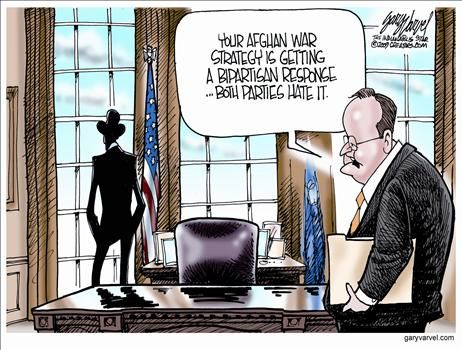
At Least We Can Agree On Something!

Political Cartoon by Gary Varvel

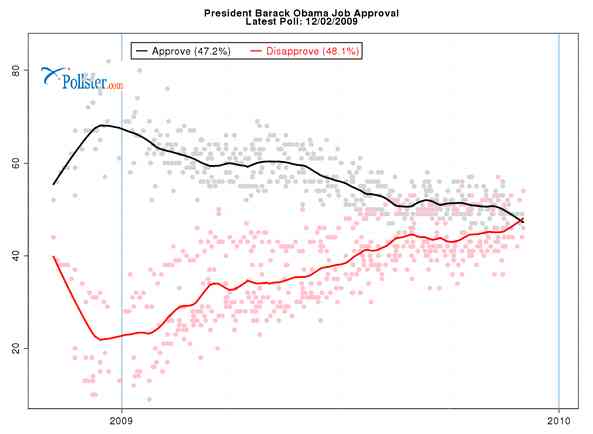
obamaapprovalpoll

Obama's 47 Percent Approval Lowest of Any President at This Point

President Obama's job approval rating has fallen to 47 percent in the latest Gallup poll, the lowest ever recorded for any president at this point in his term.

Jimmy Carter, Gerald Ford and even Richard Nixon all had higher approval ratings 10-and-a-half months into their presidencies. Obama's immediate predecessor, President George W. Bush, had an approval rating of 86 percent, or 39 points higher than Obama at this stage. Bush's support came shortly after he launched the war in Afghanistan in response to the terror attacks of Sept. 11, 2001.

White House Press Secretary Robert Gibbs said he doesn't "put a lot of stock" in the survey by Gallup, which has conducted presidential approval polls since 1938, longer than any other organization.

"If I was a heart patient and Gallup was my EKG, I'd visit my doctor," Gibbs said in response to questions from Fox. "I'm sure a six-year-old with a Crayon could do something not unlike that. I don't put a lot of stake in, never have, in the EKG that is daily Gallup trend. I don't pay a lot of attention to the meaninglessness of it."

Gallup Editor-in-Chief Frank Newport responded: "Gibbs said that if Gallup were his EKG, he would visit his doctor. Well, I think the doctor might ask him what's going on in his life that would cause his EKG to be fluctuating so much. There is, in fact, a lot going on at the moment -- the health care bill, the jobs summit, the Copenhagen climate conference and Afghanistan."

The new low comes as Obama struggles to overhaul the nation's health care system and escalates America's involvement in the Afghanistan war. He is also presiding over a deep and prolonged recession, with unemployment at 10 percent.

"There's no doubt Obama's 47 percent is mainly a result of the continuing bad economy," said Larry Sabato, director of the University of Virginia's Center for Politics. "But there is also a growing concern about government spending and debt, and a sense that Obama is trying to do too much, too soon."

He added: "President Obama has reason to be concerned about his ratings. Even in tough times, presidents have usually been able to stay above the critical 50 percent mark in the first year, when the public is most inclined to give the new incumbent the benefit of the doubt."

Obama officials have not always shown disdain for Gallup. During last year's presidential campaign, Obama adviser David Plouffe, trumpeted "the latest Gallup poll" to reporters because it showed that 53 percent of Americans did not find Obama Democratic rival, Hillary Clinton, "trustworthy."

When Gallup began taking presidential approval polls 71 years ago, Franklin Roosevelt had been president for more than five years. During his remaining time in office, his job approval rating never fell below 48 percent.

The next 11 presidents, both Democrats and Republicans, all had higher job approval ratings than Obama at this stage of their tenure. Their ratings were:

-- George W. Bush, 86 percent
-- Bill Clinton, 52 percent
-- George H.W. Bush, 71 percent
-- Ronald Reagan, 49 percent
-- Jimmy Carter, 57 percent
-- Gerald Ford, 52 percent
-- Richard Nixon, 59 percent
-- Lyndon Johnson, 74 percent
-- John Kennedy, 77 percent
-- Dwight Eisenhower, 69 percent
-- Harry Truman, 49 percent

The poll is an average of a three-day tracking of 1,529 adults taken Dec. 4-6. It has a margin of error of 3 percentage points.

By Bill Sammon - - FOXNews.com

Latest polls show Obama’s approval at below 50% (varying between 46 and 50% this week); number of people who identify themselves as Conservatives as between 43% and 51%, depending on poll and wording of question, and the number of people who identify themselves as Liberals only 19%.

REVEREND JACKSON SLAMS OBAMA

BEGIN TRANSCRIPT (From Rush Limbaugh)

RUSH: The Reverend Jackson is not happy about this. Last night on PBS on the Tavis Smiley show, Tavis Smiley talked to the Monochrome Coalition chairman and whatever else he is, the Reverend Jackson, and the question: "Some think the blame Bush rhetoric no longer applies that Obama used successfully in the campaign."
JACKSON: He essentially owns more and more. When Bush left office there were 30,000 troops in Afghanistan. We're now going to a hundred thousand, so we kind of own the Afghanistan mission. We bailed out the banks. We kind of own a plan now where you have more foreclosures than you do have modifications. We're losing jobs by the droves. Unemployment levels are disastrously high. We are the canary in the mine. We're on the front side of its pain and the backside of its prosperity. Urban America is black, but Appalachia basically is white. We must not be seen as marginal America.

RUSH: I'll tell you what's going on here with this. The Reverend Jackson -- and I got two more stories in the stack today about how black unemployment is through the roof, black unemployment is terrible, the black frame of mind is terrible, they're depressed, Obama is not doing anything for them. How is that Hoax and Change working for you? They're all livid. I mean they thought there was going to be an exact 180 degree economic reversal and it's done nothing but get bad for everybody, but they're especially upset about it because they look at him as one of them and now they feel abandoned. I'm sure Tiger Woods' choice of females is not helping 'em out with their attitudes there, either. Folks, about that, I got a great piece to share with you from Lisa Schiffren at the AmericanThinker.com on the parallels between Tiger Woods and Barack Obama. The theme is that both are the result of lies, falsely crafted images that are in no way representative of who they really are. I'll get to that in a mere moment.

One more sound bite here from Reverend Jackson. Oh, and there's total disarray over in Copenhagen, something called the Danish texts. Poor nations have found out they're going to get screwed with the climate talks over there. Oh, yeah, it's big. And then Dingy Harry is out there with his slavery comment. I don't know, folks. I have faith in all things good, and this stuff just cannot triumph, at the end of the day it just won't. This is utter disaster. Anyway, back to the Reverend Jackson, Tavis Smiley said, "How do black leaders, how do black folk, how do black people make that case to the president? In other words, how do you push back on him respectfully when you know that black folk in the 90th percentile love this president?"

JACKSON: They also love to keep their houses and they also love their jobs. So the issue is about policy. It's not about our appreciation of the impact of this presidency. We found through the attorney generals that these major banks profiled blacks and Latinos. They circumvented community reinvestment laws. As opposed to getting a bailout, they should be facing the courts for breaking the law. On the black and brown side is where the water came in the boat. But the water didn't stop. It kept on coming, the water kept coming across. A rising tide will not lift those boats stuck at the bottom that have holes in them.

RUSH: So there's trouble in paradise out there. The Reverend Jackson, his anger is pretty muted here but he's pretty mad. (interruption) What is it, Snerdley? What is it? Hm-hm. Hm-hm. Well, no, he said it's about skin color thing, but, look, the bottom line is, all of this was supposed to have vanished. We were supposed to have a postracial country. Look at the divisions that have sprung up. Look at the partisanship, the divide has gotten wider. The Reverend Jackson is not happy at all, and all of it was so predictable. Look, I'm a little long. I gotta take a quick break and we'll come back, we have more samples of Obama's Hoax and Change speech at Brookings today plus a damn good Stack of Stuff to get through, so sit tight. We'll be right back.

END TRANSCRIPT

Read the Background Material...

UK Guardian: Copenhagen Climate Summit in Disarray After 'Danish Text' Leak

Thanks, Rush!!

Black Caucus War Against Obama

Maxine-Waters (1)

A civil war is breaking out within the left of the Democratic Party pitting the Congressional Black Caucus against the first African-American president.

The battle began when California Congresswoman Maxine Waters complained publicly about the Administration’s failure to do more to help minority-owned businesses in the current recession. (Translation: In the new Stimulus of “Jobs” Bill making its way through Congress, they want a larger take). It continued yesterday when ten members of the Black Caucus refused to participate in a meeting of the House Banking Committee which was considering the bill to restructure financial regulations forcing Chairman Barney Frank to push the bill through by the uncomfortable margin of only 31-27.

The latest shot in the battle was fired by Homeland Security Chairman Bennie Thompson (D-Miss) a card carrying regular of the Black Caucus. Faced with the need to investigate the gate crashing at the White House during the recent state dinner for India, he chose to embarrass the Administration by subpoenaing White House Social Secretary Desiree Rogers rather than quietly negotiating for her appearance.

That Thompson’s action was a deliberate slap in Obama’s face is obvious (even though the media has missed it). Since when does a liberal Democratic committee chairman embarrass a liberal Democratic president by forcing a liberal Democratic Social Secretary (from Chicago no less) to resist a subpoena to appear at a hearing? Since he wanted to send a message to Obama and Chief of Staff Rahm Emanuel that the Black Caucus did not like being taken for granted.

The merits of the controversy are obvious. What possible reason would a Social Secretary, for goodness sakes, have for the assertion of executive privilege that is usually reserved for issues of national security? Obviously, none. But Thompson chose his target well. He struck at the social core of the Chicago Mafia that runs the White House, probably striking within the Obama family as well.

You don’t do that to a president of your own party, your own ideology, and even your own race unless you want to make a point.

The friction between the Black Caucus and Obama escalated when Waters berated the Administration for failing to rework a business loan from Goldman Sachs to the Inner City Broadcasting Corporation. Inner City is run by Pierre Sutton, son of Percy Sutton, the long time media giant in the African-American community. Two weeks after she raised the issue in a meeting with Treasury Secretary Timothy Geithner and Emanuel, Goldman saw the light and restructured the loan.

Coming on top of liberal angst with the decision by the “peace” president to escalate the war in Afghanistan, this split with the black caucus comes at an awkward time.

But you pay a price when you mess with the African American Caucus and the Suttons. The Obama Administration is feeling it. It’s kind of fun to watch.

Source: Front Page

And Take Heart… Palin now as popular as Obama

sarah-palin-advisor-needed Barack Obama has sunk to a new low in Gallup's job approval numbers. The polling firm reported Monday that Obama's approval rating had dropped to 47% in their rolling three day average.

Perhaps equally important, Gallup says 46% of the people they asked disapprove of the job Obama is doing as president.
Those numbers are almost identical to favorable/unfavorable numbers for Sarah Palin in a new CNN poll , which showed the former Alaska governor at 46% favorable and 46% unfavorable.

Given the Obamedia's unparalleled trashing of Palin and their sycophantic support of the One, these new numbers--even if temporary--bespeak two important points: the waning influence of the legacy media, and the appeal that Palin has to a substantial portion of the public.

By: William Tate – American Thinker
Page Printed from: (Shout Out to Babs from As.A.Mom) http://www.americanthinker.com/blog/2009/12/palin_now_as_popular_as... at December 08, 2009 - 04:48:50 PM EST

And the good thing is that Palin’s numbers are going up while Obama’s numbers are going down…

Tuesday, October 27, 2009

Gallup Poll: Conservatives Outnumber Moderates

A new Gallup poll shows that conservatives outnumber moderates for the first time since 2004.

Gallup’s breakdown shows that 40 percent of Americans call their political views conservative, 36 percent moderate and 20 percent liberal. Last year, conservatives were tied with moderates at 37 percent. While Gallup first documented this trend in June, the finding has been sustained through the third quarter.

So what put conservatives into the lead? Independents, apparently. Now, 35 percent of them are self-proclaimed conservatives, up from 29 percent last year. Meanwhile, the portion of independents who call themselves moderate dipped to 43 percent from 46 percent.

Among Republicans, 72 percent now call themselves conservative, up from 71 percent last year. Among Democrats, 22 percent now call themselves conservative, up from 21 percent in 2008.

Gallup also discovered that Americans have turned more conservative on specific issues. For example, perceptions that there is too much government regulation of business rose to 45 percent this year from 38 percent last year.

These findings would seem to bode well for Republicans in the 2010 elections. “The question is whether increased conservatism, particularly among independents, will translate into heightened support for Republican candidates,” Gallup points out.

“Right now, it appears it may. Although Gallup polling continues to show the Democratic Party leading the Republican Party in Americans' party identification, that lead has been narrowing since the beginning of the year and now stands at six points, the smallest since 2005.”

That trend stems from the increasing number of independents who now lean Republican, Gallup says.

A Real Clear Politics compilation of polls by ABC/The Washington Post, Rasmussen Reports, CBS and Gallup shows that on average Democrats have a lead of 45 percent to 39.5 percent over Republicans in next year’s congressional races.

That data comes on the heels of an August Gallup poll that shows self-identified conservatives outnumber self-identified liberals in America.

According to that survey, more than 160,000 respondents in Gallup polls conducted From January to June 2009 have described themselves as either “conservative” (31 percent) or “very conservative” (9 percent) – for a total of 40 percent.

At the same time, 16 percent identified themselves as “liberal” while 5 percent described themselves as “very liberal – for a total of 21 percent.

According to Gallup, liberals lag behind conservatives on a statewide level, and conservatives have big margins in all but three states.

“Conservatives outnumber liberals by statistically significant margins in 47 of the 50 states, with the two groups statistically tied in Hawaii, Vermont, and Massachusetts,” reported a Gallup analysis.

“In fact, while all 50 states are, to some degree, more conservative than liberal (with the conservative advantage ranging from 1 to 34 points), Gallup's 2009 party ID results indicate that Democrats have significant party ID advantages in 30 states and Republicans in only 4,” said the analysis. “Despite the Democratic Party's political strength – seen in its majority representation in Congress and in state houses across the country – more Americans consider themselves conservative than liberal.

By: Dan Weil

Art Laffler ... "Jack Kennedy would not be allowed in the Republican Party these days because he would considered too conservative!", that is how liberal we have become, mostly because of slow progressive brainwashing taking us away from our core values, traditions and beliefs!!

Saturday, June 13, 2009

OBAMA'S ISSUES CRUMBLING

At last, there is convincing evidence that Obama's poll numbers may be descending to earth. While his approval remains high -- and his personal favorability is even higher -- the underlying numbers suggest that a decline may be in the offing. Even as he stands on his pedestal, the numbers under his feet are crumbling.

According to a Rasmussen poll, more voters now trust Republicans more than Democrats to handle the economy, by a margin of 45-39. Scott Rasmussen notes that "this is the first time in over two years of polling that the GOP has held the advantage on this issue." Last month, he had the Democrats holding a one-point lead, but they lost it in June's polling.

And the Democratic leads over Republicans on their core issues are also dropping. Particularly interesting is the Democratic decline over healthcare, from an 18-point lead in May to only 10 points now.

A Gallup poll also confirms that the president's personal ratings are high, but the underlying data less so. While 67 percent of voters give Obama personal favorable ratings and 61 percent approve of his job performance (Rasmussen has his job approval lower, at 55 percent), they give him much lower ratings on specific issues.
Gallup shows Obama getting only 55 percent approval on his handling of the economy (down from 59 percent in February) and finds that only 45 percent approve of his handling of federal spending while 46 percent approve of his treatment of the budget deficit.

As it becomes clearer that the deficit caused by spending has landed us in a new economic crisis, entirely of Obama's own making, his popularity and job performance are likely to drop as well.

The old recession -- that the public says was caused by Bush -- shows signs of winding down. But the new recession and/or inflation -- triggered by Obama's massive deficits -- is just now coming upon us.

If Obama refuses to cut back on his spending/stimulus plans (despite convincing evidence that Americans are not spending the money), he has three options:

a) He can raise taxes, which will trigger a deeper recession;
b) He can print money, which will trigger huge inflation;
c) He can pay more interest to borrow money, which will send the economy diving down again.

The blame for these outcomes will fall squarely on Obama's deficit and spending policies. The fact that Americans are aware of these issues, and already disapprove of Obama's performance on them, indicates that they will be increasingly receptive to blaming him for the "new" recession.

Interestingly, Obama's polling is now the exact opposite of President Clinton's in the days after Monica Lewinsky. Back then, the president's approval for handling specific issues was his forte, while his job approval remained high but his personal favorability lagged 20 points behind. Ultimately, it is a politician's performance on specific issues that determines his electability. Personal favorability withers in the face of issue differences. Obama is about to find out that you cannot rely on image to bolster your presidency when the underlying issues are crumbling.

All this data suggests that Obama might run out of steam just as he gets to his healthcare agenda. As unemployment mounts, month after month, and Obama's claims of job creation (or savings) ring hollow, it is possible that he will not have the heft to pass his radical restructuring of the healthcare system. The automaton Democratic majority may pass it anyway, but it will be a one-way ticket to oblivion if they do.

By EILEEN MCGANN AND DICK MORRIS – Dick Morris.com – Dick’s new book: Catastrophe

Posted: Daily Thought Pad

Tuesday, January 20, 2009

Bush Exits

Bill O'Reilly
by  Bill O'Reilly 

Bush leaves office with a 34 percent approval rating, according to a recent Gallup poll. That ties him with Jimmy Carter's approval rating when he left office in 1981, not exactly a place you want to be. However, the war on terror issue is still being defined and will likely help Bush when history is written down the line.

Immediately after the attack on 9/11, Muslim jihadists had a big wind at their backs. We saw TV images of Muslims dancing in the streets as the great Satan America was humbled by al-Qaida. Almost instantly, the invincibility of the United States was challenged and the physical safety of Americans, at risk. It was very possible that further attacks were close.

Moving quickly, the Bush administration reorganized the FBI into a terror-fighting organization and toppled the Taliban in Afghanistan, disrupting al-Qaida's command and control. Those successful tactics blunted a number of active terror plots and resulted in the capture of a number of al-Qaida big shots, all of whom broke under coerced interrogation. The information they gave up allowed the Bush administration to further damage the terrorist infrastructure.

Then came Iraq, an operation designed to cleanse the Muslim world of the huge terrorist enabler Saddam Hussein. The price of that war is still being debated, but what honest people don't dispute is that the al-Qaida foot soldiers who invaded Iraq hoping to defeat the U.S. military were eventually decimated. The price for America in Iraq has been enormous, but al-Qaida has also paid big.

Today, the terror threat still exists, but is no longer centralized and has lost most of its momentum. In short, the United States is winning the shooting war, and President Bush should get credit for that.

On the economic front, however, the picture is different. The dramatic rise in oil prices last spring was artificially driven by greedy speculators, some of whom worked out of brokerage houses like Morgan Stanley and Goldman Sachs. The oil company chieftains quickly realized they could make billions raising their prices to reflect the upward price speculation and did so with gusto. Thus, millions of consumer dollars were diverted to gas bills instead of other obligations. That lighted the fuse of the recession.

At the same time, banks were making risky home loans to unqualified consumers. The banks then sold many of those loans to quick-buck artists at places like Merrill Lynch and Lehman Brothers. When consumers began to default because money became tight, panic ensued and the recession roared in.

Where was President Bush while all this was happening? He continued to put forth that the economy was fundamentally strong when it was not. That is on the president. If his economic advisers misled him, he should have said so. But Bush is leaving office with no credible explanation for the collapse.

The Democratic Congress also stood by and did nothing to protect the folks. Last July, Congressman Barney Frank, chairman of the House Financial Services Committee, told the world Fannie Mae and Freddie Mac were "in good shape going forward."

A few weeks later those mortgage entities collapsed. Frank is now blaming the Republicans, but he is being flat-out dishonest in not taking any responsibility.

Like a sports team that loses big, the head coach is the main guy. After Iraq and the wobbling economy, the folks lost confidence in President Bush, and Barack Obama capitalized on that.

The truth is that the Bush administration did very well in protecting us against terrorist killers -- but not so well in protecting us against Wall Street greed heads.


Mr. O'Reilly is host of the Fox News show "The O'Reilly Factor" and author of "Who's Looking Out for You?"