Showing posts with label American National Security. Show all posts

Tuesday, May 26, 2009

Cheney’s Speech – The Top 10 Lines

Former Vice President Dick Cheney spoke Thursday on national security at the American Enterprise Institute, a Washington, D.C. think tank. Here are the top ten lines in the speech, as compiled by the editors of FOX Nation:

No. 10:  The administration has found that it’s easy to receive applause in Europe for closing Guantanamo. But it’s tricky to come up with an alternative that will serve the interests of justice and America’s national security.

No. 9:   In the category of euphemism, the prizewinning entry would be a recent editorial in a familiar newspaper that referred to terrorists we’ve captured as, quote, “abducted.” Here we have ruthless enemies of this country, stopped in their tracks by brave operatives in the service of America, and a major editorial page makes them sound like they were kidnap victims, picked up at random on their way to the movies.

No. 8:  If fine speech-making, appeals to reason, or pleas for compassion had the power to move them, the terrorists would long ago have abandoned the field. And when they see the American government caught up in arguments about interrogations, or whether foreign terrorists have constitutional rights, they don’t stand back in awe of our legal system and wonder whether they had misjudged us all along. Instead the terrorists see just what they were hoping for – our unity gone, our resolve shaken, our leaders distracted. In short, they see weakness and opportunity.

No. 7: Yet having reserved for himself the authority to order enhanced interrogation after an emergency, you would think that President Obama would be less disdainful of what his predecessor authorized after 9/11. It’s almost gone unnoticed that the president has retained the power to order the same methods in the same circumstances. When they talk about interrogations, he and his administration speak as if they have resolved some great moral dilemma in how to extract critical information from terrorists. Instead they have put the decision off, while assigning a presumption of moral superiority to any decision they make in the future.

No. 6:  To completely rule out enhanced interrogation methods in the future is unwise in the extreme. It is recklessness cloaked in righteousness, and would make the American people less safe.

No. 5: This recruitment-tool theory has become something of a mantra lately, including from the President himself. And after a familiar fashion, it excuses the violent and blames America for the evil that others do. It’s another version of that same old refrain from the Left, “We brought it on ourselves.” It is much closer to the truth that terrorists hate this country precisely because of the values we profess and seek to live by, not by some alleged failure to do so. Nor are terrorists or those who see them as victims exactly the best judges of America’s moral standards, one way or the other.

No. 4: Intelligence officers of the United States were not trying to rough up some terrorists simply to avenge the dead of 9/11. We know the difference in this country between justice and vengeance.

No. 3: To the very end of our administration, we kept al-Qaeda terrorists busy with other problems. We focused on getting their secrets, instead of sharing ours with them. And on our watch, they never hit this country again. After the most lethal and devastating terrorist attack ever, seven and a half years without a repeat is not a record to be rebuked and scorned, much less criminalized. It is a record to be continued until the danger has passed.

No. 2: In the fight against terrorism, there is no middle ground, and half-measures keep you half exposed. You cannot keep just some nuclear-armed terrorists out of the United States, you must keep every nuclear-armed terrorist out of the United States. Triangulation is a political strategy, not a national security strategy.

No. 1: Critics of our policies are given to lecturing on the theme of being consistent with American values. But no moral value held dear by the American people obliges public servants to sacrifice innocent lives to spare a captured terrorist from unpleasant things. And when an entire population is targeted by a terror network, nothing is more consistent with American values than to stop them.

Wednesday, May 20, 2009

Newt Gingrich: Why Speaker Pelosi Should Step Down

The case against Nancy Pelosi remaining Speaker of the House is as simple as it is devastating:

The person who is No. 2 in line to be commander in chief (pretty scary thought… isn’t it… Biden and Pelosi) can't have contempt for the men and women who protect our nation. America can't afford it.

To test how much damage Speaker Pelosi has done to the defense of our nation, ask yourself this: If you were a young man or woman just starting out today, would you put on a uniform or become an intelligence officer to defend America, knowing that tomorrow a politician like Nancy Pelosi could decide you were a criminal?
Would you?

This Isn't About Politics. It's About National Security

The controversy swirling around Speaker Pelosi isn't political - she may think it is, other liberal Democrats may think it is, and the media may want it to appear that way.

But this isn't about politics. It's about national security.

At issue is whether Speaker Pelosi was informed, at a briefing by intelligence officers on September 4, 2002 when she was the ranking Democrat on the House Intelligence Committee, that the CIA had used and was using enhanced interrogation techniques - specifically waterboarding - on captured al Qaeda terrorists.

From a Question of Memory to a Question of Criminality

Prior to her now infamous press conference last week, Speaker Pelosi insisted that the CIA had not told her in 2002 that waterboarding and other enhanced techniques were being used. At last week's press conference she went beyond this position to assert that "the only mention of waterboarding at [the September 2002] briefing was that it was not being employed."
In contrast, Leon Panetta, the current CIA director, wrote a memo last Friday to CIA employees in which he stated that "our contemporaneous records from September 2002 indicate that CIA officers briefed truthfully on the interrogation of [Al Qaeda terrorist] Abu Zubaydah, describing 'the enhanced techniques that had been employed.'"
And so the question, prior to her rambling press conference, was one of memory: Did Speaker Pelosi remember correctly the briefing she received in 2002?
If she had confined the controversy to her memory versus the CIA's, Speaker Pelosi may have saved herself. She would be guilty of irresponsibility and incompetence perhaps, but that would basically be it. Not good, but not disqualifying.

Pelosi on the CIA: "They Mislead Us All The Time"

But Speaker Pelosi did not confine the question to the reliability of memory. Instead, she made the allegation last week that the CIA intentionally misled her - misled Congress - and not just once, but routinely.
"They mislead us all the time," she said.
She charged that the CIA, deliberately and as a matter of policy, violated the law by lying to Congress.
And with that allegation, Speaker Pelosi disqualified herself from the office she holds.

Why Did Pelosi Escalate the Controversy into a Full Scale War With the CIA?

And the question that remains is why? Why would Speaker Pelosi escalate the small skirmish she found herself in over the 2002 briefing into a full-scale war with the CIA?
Perhaps it's because if America knew that Speaker Pelosi consented, fully informed and without complaint, to waterboarding back in 2002, it would reveal the current liberal bloodlust over interrogations for what it is: The Left's attempt to hunt down and purge its political opponents.
Remember what America was like in September, 2002, less than a year after 9/11.
America was terrified. As I said on ABC Radio last week, our entire defense, intelligence and justice establishment expected that there would be additional al Qaeda attacks, we just didn't know where and we didn't know when.

If Pelosi Consented to Waterboarding in 2002, the Bush Policy Is Vindicated

If Nancy Pelosi believed that waterboarding was justified in 2002 - just like Porter Goss, President Bush, Vice President Cheney and CIA Director Tenet - then a policy of selectively using enhanced interrogation techniques in carefully circumscribed ways in order to prevent future attacks - in other words, the Bush Administration policy - is vindicated.

Sponsored Content

OUTRAGE!! Billion-dollar drug company hides astounding discovery of a natural cancer killer.

One pharmaceutical company actually made the 'discovery of the century' - a miracle breakthrough that could save you or someone you love from the ravages of cancer. But...

They hid the secret for SEVEN FULL YEARS...with no plans to tell anyone about it ever! Why? Because the substance they found is completely natural... so they couldn't take out a patent on it. Until one brave researcher came forward to break the silence-and tell the world about this true cancer cure.

Click here to read the full story of this astounding breakthrough

But rather than admit that President Bush, when faced with an array of difficult choices, made the hard choice that kept the nation safe, Nancy Pelosi has instead retreated into the cheap sanctity of ignorance. She didn't know, so she claims. That's why she didn't do anything about it.
But President Bush did know. It was his job to know, and he made the tough choices needed to save American lives.
It was Nancy Pelosi's job to know too. But to avoid culpability for the choices she supported, she's now telling us she didn't know. And she's calling the intelligence officials who say otherwise liars and criminals.
Shame on her.

Speaker Pelosi Has Made America Less Safe

Speaker Pelosi has damaged America's safety.
She's made America less secure by sending a signal to the men and women defending our country that they can't count on their leaders to defend them.
And every day they spend worrying about being politically persecuted is a day we are made more vulnerable to a nuclear attack on one of our cities, a biological attack on one of our subways, or a bomb going off in one of our malls.
America is losing ground because of Nancy Pelosi's contempt for those who defend her.
Democrats owe it to their country and our national security to replace Nancy Pelosi as Speaker of the House.

  Your friend,
Newt Gingrich
   Newt Gingrich

Newt's Quick Links:

  • Congratulations to the men and women - both famous and not-so-famous - who made the third annual GI Film Festival such a success last week. If you don't know about the GI Film Festival click here to learn more about this one-of-a-kind event that honors (in a way Hollywood rarely does) the achievements and sacrifices of American servicemen and women. This year's festival featured 16 feature-length documentaries, two major feature films and 30 short films covering the Civil War, WWII, Korea, Vietnam, Iraq and Afghanistan.
  • And speaking of the GI Film Festival, congratulations to David Bossie and Citizens United for the selection of their documentary, "Perfect Valor", as best documentary at the festival. "Perfect Valor" is a riveting look at the campaign by the Coalition Forces in Iraq for control of Fallujah. Seen through the eyes of the troops who were there, and narrated by former Sen. Fred Thompson, "Perfect Valor" picks up where the mainstream media failed long ago to tell the real story of our forces in Iraq.
  • And speaking of films, Callista's and my new film, "Ronald Reagan: Rendezvous with Destiny," had its New York premiere last night at the DGA Theatre. We were thrilled by the reception it received.
  • And speaking of being thrilled, my new book with my daughter Jackie Gingrich Cushman, 5 Principles for a Successful Life: From Our Family to Yours, had an amazing first week, reaching #3 on Amazon.com under self-help books. For your own copy, just click here. And check out 5PrinciplesOfLife.com to submit your own story on how these principles have helped you or someone you love.
  • Callista and I started work on our next film, "Rediscovering God in America Part II," a few weeks ago, filming at Gettysburg, Cape Henry, Jamestown, and Mount Vernon. You can view a photo slideshow of our tapings at GingrichProductions.com.

Newt Gingrich
Photo Credit: Gingrich Productions

Monday, May 4, 2009

Fred Thompson: Obama Loosed 'Dogs of War' on CIA

Former Senator, TV star and presidential candidate Fred Thompson tells Newsmax that President Barack Obama is revealing his “naivete, ineptitude and arrogance” as he deals with matters of national security.

The Tennessee Republican, who now hosts a radio show on Westwood One along with his wife Jeri, also said the “dogs of war have been loosed” over left-wing attempts to single out Bush-era officials for prosecution relating to the treatment of detainees.

Newsmax.TV’s Ashley Martella cited the announcement that the Defense Department is going to release many pictures showing alleged abuse by U.S. troops in Iraq and Afghanistan, and asked Thompson what purpose that might serve.

“None, other than to serve as propaganda tools for our worst enemies,” Thompson said.

See Video: Fred Thompson Slams Obama's National Security Debacle 

“This was set in motion when the president first decided to release” CIA memos on interrogation techniques used on terrorist suspects, Thompson told Newsmax.

“There was no purpose in doing that except to make him look good internationally and to the left wing here at home,” he said. “It did a lot of damage.

“In one stroke of a pen he declassified top-secret documents that people would otherwise go to jail for releasing. It gave al-Qaida and the Taliban a blueprint as to the outer limits of our interrogation techniques.

“We have to remember that [the techniques were used] in the aftermath of 9/11. Congress was briefed on these techniques. Some of them asked if they were really going far enough to get what they needed to get, and it was approved at high levels in the administration.

“They carefully crafted them as best they could to not go too far, and to provide safeguards when they were carrying out these admittedly rough techniques on these people who had this vital information.

“So now we’re really talking about a war crimes tribunal, which this country has never done. We’ve never brought to criminal court prior administrations in this country.

“Harry Truman could have been accused of war crimes, I suppose, for dropping the bombs. President Obama authorized the killing of those three [pirates] in the Indian Ocean not too long ago. Prosecuting these people under these circumstances is something you hear about in banana republics and third-world countries, not the United States of America.

“The president’s opened up a terrible Pandora’s Box and there’s going to be a price to pay before this thing is ended.”

Martella asked if the Obama administration was acquiescing to its far-left base when it released the CIA memos on interrogation techniques.

“I think in this case, in all probability, they thought that they could cater to their left wing, appease their demands, by releasing these memos and then it might not go any further,” Thompson said.

“Because surely they were able to see that this was bad for them the way it’s going to be bad for the country.

“This is going to have ramifications that are far-reaching. They thought they could put the genie back in the bottle after they opened it, and of course appeasement never works that way.

“There was a firestorm. The attorney general’s received 250 names in a petition to urge the appointment of a special prosecutor for this. The left-wing blogs went nuts. They started running television ads and so forth.

“And then after promising that there would be no prosecutions, [Obama] acquiesced and now opened the door for that. So I think it’s a case of naivete, ineptitude and unbelievable arrogance and lack of experience.

“We elected someone who didn’t have two minutes’ worth of experience with regard to matters concerning national security. Now he’s cast in this position and he’s making decisions that are going to have far-reaching ramifications not only abroad, and not only with our enemies, but in dividing our country even further here at home in ways I don’t think we’ve ever been divided before.

“We’re going to have members of Congress testifying against each other if they go down this road.”

Martella noted that Rep. Peter King of New York has said that if Democrats do go ahead and attempt to prosecute Bush administration CIA interrogation lawyers, the Republicans should “go to war” with them.

“That just gives you an example of the atmosphere on Capitol Hill today,” Thompson observed.

“People are angry. People are upset. You’ve got people on the left, you’ve got the Democrats talking about truth commissions, talking about investigations and Congressional hearings and urging prosecution. They’re fighting among each other on the Democratic side as to just how they should go and how far they should go.”

Some of these Democrats are “the same people who were briefed on these techniques back in 2002,” Thompson said, “including Nancy Pelosi, who’s not telling the truth now, who’s trying to parse words and trying to get around the fact that she knew what was going on, as others did back when this happened.

“That creates a new level of animosity like I’ve never seen before, and I served in the Senate for eight years. The dogs of war have been loosed in this country and I don’t know what is going to happen before we see the end of it. But none of it’s going to be good.”

Thompson’s radio show is heard on weekdays from noon to 2 p.m.

By: Jim Meyers

See Video: Fred Thompson Slams Obama's National Security Debacle - http://video.newsmax.com/?assetId=V3661156

Source:  Newsmax

Related Articles:

On Torture And War Criminals

Muslims: 'We Do That On First Dates'

The West Coast Plot: An "Inconvenient Truth"

Hoekstra: Congress Knew About Memos

U.S. Presidential Libraries

Video:  Top Intelligence Republican:  Ready Fire, Aim

Sunday, May 3, 2009

Jeffrey Bell: Kemp Brought America Back from 1970s

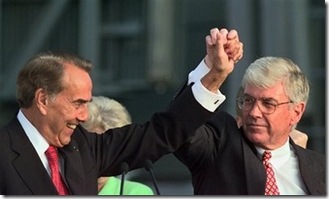
Dole and Kemp

Bob Dole and Jack Kemp 1996 Race

Kemp and Reagan 

A Young Jack Kemp with Ronald Reagan 1967

There were two big ideas that changed the world in the 1980s: Supply-side economics and a bold strategy for winning the Cold War. One was the handiwork of Jack Kemp, the other of Ronald Reagan.

It’s important to understand that the first, introduced into American politics by a then-young Kemp in the 1970s, preceded the second. No look back on the life of Jack Kemp is complete without the recognition that, without Kemp’s success, the Reagan-led peaceful victory in the Cold War could never have happened.

Restoration of strong economic growth while ending double-digit inflation was a vital political and psychological building block to Reagan’s optimistic, pro-active strategy in the Cold War. It facilitated a massive defense buildup while generating the domestic political strength that Reagan needed during the confrontational phase of his foreign policy in the early and mid-1980s.

As the magnitude of the Reagan economic expansion became clear, it revived the worldwide charisma of capitalism from its low point in the 1970s. This unexpected resurrection of capitalism demoralized the global left. It also paved the way for Mikhail Gorbachev’s conciliatory foreign and domestic policy and his announcement in 1988, Reagan’s final year in office, that the Soviet Union would carry out a complete unilateral withdrawal from Afghanistan. Nobody predicted it at the time, but this was the critical first step in ending the Cold War and in the unraveling of the Soviet empire which quickly followed.

If Reagan had not adopted Kemp’s economic program as his own, he almost certainly would not have been elected president in the first place. More than any other factor, Jack Kemp’s agenda ended the fixation on disasters of the 1970s that had left the U. S. economy, American morale, and the Republican Party at historic lows.

Even today’s financial meltdown, painful and scary as it is, pales in comparison to the demoralizing decade of the 1970s. It’s hard to convey how bad the 1970s were to anyone born after 1950.

Kent State. Arab oil embargo. Stagflation. Watergate. Impeachment. Fall of Saigon. Interminable lines at gas stations. Explosion of the welfare rolls. Explosion of the rate of violent crime. Explosion of divorce, abortion, and births out of wedlock. Eurocommunism. Armed Communist takeovers of Nicaragua, Angola, Mozambique, Guinea-Bissau, Granada, Laos and Cambodia, as well as South Vietnam. The Red Army invasion of Afghanistan. The fall of the Shah of Iran and the subsequent imprisonment of more than 100 American foreign service officers to be publicly humiliated, every day, in Tehran for nearly 15 months.

Have I left anything out? Yes. For four years we had a president, Jimmy Carter, who presided over flop after flop, fiasco after fiasco, never showing the slightest awareness of personal accountability or the slightest alteration in a demeanor of smug, superior self-congratulation.

Because of the collapse of the Nixon administration, Republicans blamed themselves for all this. So did the vast majority of voters. Following the 1974 elections, the Republican Party had 144 representatives, 38 senators, and 12 governors. Here is the list of states that Republicans still ran in 1975, in the sense of possessing the governorship and both houses of the legislature: Kansas. Two years later, Carter completed the dismantling of the GOP by ousting Gerald Ford from the White House, while the colossal post-1974 Democratic dominance in Congress and the states stayed roughly the same.

Think the Republican Party is in bad shape today? You should have seen it then. In the wake of stagflation, Watergate, and America’s first lost war—all either starting or ending in ignominy in the Nixon-Ford years — early GOP recovery was far from a betting favorite.

It happened because of two men, Ronald Reagan and Jack Kemp. It is because of them — their leadership, their determination, their creativity — that for Republicans, the bleak 1970s turned out to be in a deep sense the best of times,

exceeded in their ultimate positive impact only by the founding of the party and the rise of Abraham Lincoln in the 1850s. I had the good fortune to work closely with both of these extraordinary men in this, their most politically creative period.

To say we now know all about Ronald Reagan is tempting, but as yet far from accurate. Although virtually no one realized it at the time — I count myself among the ignorant — in retrospect Reagan had nearly unerring political and policy judgment, yet zero desire — perhaps minus desire — to call attention to his own shrewdness. He was accused of living in a Hollywood-inspired dream world, and maybe he did. But the more we learn of him from the release of his notebooks and private papers, the more we sense that Reagan was a deeply intuitive politician who knew how to mold reality until it resembled his dreams.

Like the Hollywood movies of the 1940s, every one of Ronald Reagan’s dreams had a happy ending for America. Jack Kemp, a native of Southern California, was a star quarterback for the Buffalo Bills of the American Football League who retired after the 1969 season to run for Congress as a Republican from the blue-collar Buffalo suburbs. He upset an incumbent Democratic congressman in 1970 at the age of 35 and was easily re-elected until he vacated his seat to run for President in 1988. Defeated for the nomination, he served as Secretary of Housing and Urban Development under President George H. W. Bush from 1989 to 1993 and was the Republican Party nominee for Vice President, running unsuccessfully with Republican presidential candidate Bob Dole against President Bill Clinton in 1996.

But this thumbnail biography, impressive as it is, gives the merest hint of the impact Kemp had on his party, his country, and the world. He achieved by far the most positive impact on global economic policy of any legislator of the past century.

From his earliest days in the House of Representatives, Kemp asked penetrating questions to knowledgeable people about all sorts of issues. His interests ranged widely across foreign policy and social issues as well as economics. But as with many men and women who entered politics in the 1970s, he found himself drawn inexorably to the crisis of stagflation and monetary breakdown that overshadowed those times.

Pessimism about the free market was pervasive. In 1971, Kemp’s first year in Congress, a center-right Republican president, Richard Nixon, severed the post-World War II link of the dollar to gold, imposed wage and price controls on the economy, and proclaimed “We are all Keynesians now.” The Club of Rome issued a widely celebrated report predicting a dim global future of shrinking natural resources and limits to growth.

Kemp’s rise from working-class origins to football fame and a seat in Congress left him with a far different view of America’s economic potential. It undoubtedly helped that, like Reagan, he radiated the self-confidence of a high achiever from outside politics at a time when conventional politics had become sterile.

The backbencher from Buffalo found himself drawn to a small contrarian band of economists, journalists, and political activists. It was a group that was often at each other’s throats but was united by a desire to break free from the pessimism that pervaded conventional economics throughout the 1970s.

The late conservative Keynesian economist Herbert Stein, who had chaired Nixon’s Council of Economic Advisors and whose son is the writer and comedian Ben Stein, gave us the sobriquet “supply siders,” to distinguish us from the “demand side” views of both Keynesians and monetarists. It was not meant to be flattering, but we accepted the label anyway as a reasonable capsule of what was different about our views.

Kemp was the undisputed quarterback but proved willing on occasion to switch to the role of referee when that was needed. It often was.

From early on, supply siders focused on the need for tax cuts. An early package of Kemp tax proposals focused on multiple credits and deductions for capital investment.

But in 1976 Kemp decided to simplify things by offering an across-the-board 30 percent reduction in income tax rates. The new bill was written to mimic the Kennedy tax cut that passed and was signed into law by President Johnson in 1964 and became fully effective a few months later on New Year’s Day of 1965. Most congressional Republicans, including 1964 presidential nominee Barry Goldwater, had charged fiscal irresponsibility and opposed the tax cut, which was followed by several years of accelerated growth and higher-than-expected Federal revenues.

In 1977, the Kemp bill became Kemp-Roth by gaining the co-sponsorship of Sen. William Roth of Delaware, a member of the Senate Finance Committee. To get Roth to sign on, Kemp agreed to stretch out implementation to three years, 10 percent a year. This reassured fiscal conservatives and broadened rank-and-file congressional backing. Kemp convinced Republican national chairman Bill Brock to make Kemp-Roth a key GOP plank in the 1978 congressional elections. A diluted version of the bill actually passed Congress in 1978, only to be vetoed by President Carter. But supply siders scored their first big legislative victory when Carter was maneuvered into signing a cut in the top capital gains tax rate from 49 to 28 percent.

The tax cut had added significance because it was the handiwork of Wisconsin Congressman William Steiger, a respected young GOP moderate who had several years of seniority on Kemp. Increasingly, Kemp-Roth appeared capable of uniting the right, center and left of the Republican Party and attracting some conservative Democratic backing as well.

Getting Reagan to make it the centerpiece of his campaign, however, was a complex process that culminated with success in 1979, but left his campaign team with multiple wounds that never fully healed on the personal level.

The resistance was never from Reagan himself. He was attracted to Kemp-Roth from the moment it was unveiled, and endorsed it often in his speeches and radio commentaries. But as the frontrunner for the 1980 nomination, Reagan had attracted a cross-section of elite Republican economic advisers, nearly all of whom thought in then-prevalent demand-side terms. This translated into their fear that a massive personal income tax cut would put too many dollars into the pockets of American taxpayers, causing these taxpayers to bid up prices, which in turn would cause a damaging spike in inflation. They were dismissive of Say’s Law, promulgated by a 19th-century French economist who argued that stimulating increased supply would of itself create a corresponding demand.

Ultimately the gridlock in Reagan’s camp was broken on the political side. Reagan’s campaign manager and chief strategist was John Sears, a canny, pragmatic veteran of the 1968 Nixon campaign and manager of Reagan’s surprisingly strong 1976 primary challenge against President Ford. Sears’ greatest fear was the possibility that Kemp, at the time 44 years old to Reagan’s 68, would enter the 1980 primaries and divert conservative votes toward a younger and more programmatic alternative, potentially costing Reagan the nomination. Sears was attracted to the supply-side agenda on substantive,

future-oriented grounds, but he probably would not have overcome elite opposition to highlighting the supply-side agenda had it been a political vehicle for anyone other than the attractive and articulate Kemp. Sears persuaded Reagan to offer Kemp a prominent role in the campaign as “economic spokesman,” and Kemp endorsed Reagan as the “oldest and wisest” of those in the 1980 race.

From then on, the alliance for supply side between the movie star and the quarterback was unbreakable, and together they accomplished a reduction in the top income tax rate from 70 percent (its level in 1980) to 28 percent in 1988. As taxpayers know, Bill Clinton and now Barack Obama have done their best to push marginal income tax rates back up to as much as 40 percent, and this battle will never truly end.But one thing did end. In the wake of the Reagan-Kemp tax revolution, the steeply progressive income tax -- once as high as 91 percent in this country and as recently as 1979 still at an amazing 98 percent in Great Britain -- a cornerstone of the worldwide economic left was no longer viable. Dynamiting of this cornerstone helped end not just Soviet-style communism, but old-fashioned confiscatory socialism as a live option in the democratic world as well.

One of the most revealing tests of a historic political leader is whether major unfulfilled elements of his or her agenda stay alive following the leader’s departure from the scene. Reagan passes this test in spades, perhaps most strikingly when one of his central goals, decentralization of the Federal welfare entitlement, was signed into law by a Democratic president in 1996, nearly eight years after the end of the Reagan era.

For Jack Kemp, a major Republican failing was political outreach to minorities, particularly black and Hispanic voters. By his advocacy of tax-favored enterprise zones and urban homesteading, and his close collaboration with such prominent minority legislators as Congressmen Robert Garcia of the South Bronx and Walter Fauntroy of the District of Columbia, Kemp was a pioneer in left-right, white-black and white-Hispanic coalition building. His strategy was not to play down conservative doctrine in the manner of a liberal Republican, but to adapt conservative beliefs to the needs of these communities. At a time when minorities are a growing share of the national vote and the Republican share of this vote more dismal than ever, either Republicans will find a way to revive Kemp-style conservative outreach or resign themselves once again to their own version of minority status.

Even today’s financial crisis, on one level an undeniable threat to the revitalization of capitalism that the political achievements of Reagan, Kemp, and Margaret Thatcher made possible, is a vindication of Kemp and the supply siders of the 1970s. It is sometimes forgotten that the origin of supply-side economics was intertwined not with tax policy, but with the 1971 breakdown of the Bretton Woods monetary system which provided a residual link of the dollar to gold. It was the double-digit inflation that ignited in the wake of the Nixon administration’s “liberation” of the dollar that pushed millions of middle-class taxpayers into marginal tax brackets never designed for them. This in turn helped create the mass base of the tax revolution that took off in the late 1970s.

The most important article about early supply-side theory appeared in Irving Kristol’s Public Interest magazine in 1975. Written by Wall Street Journal editorial writer Jude Wanniski, it was titled “The Mundell-Laffer Hypothesis.”

I remember avidly reading it as a frazzled director of research at Reagan’s exploratory campaign committee in Washington, preparing issue papers for the1976 nomination fight. The article was almost exclusively about monetary policy, most immediately the dangers of fiat money in the newly created “dollar standard.” Columbia professor Robert Mundell, along with Arthur Laffer the academic godfather of the supply side, won the Nobel Prize for Economics in 1999 not for fiscal studies but for his groundbreaking work in monetary policy.

A long-time advocate of fixed currency exchange rates, the Canadian Mundell is today widely credited as the prime architect of the Euro and as a major behind-the-scenes adviser to the top economic policymakers of the People’s Republic of China. It seems logical to wonder if it is an accident that this increasingly important nation in today’s global economy, holding in Beijing dollar-denominated debt instruments in the amount of two trillion dollars as their national monetary reserve, has consistently opposed floating exchange rates and recently singled out for blame the distorting role of the dollar — a single nation’s debt — as the world’s official reserve currency.

Regardless of where this interesting new debate leads, it is patently absurd to allow Barack Obama and Lawrence Summers to treat a pure crisis of monetary policy centered in the liquidity of the global banking system as a repudiation of (take your pick) modern capitalism, American-style entrepreneurship, or of private American medicine. Jack Kemp, who lost his courageous battle with cancer amid all the prayers of his many friends, fellow agitators, and admirers, could have told you that in 1977.

By: Jeffrey Bell, a visiting fellow at the Ethics and Public Policy Center in Washington, was national campaign coordinator of Kemp for President in 1988.

Source:  Newsmax

Posted:  Daily Thought Pad

Saturday, October 4, 2008

Thought For The Day - 10.04.08

“The Greatest Fear Is Fear Itself!” …President Franklin Delano Roosevelt, the man that Joe Biden and Katie Couric thought was president when the American Stock Market crashed in 1929.

(Nothing Gets Our Attention Like Fear says Gavin de Becker, Security Expert & Author of ‘The Gift of Fear’  & ‘Fear Less’.  He also says that what Americans should fear the most is the ‘cure’, the rights we have given up so freely since 9/11, the invasive precautions we now accept in the name of security and the daily local news broadcast that keeps us in a state of fear!!)

Biden Secret Service Codename: 'Assassination Insurance'

While Gov. Sarah Palin is being grilled on her position on mark-to-market accounting rules, the press can't bother to ask Joe Biden if he could give us a ballpark estimate on when Franklin D. Roosevelt was president -- or maybe take a stab at guessing the decade when televisions were first available to the public. 

Being interviewed by Katie Couric on the "CBS Evening News," Biden said: "When the stock market crashed, Franklin D. Roosevelt got on the television and didn't just talk about the, you know, the princes of greed. He said, 'Look, here's what happened."

For those of you who aren't hard-core history buffs, Biden not only named the wrong president during the 1929 stock market crash, he also claimed a president who wasn't president during the stock market crash went on TV before Americans had TVs.

Other than that, the statement holds up pretty well. At least Biden managed to avoid mentioning any "clean" Negroes he had met.

Couric was nearly moved to tears by the brilliance of Biden's brain-damaged remark. She was especially intrigued by Biden's claim that FDR had said the new iPhone was the bomb!

Here is Couric's full response to Biden's bizarre outburst about FDR (a) being president and (b) going on TV in 1929: "Relating to the fears of the average American is one of Biden's strong suits."  ...Yet she is the one looking down on Sarah Palin; scrunching up her face in looks of bewilderment.

But when our beauteous Sarah said that John McCain was a better leader on the economy than Barack Obama, Couric relentlessly badgered her for evidence. "Why do you say that?" Couric demanded. "Why are they waiting for John McCain and not Barack Obama? ... Can you give us any more examples of his leading the charge for more oversight?"

The beauteous Sarah had cited McCain's prescient warnings about Fannie Mae and Freddie Mac. But Couric, the crackerjack journalist who didn't know FDR wasn't president in 1929, demanded more examples from Palin.

We are currently in the middle of a massive financial crisis brought on by Fannie Mae. McCain was right on Fannie Mae; Obama was wrong. That's not enough?

Not for the affable Eva Braun of evening TV! "I'm just going to ask you one more time," Couric snipped, "not to belabor the point. Specific examples in his 26 years of pushing for more regulation?" 

This would be like responding to someone who predicted the 9/11 attacks by saying: OK, you got one thing right. Not to belabor the point, but what else?

Obama was not merely wrong on Fannie Mae: He is owned by Fannie Mae. 

Somehow Obama managed to become the second biggest all-time recipient of Fannie Mae political money after only three years in the Senate. The biggest beneficiary, Democratic Sen. Chris Dodd, had a 30-year head start on receiving loot from Fannie Mae -- the government-backed institution behind our current crisis.

How does the Democratic ticket stack up on other major issues facing the nation, say, gas prices?

Shockingly, Sen. Joe Biden was one of only five senators to vote against the first Alaskan pipeline bill in 1973. This is like having been a Nazi sympathizer during World War II. If Sarah Palin does nothing else, she has got to tie that idiotic pipeline vote around Biden's neck.

The Senate passed the 1973 Alaskan pipeline bill by an overwhelming 80-5 vote. Only five senators voted against the pipeline on final passage. Sen. Biden is the only one who is still in the Senate -- the other four having been confined to mental institutions long ago.

The stakes were clear: This was in the midst of the first Arab oil embargo. Liberal Democrats, such as senators Robert Byrd, Mike Mansfield, Frank Church and Hubert Humphrey, all voted for the pipeline.

But Biden cast one of only five votes against the pipeline that has produced more than 15 billion barrels of oil, supplied nearly 20 percent of this nation's oil, created tens of thousands of jobs, added hundreds of billions of dollars to the U.S. economy and reduced money transfers to the nation's enemies by about the same amount.

The only argument against the pipeline was that it would harm the caribou, an argument that was both trivial and wrong. The caribou population near the pipeline increased from 5,000 in the 1970s to 32,000 by 2002.

It would have been bad enough to vote against the pipeline bill even if it had hurt the caribou. A sane person would still say: Our enemies have us in a vice grip. Sorry, caribou, you've got to take one for the team. But when the pipeline goes through and the caribou population sextuples in the next 20 years, you really look like a moron.

We couldn't possibly expect Couric to ask Biden about a vote that is the equivalent of voting against the invention of the wheel. But couldn't she have come up with just one follow-up question for Biden on FDR's magnificent handling of the 1929 stock market crash?

Or here's a question the public is dying to know: "If Obama wanted a historically delusional vice president, why not Lyndon LaRouche?" At least LaRouche didn't vote against the Alaskan pipeline.

The media also keeps telling us that Obama is ahead in the polls by as much as 9 percentage points, because of his ‘handling’ of the present economic crisis… Handling???  He is nowhere around!!  And as we all know, statistics and polls can be interpreted and spun by anyone who wants to and needs to… The fact is that only one poll, that interviewed Democrats to Republicans 2 to 1, shows Obama ahead of McCain by more than 3 percentage points… while others show them from 3 percentage points apart to being in a dead heat, even with all the media spin for Obama and with McCain being off the campaign trail and doing his job in Washington.

By Ann Coulter for NewsMax

“McCain wants to ‘put his country first’. The best way is simple: Get aggressive and win the election!” …Larry Elder, who says McCain needs to take off the gloves!

Sunday, August 31, 2008

Changes In Politics

Although the Great Depression of the 1930s began under Herbert Hoover, unemployment during Hoover's last year in office was not as high as it became during each of the first five years under FDR.

During the eight years of FDR's first two terms as president, there were only two years in which unemployment was lower than it had been under Herbert Hoover-- and not by much.

World War II has been credited by some with getting the United States out of the Great Depression. What the war did was put an end to the New Deal, as national survival became the top priority and replaced FDR's anti-business and class warfare rhetoric.

Senator Obama's rhetoric today is the anti-business and class warfare rhetoric that worked so brilliantly in a political sense for FDR in the 1930s. But Obama is following an opposite course from FDR when it comes to recognizing threats to American national security.

Senator Obama has repeatedly tried to deal with national security threats with rhetoric. He tried to dismiss the threat of a nuclear Iran with because Iran is "a small nation"-- even though it is larger than Japan, which launched a devastating attack against the United States at Pearl Harbor.
FDR had the good sense to begin urging greater military preparedness in 1940, more than a year before the United States was attacked. He said, "If you wait until you see the whites of their eyes, you will never know what hit you."

Cutting the military budget and taking foreign policy problems to the United Nations are Obama's version of "change."

That is change that we dare not believe in. It is the audacity of hype.

One of the few political cliches that makes sense is that "In politics, overnight is a lifetime."

Less than a year ago, the big question was whether Rudolph Giuliani could beat Hillary Clinton in this year's presidential election. Less than two months ago, Barack Obama had a huge lead over John McCain in the polls. Less than a week ago, the smart money was saying that Mitt Romney would be McCain's choice for vice president.

We don't need Barack Obama to create "change." Things change in politics, in the economy, and elsewhere in American society, without waiting for a political messiah to lead us into the promised land.

Who would have thought that Obama's big speech at the Democratic convention would disappoint expectations, while McCain's speech electrified his audience when he announced his choice of Governor Sarah Palin for his running mate?

Some people were surprised that his choice was a woman. What is more surprising is that she is an articulate Republican. How many of those have you seen?

Despite the incessantly repeated mantra of "change," Barack Obama's politics is as old as the New Deal and he is behind the curve when it comes to today's economy.
Senator Obama's statement that "our economy is in turmoil" is standard stuff on the left and in the mainstream media, which has been dying to use the word "recession."

Not only has the economic slowdown failed to reach the definition of a recession, the most recent data show the U.S. economy growing at a rate exceeding 3 percent-- a rate that many European economies would die for, despite our being constantly urged to imitate those countries whose end results are not as good as ours.

Barack Obama's "change" is a recycling of the kinds of policies and rhetoric of the New Deal that prolonged the Great Depression of the 1930s far beyond the duration of any depression before or since.

These are the same kinds of liberal policies that led to double-digit inflation, double-digit interest rates and rising unemployment during the Carter administration. These are "back to the future" changes to economic disasters that need repeating.

Make no mistake, the political rhetoric of FDR was great. For those who admire political rhetoric, as so many of Barack Obama's supporters seem to, FDR was tops. For those who go by actual results, FDR's track record was abysmal.


by Thomas Sowell

Posted by TownHall.com