Showing posts with label Banking. Show all posts

Friday, August 24, 2012

Customer Deposits Are Property of the Bank: Close Your Account NOW

By Susanne Posel - heintelhub.com - August 24, 2012 – h/t to MJ

In June of 2012, Eric Bloom, former chief executive, and Charles Mosely, head trader of Sentinel Management Group (SMG) were indicted for stealing $500 million in customer secured funds.

Both Mosely and Bloom were accused of “exposing” customer segregated funds “to a portfolio of highly risky derivatives.”

These customer funds were used to “back up personal investments” which were part of “collateral for a loan from Bank of New York Mellon” (BNYM).

This loan derived from stolen customer monies was “used to purchase millions of dollars worth of high-risk, illiquid securities, including collateralized debt obligations, or CDOs, for a trading portfolio that benefited Sentinel’s officers, including Mosley, Bloom and certain Bloom family members.”

Fast forward to August 9th of 2012, and the 7th Circuit Court of Appeals (CCA) rules that BNYM can be moved to first in line of creditors over the customers that had their funds stolen by SMG.

When a banking customer deposits their money into their bank account, the Federal Deposit Insurance Corporation (FDIC) and Securities Investor Protection Corporation (SPIC) are in place to protect the customer from fraud or theft.

The ruling from the CCA means that these regulatory systems will not insure customer funds, investments, depositors and retirees who hold accounts in banks.

In fact, the banking institution is now legally allowed to use those customer funds deposited as collateral, payment on debts for loans made, or free use on the stock market to purchase investments as the bank sees fit.

Fred Grede, SMG trustee, explained that brokers are no longer required to keep customer money separate from their own. “It does not bode well for the protection of customer funds.”

Since the ruling gives banks the right to co-mingle customer funds with their own, no crime can be committed for the use of customer deposited monies.

According to Walker Todd , former lawyer for the Federal Reserve Bank of New York and Cleveland:

“Basically, there is a new 7th Circuit opinion saying that there is no reason to impose a constructive trust on a lender’s takings of customers’ funds from client commodity firms that were used (inappropriately) to secure the firms’ borrowings, as long as the lender can say that it did not know WITH CERTAINTY that customers’ funds were being repledged. Negligence and misappropriation (vs. knowing criminal intent) are now a sufficient excuse for letting the lender keep the money and go to the head of the line for distributions in bankruptcies of the client commodity firms.”

When a customer deposits money into a bank, the bank essentially issues a promise to have those funds available when the customer returns to withdraw the deposited amount.

When the same customer withdraws funds from their account (whether checking or savings) the customer assumes that the bank has enough funds to cover their withdrawal; including the presumption that their monies are separate from the bank’s assets.

Now, those funds are up for grabs by the bank at their discretion without explanation to the customer – nor is the bank obligated to recoup the customer should they “lose” those funds due to bad loans, bankruptcy or stock market loss.

In Texas, Pamela Cobb, manager of Bank of America (BoA), stole an estimated $2 million from customer funds for personal use. Cobb had been taking customer segregated funds since 2002.

Customers have complained of fraudulent charges placed on their accounts that BoA cannot explain. When the customer brings these charges to the in-house fraud department, they are given the run-around until they acquiesce.

Other customers have had their private possessions stolen right out of their safety deposit box held at BoA. The safety deposit box was drilled into and the contents shipped to the BoA corporate holding center in South Carolina.

In 1992 to 2003, Citibank called their theft of customer funds “account sweeping” wherein they stole more than $14 million from customers nationally.

Using computerized credit card processes to remove positive and negative balances from customers, the scheme included double payments or funds paid out on returned purchases that were then attributed back to the customer.

At Chase bank, an anonymous employee opened an account under a customer name (targeting an Alzheimer’s sufferer), complete with a personal debit card.

An estimated $300 per day was withdrawn on the fraudulent account. When family representing the victim alerted Chase, they brushed them off with an internal investigation claim – even as the family sought legal action.

Banking fraud against the elderly has risen of late, since banks realize they can steal massive amounts of cash from their aging customers with little to no repercussions.

The recent ruling on SMG has given the banking industry the legal backing they have been lacking when stealing from their customers.

Our financial institutions have been planning for a financial collapse wherein the US government will not offer assistance.

The resolution plans required by the Federal Reserve Bank, described schemes to have the major domestic banks remain afloat by selling off assets, finding alternative sources of funding, reducing risky measures that make a quick buck. These strategies were to be perfected with “no assumption of extraordinary support from the public sector.”

The mega-banks, through Wall Street, are also acquiring firearms, ammunition and control over private mercenary corporations like DynCorp and ‘Blackwater” as authorized by the Department of Defense (DoD) directive 3025.18 .

DynCorp is a military-based private mercenary contractor that provides (among other services) intelligence training and support, international security, contingency plans and operations. Ninety-six percent of their funding is based on annual revenues from the US federal government.

The international branch of DynCorp has operated as a “police force” even assisting local law enforcement during Hurricane Katrina.

Named as investors for the amassing of gun and ammunition manufacturers are Citibank, BoA, Barclays and Deutsche Bank who are pouring money into Cerebus and Veritas Equity who have taken over private corporations involved in the controlling riot situations.

The Federal Reserve Bank, one of the heads of banking cartels, has their own police force which operates as a protective security for the Fed against the American public.

As part of the Federal Reserve Act signed in 1913, the designation of a Federal Law Enforcement – special police officers that are exclusively regulated by authority of the Fed (whether in uniform or plain clothes.

These specialized police officers (who train with Special Response Teams) can work in tandem with local law enforcement or US federal agencies. These officers are heavily armed with semi-automatic pistols, sub machine guns and assault rifles as well as body armor.

Of recent, when withdrawing cash from an ATM, the daily allotted amount has decreased with some banks, thereby forcing the customer to go into the branch and extract the difference with a teller.

At this point, according to anonymous informants, the customer is taken into a backroom to be questioned as to why they want the cash, what they are purchasing with the cash, why they are not choosing to use a debit card or another form of digital trade to make the purchase. These questions are not only intrusive, they are illegal.

Some anonymous sources have said that banking representatives who conduct the integrations are directed to keep a record of customer responses on an online application that will be sent to the FBI in conjunction with Patriot Act mandates on tracking banking activity.

Customer funds are no longer secure, no longer backed by the FDIC or other insurance corporations, and banks are legally allowed to co-mingled customer money with other funds of the bank. The only safe place for your money is with you.

Now is the time to close your bank account.

Susanne Posel is the Chief Editor of Occupy Corporatism Our alternative news site is dedicated to reporting the news as it actually happens; not as it is spun by the corporate-funded mainstream media. You can find us on our Facebook page.

Related:

Friday, June 22, 2012

GLOBAL ELITES THROWN OUT OF ICELAND: Iceland Dismantles Corrupt Gov’t Then Arrests All Rothschild Bankers

clip_image001Freedumbnation:

Since the 1900′s the vast majority of the American population has dreamed about saying “NO” to the Unconstitutional, corrupt, Rothschild/Rockefeller banking criminals, but no one has dared to do so. Why? If just half of our Nation, and the “1%”, who pay the majority of the taxes, just said NO MORE! Our Gov’t would literally change over night. Why is it so hard, for some people to understand, that by simply NOT giving your money, to large Corporations, who then send jobs, Intellectual Property, etc. offshore and promote anti-Constitutional rights… You will accomplish more, than if you used violence. In other words… RESEARCH WHERE YOU ARE SENDING EVERY SINGLE PENNY!!! Is that so hard? The truth of the matter is… No one, except the Icelanders, have to been the only culture on the planet to carry out this successfully. Not only have they been successful, at overthrowing the corrupt Gov’t, they’ve drafted a Constitution, that will stop this from happening ever again. That’s not the best part… The best part, is that they have arrested ALL Rothschild/Rockefeller banking puppets, responsible for the Country’s economic Chaos and meltdown.

Last week 9 people were arrested in London and Reykjavik for their possible responsibility for Iceland’s financial collapse in 2008, a deep crisis which developed into an unprecedented public reaction that is changing the country’s direction.

It has been a revolution without weapons in Iceland, the country that hosts the world’s oldest democracy (since 930), and whose citizens have managed to effect change by going on demonstrations and banging pots and pans. Why have the rest of the Western countries not even heard about it?

Pressure from Icelandic citizens’ has managed not only to bring down a government, but also begin the drafting of a new constitution (in process) and is seeking to put in jail those bankers responsible for the financial crisis in the country. As the saying goes, if you ask for things politely it is much easier to get them.

This quiet revolutionary process has its origins in 2008 when the Icelandic government decided to nationalize the three largest banks, Landsbanki, Kaupthing and Glitnir, whose clients were mainly British, and North and South American.

After the State took over, the official currency (krona) plummeted and the stock market suspended its activity after a 76% collapse. Iceland was becoming bankrupt and to save the situation, the International Monetary Fund (IMF) injected U.S. $ 2,100 million and the Nordic countries helped with another 2,500 million.

Great little victories of ordinary people While banks and local and foreign authorities were desperately seeking economic solutions, the Icelandic people took to the streets and their persistent daily demonstrations outside parliament in Reykjavik prompted the resignation of the conservative Prime Minister Geir H. Haarde and his entire government. Citizens demanded, in addition, to convene early elections, and they succeeded. In April a coalition government was elected, formed by the Social Democratic Alliance and the Left Green Movement, headed by a new Prime Minister, Jóhanna Sigurðardóttir.

Throughout 2009 the Icelandic economy continued to be in a precarious situation (at the end of the year the GDP had dropped by 7%) but, despite this, the Parliament proposed to repay the debt to Britain and the Netherlands with a payment of 3,500 million Euros, a sum to be paid every month by Icelandic families for 15 years at 5.5% interest.

The move sparked anger again in the Icelanders, who returned to the streets demanding that, at least, that decision was put to a referendum. Another big small victory for the street protests: in March 2010 that vote was held and an overwhelming 93% of the population refused to repay the debt, at least with those conditions.

This forced the creditors to rethink the deal and improve it, offering 3% interest and payment over 37 years. Not even that was enough. The current president, on seeing that Parliament approved the agreement by a narrow margin, decided last month not to approve it and to call on the Icelandic people to vote in a referendum so that they would have the last word.

The bankers are fleeing in fear returning to the tense situation in 2010, while the Icelanders were refusing to pay a debt incurred by financial sharks without consultation, the coalition government had launched an investigation to determine legal responsibilities for the fatal economic crisis and had already arrested several bankers and top executives closely linked to high risk operations.

Interpol, meanwhile, had issued an international arrest warrant against Sigurdur Einarsson, former president of one of the banks. This situation led scared bankers and executives to leave the country en masse.

In this context of crisis, an assembly was elected to draft a new constitution that would reflect the lessons learned and replace the current one, inspired by the Danish constitution.

To do this, instead of calling experts and politicians, Iceland decided to appeal directly to the people, after all they have sovereign power over the law. More than 500 Icelanders presented themselves as candidates to participate in this exercise in direct democracy and write a new constitution. 25 of them, without party affiliations, including lawyers, students, journalists, farmers and trade union representatives were elected.

Among other developments, this constitution will call for the protection, like no other, of freedom of information and expression in the so-called Icelandic Modern Media Initiative, in a bill that aims to make the country a safe haven for investigative journalism and freedom of information, where sources, journalists and Internet providers that host news reporting are protected.

The people, for once, will decide the future of the country while bankers and politicians witness the transformation of a nation from the sidelines.

The Bilderberg Group’s Connection To Everything In The World – Updated

Saturday, May 12, 2012

American Freedom – Chinese Style?

A Chinese Group Plans To Construct A 200 Acre 

A Chinese group known as "Sino-Michigan Properties LLC" has bought up 200 acres of land near the town of Milan, Michigan.  Their plan is to construct a "China City" with artificial lakes, a Chinese cultural center and hundreds of housing units for Chinese citizens.  Essentially, it would be a little slice of communist China dropped right into the heartland of America.  This "China City" would be located about 40 minutes from both Detroit and Toledo, and it would be marketed to Chinese business people that want to start businesses in the United States.  Unfortunately, this is not just an isolated incident.  In fact, Chinese companies have been buying up land and businesses all over the country in recent years.  There has even been talk of establishing "special economic zones" inside the United States modeled after the Chinese city of Shenzhen.  It was inevitable that the Chinese were going to do something with the trillions of dollars that they have made flooding our shores with cheap products.  Now they are rapidly buying up pieces of America, and many of our politicians are welcoming them with open arms.

The town of Milan, Michigan is a small farming community of only about 6,000 people, but big changes are coming their way.  The following is from a recent Dayton Daily News article about this new project....

A group of mainland Chinese known as Sino-Michigan Properties LLC paid $1.9 million for 200 acres of farmland on Milan city limits in purchases this year and in 2011, according to local officials and property records.

Unfortunately, the goal does not appear to be to integrate this new "city" into the existing community in and around Milan.

Rather, it appears that all of the new housing will be sold to people coming over from China.  According to the Milan News Leader newspaper, the new housing units "would be marketed to Chinese business people who want to start companies in the United States".

In essence, we would be looking at a new Chinese city right in the middle of Michigan.

Doug Smith, senior vice president for business and community development for the Michigan Economic Development Corp., recently said the following about what the Chinese group plans to do....

"It’s a group that wants to build a China city, starting with housing over there in Milan"

Milan is not far from the University of Michigan in Ann Arbor, which is a very popular destination for Chinese students.  Apparently that is one reason why Milan was chosen.

This new project would be a Chinese community built by Chinese and specifically designed for Chinese.

But isn't this supposed to be America?

Fortunately, the project does not have final approval yet.  It still must be approved by the two townships outside of Milan where the land is located.

For some reason, the Chinese seem to be particularly interested in this area of the country.

For example, a different Chinese investment group has been busy buying up chunks of real estate over in nearby Toledo, Ohio.  The following is from an article in the Toledo Blade on May 26th, 2011....

Dashing Pacific Group Ltd., which has already purchased the nearby Docks restaurant complex for $2.15 million, put its $3.8 million offer to buy the southern 69 acres at the Marina District in East Toledo back on the table for approval by Toledo City Council. Additionally, Dashing Pacific Chairman Yuan Xiaohong, in a letter signed in Hangzhou, said the firm wants a two-year option to buy the decommissioned Toledo Edison power plant property on the site.

So should we be alarmed that the Chinese are buying up pieces of America?

Well, if they simply wanted to enjoy living in America and wanted to integrate into the wider community that would be one thing.

But it is another thing altogether to start dropping slices of communist China inside of U.S. territory.

In a previous article entitled "China Wants To Construct A 50 Square Mile Self-Sustaining City South Of Boise, Idaho", I discussed a potential deal that Sinomach (a company controlled by the Chinese government) was exploring with the government of Idaho.  The following is a description of that potential project from an article in the Idaho Statesman....

A Chinese national company is interested in developing a 10,000- to 30,000-acre technology zone for industry, retail centers and homes south of the Boise Airport.

There was talk that this "technology zone" would be modeled after the "special economic zones" that have been developed in China.  The city of Shenzhen is perhaps the most famous example of this.

Fortunately that deal appears to have stalled, but other mammoth deals have been moving forward in other parts of the country.

For example, the Chinese have been very busy gobbling up oil and gas fields.  The following is a quote from a local Texas news source about a deal that a company owned by the Chinese government did with Chesapeake Energy down in Texas....

State-owned Chinese energy giant CNOOC is buying a multibillion-dollar stake in 600,000 acres of South Texas oil and gas fields, potentially testing the political waters for further expansion into U.S. energy reserves.

With the announcement Monday that it would pay up to $2.2 billion for a one-third stake in Chesapeake Energy assets, CNOOC lays claim to a share of properties that eventually could produce up to half a million barrels a day of oil equivalent.

You can read more about that particular deal right here.

So is it really a good idea to be allowing the Chinese to buy up our precious energy resources?

The answer to that question is obvious.

Sadly, the examples noted above are not isolated incidents.  The truth is that the Chinese have been snapping up real estate and business assets all over America as a recent Forbes article explained....

According to a recent report in the New York Times, investors from China are “snapping up luxury apartments” and are planning to spend hundreds of millions of dollars on commercial and residential projects like Atlantic Yards in Brooklyn. Chinese companies also have signed major leases at the Empire State Building and at 1 World Trade Center, the report said.

So get ready - the Chinese are buying up U.S. land and they are moving in whether you like it or not.

So what will the long-term consequences be of allowing a communist superpower to buy up large sections of America?

That is a very good question.

Fed clears China's first US bank takeover

Yahoo ^ |Wednesday, May 09, 2012 6:33:39 PM · by GeorgeWashingtonsGhost · 18 replies

The United States on Wednesday opened its banking market to ICBC, China's biggest bank, for the first time clearing a takeover of a US bank by a Chinese state-controlled company. Just days after high-level US-China economic talks in Beijing, the Federal Reserve approved an application from Industrial and Commercial Bank of China to buy a majority stake in the US subsidiary of Bank of East Asia. The transaction will make ICBC the first Chinese state-controlled bank to acquire retail bank branches in the United States. ICBC has been the most aggressive of China's "big four" banks in expanding overseas. According...

 China & the Other Central Banks Are Buying Gold-Ranting Andy Hoffman--09.May.2012

The Financial Survival Network ^ | 05/09/2012 | Kerry Lutz  -  Listen to the Interview Here - http://financialsurvivalnetwork.com/2012/05/the-people-have-spoken/

www.FinancialSurvivalNetwork.com presents: "Ranting" Andy Hoffman gives us the update on the latest precious metals slam down; the reasons to own gold and silver couldn't be stronger. If the prices stay down this low, don't be surprised to witness a major flood of buying. We're also getting into the Indian Wedding Season, which will result in increased demand along with massive sovereign central bank purchases. This is worse than 2008, and banks are blowing up all over Europe. Spain has just bailed out its third largest bank. Who's going to bail out Spain? Greece is planning to reneg on its debt....

World Affairs Brief

Both Republican and Democratic administrations have been supplying the Chinese with high technology weapons systems for years, knowing that they, in turn, are supplying other enemies (Iran, Iraq, Pakistan, North Korea) as well. Both Russia and China continue to protest against any US anti-ballistic missile system, even though such systems are purely defensive. It doesn't take a genius to understand that ABM systems only threaten someone who intends to launch ballistic missiles someday.

"The US supplying Chinese with US high tech weapons systems?”

Note: He went into personal details not shown here, of experiences when as a person holding security classification, in U.S. weapons development, how they were ordered to allow Chinese military officers go over the details of secret projects they were working on !!

 Shocking News: China Sells Energy Pills Made From Baby Flesh

Customs officials in South Korea have uncovered a horrifying reality coming from China. Since last August, the Koreans have confiscated over 17,000 "energy pills" that were made from the dried flesh of babies. The rest of the nauseating details can be found HERE.

China is exporting pills made from dried and pulverized human baby flesh. [They are hyped as a medicinal cure-all.] DailyMail 2012 May 7 (Cached)
http://www.dailymail.co.uk/news/article-2140702/South-Korea-customs-officials-thousands-pills-filled-powdered-human-baby-flesh.html#ixzz1uDZvdZaW

 Soy-Crop Bust Spurs China to Drain U.S. Bins: Commodities

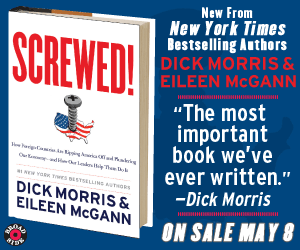
 China Has Hacked Our Electric Power Grid: Read About It In Screwed!
By DICK MORRIS  -  Published on DickMorris.com on May 10, 2012

In our new book Screwed!, we report that almost unnoticed and with no threat of retaliation, China has likely hacked into the United States electric grid, potentially giving it the ability to paralyze our economy and our nation by tapping a few keys on a computer. (This is an ad by Dick Morris for his book… but the book is well worth reading.  He covers a lot of important topics in great detail that others are ignoring!)

Writing in the Wall Street Journal, Bush's anti-terrorism coordinator Richard Clarke reports that "in 2009, the control systems for the U.S. electric power grid [were] hacked and secret openings created so that the attacker could get back in with ease.  One expert noted that the hackers "left behind software that could be used to cause disruptions or even shut down the system."

While we cannot confirm that it was China that did the hacking, it is the only country with the technical expertise in hacking to have accomplished it.

Click Here to order a copy of Dick and Eileen's new book, SCREWED!

What were the hackers after?  Clarke notes that "there is no money to steal on the electrical grid, nor is there any intelligence value that would justify cyber espionage.  The only point to penetrating the grid's controls is to counter American military superiority by threatening to damage the underpinning of the U.S. economy.  Chinese military strategists have written about how in this way a nation like China could gain an equal footing with the militarily superior United States."

Anti-terror watchdogs have long been aware of the danger of an electromagnetic pulse triggered by the explosion of a nuclear device in the atmosphere over the United States.  But by acquiring the ability to enter our grid anytime it wishes and disable it, China has likely acquired the ability to accomplish the same result without exploding a bomb.

Not only has Beijing likely hacked into our grid but, according to authors Brett M. Decker and William C. Triplett II in their excellent book Bowing to Beijing, China has even hacked into the Pentagon computer network "including the one serving [then] Defense Secretary Robert Gates." 

James Lewis, director of the technology and policy program at the Washington think tank Center for Strategic and International Studies called the Chinese hacking "an espionage Pearl Harbor."  Lewis told 60 minutes that China had downloaded vast amounts of information from every major U.S. agency saying that we have lost more information than is stored in the entire Library of Congress through Chinese hacking.

What is the U.S. doing about it? Nothing.  The modern day story of appeasement is not Obama's kowtowing to Muslim extremists as much as his total failure to confront China.

The president and Secretary of State Clinton fret over alienating China for fear that they will stop lending us money.  Romney, who understands these things better than either Obama or Clinton, emphasizes China's vulnerability. "We sell then $50 billion.  They sell us $400 billion.  They want a trade war?  Bring it on!"

The Chinese lend us money because they have to.  They buy dollars to make our currency artificially expensive and theirs' commensurately cheap.  With their currency manipulation, our products are 40% more costly in their markets and theirs' are 40% cheaper in our stores, fueling the imbalance of trade.  Once they own the dollars, what are they going to do with them?  The only safe thing is to buy U.S. Treasury notes, hence they "lend" us money.  If they stopped buying dollars and acquiring an unfair trade advantage over us, we wouldn't need them to keep lending us money, our economy would be thriving.

We cannot sit by complacently and let China rob us blind, hacking our technology, our military secrets, and our power grid.  We need a president who will stand up for America.

To grasp the appalling extent of Chinese hacking and espionage against the U.S. commercial and military sectors, read about it in Screwed!, on sale now!

Friday, September 30, 2011

BANK OF AMERICA TO CHARGE $5 MONTH FEE FOR USING DEBIT CARD

NEW YORK (The Blaze/AP) — Bank of America plans to start charging customers a $5 monthly fee for using their debit card to make purchases. The fee will be rolled out starting early next year.

A number of banks have already either rolled out or are testing such fees. But Bank of America’s announcement carries added weight because it is the largest U.S. bank by deposits.

Anne Pace, a Bank of America Corp. spokeswoman, said Thursday that customers will only be charged the fee if they use their debit cards for purchases in any given month. Customers won’t be charged if they only use their cards at an ATM.

The fee will apply to basic accounts and will be in addition to any existing monthly service fees. For example, one of the bank’s basic accounts charges a $12 monthly fee unless customers meet certain conditions, such as maintaining a minimum average balance of $1,500.

A fee for using debit cards is still a novel concept for many consumers and was unheard of before this year. But there are signs it may soon become an industry norm.

SunTrust, a regional bank based in Atlanta, began charging a $5 debit card fee on its basic checking accounts this summer. Regions Financial, which is based in Birmingham, Ala., plans to start charging a $4 fee next month.

Chase and Wells Fargo are also testing $3 monthly debit card fees in select markets. Neither bank has said when it will make a final decision on whether to roll out the fee more broadly.


“I might use all cash. Or go back to writing checks,” he said.

The debit card fee isn’t the only unwelcome change for checking account customers are seeing either. The banking industry has been raising fees and scaling back on rewards programs as they adjust to new regulations that will limit traditional revenue sources.

Starting Oct. 1, a regulation will cap the fees that banks can collect from merchants whenever customers swipe their debit cards. Those fees generated $19 billion in revenue for banks in 2009, according to the Nilson Report, which tracks the payments industry.

There is no similar cap on the fees that banks can collect from merchants when customers use their credit cards, however. That means banks may increasingly encourage customers to reach for their credit cards, reversing a trend toward debit card usage in the past several years.

An increasing reliance on credit cards would be particularly beneficial for Bank of America, which is a major credit card issuer, notes Bart Narter, a banking analyst with Celent, a consulting firm.

“It’s become a more profitable business, at least in relation to debit cards,” Narter said.

This summer, an Associated Press-GfK poll found that two-thirds of consumers use debit cards more frequently than credit cards. But when asked how they would react if they were charged a $3 monthly debit card fee, 61 percent said they’d find another way to pay.

If the fee were $5, 66 percent said they would also change their payment method.

Bank of America’s debit card fee will be rolled out in stages starting with select states in early 2012. The company would not say which states would be affected first.

Bank of America shares rose 9 cents, or 1.5 percent, to $6.25 in afternoon trading.

h/t to the Blaze

Dodd-Frank: The End Of Free Checking?

On Sat., Oct. 1, new regulations from the Dodd-Frank financial overhaul go into effect on debit cards. Specifically, they impose price controls on “interchange fees,” the fees that banks and credit unions charge to retailers on debit card transactions.

The average interchange fee is about 44 cents. The new rules limit the fees to 21 to 24 cents.

“The costs of processing debit card transactions doesn’t go away because you limit the price,” said John Berlau, director of the Center for Investors and Entrepreneurs at the libertarian Competitive Enterprise Institute. “That shifts the costs to consumers.”

These fees are used by banks to offer free checking and rewards programs. But now those programs may be be coming to an end. Just 45% of noninterest checking accounts are now free, down from 65% last year, according to a recent survey by Bankrate.com. The average monthly fee for those accounts has risen 75% in

the last year to $4.37.

Bank of America (BAC) just announced a $5 monthly fee for debit cards, starting early next year. BofA cited regulatory costs. Wells Fargo (WFC) and Chase (JPM) has experimented with $3 fees in some markets. Earlier in the year, SunTrust (STI) bank ended its debit card reward program.

Berlau notes other consequences:

Much of these costs will be transferred to consumers in terms of loss of free checking and debit card rewards, new charges for using an ATM, and other fee hikes and service cuts. In its rule, the (Federal Reserve) almost invited banks and credit unions to do this, “helpfully” pointing out that “the interchange fee standard would not limit the ability of an issuer to earn revenue from other sources, such as charging fees to cardholders.”

And there may be other nasty surprises, such as job losses. A Wall Street Journal editorial blamed at least part of the 40,000 Bank of America job losses on the loss of revenue due to the Dodd-Frank price controls. And late last week, Texas-based International Bancshares announced that due to the revenue loss from the price controls, it was closing 55 branches in grocery stores and shedding 500 jobs.

Even retailers may not get the full benefit they are expecting. According to one article, debit card processors can charge an additional fee when merchandise is returned, and that fee may not be covered by the regulations. Processors also may charge flat fees on transactions rather than a percentage-based fee, meaning retailers may pay more on small sales. Expect more processors to do that as the regulations take hold.

By David Hogberg   -  Thu., Sept. 29, 2011 11:30 AM ET  -  Capital Hill  -  h/t to Jean Stoner

Related:

The Secret Gov’t Bank That’s Financing More Solyndras

And at the core of this guy’s fiscal policies…
Photobucket

Saturday, March 28, 2009

Forrest Gump Explains The Banking Mess

Mortgage Backed Securities are like boxes of chocolates. Criminals on Wall Street stole a few chocolates from the boxes and replaced them with turds. Their criminal buddies at Standard & Poor rated these boxes AAA Investment Grade chocolates. These boxes were then sold all over the world to investors. Eventually somebody bites into a turd and discovers the crime. Suddenly nobody trusts American chocolates anymore worldwide.

Hank Paulson now wants the American taxpayers to buy up and hold all these boxes of turd-infested chocolates for $700 billion dollars until the market for turds returns to normal. Meanwhile, Hank’s buddies, the Wall Street criminals who stole all the good chocolates are not being investigated, arrested, or indicted.

Mama always said: ‘Sniff the chocolates first, Forrest’.

Quote of the day from a fund manager:

“This is worse than a divorce… I’ve lost half of my net worth and I still have my wife…”

The bailout–a different perspective:

Back in 1990, the Government seized the Mustang Ranch brothel in Nevada for tax evasion and, as required by law, tried to run it. They failed and it closed. Now we are trusting the economy of our country to a pack of nit-wits who couldn’t make money running a whore house and selling booze?

Posted in Banking, Nationalization, politics at 9:11 am by Administrator - 01.20.09

Permalink

Thursday, September 11, 2008

Whitney: Worst Is Yet To Come For Banking

Meredith Whitney, the Oppenheimer & Co. analyst who called Wall Street's mortgage market meltdown last fall, now says the worst is yet to come for the global financial industry.

"What's ahead is much more severe than what we've seen so far," Whitney told Fortune magazine.

She submits that banks are facing dramatically larger credit losses than they have reported so far and thinks the economy is about to sink into an "early 1980s-style recession," that will "devastate 10 percent of the population," which became financially overextended during the housing boom.

"It feels like I am at the epicenter of the biggest financial crisis in history," she says.

"While my loss estimates are much more severe than those of my peers, my biggest concern is that they are way too low," she said.

Of the 14 financial stocks Whitney covers, she rates five as under-perform and the rest "market perform."

Whitney correctly predicted last fall that Citigroup would be compelled to bolster its leaky balance sheet.

According to Fortune, she followed that call with forecasts of more losses and write-downs at the likes of Bank of America, Lehman Brothers, and UBS, as well as some insightful tangents on how the implosion of the bond insurers would threaten banks' bottom line.

On a Merrill Lunch conference call in mid-July, she asked CEO John Thain why the company wasn't unloading damaged assets and boosting assets. Thain demurred, but less than two weeks later, Merrill did just that. It agreed to sell more than $30 billion of collateralized debt obligations for 22 cents on the dollar.

Whitney said that, while her peers are searching for some sort of light at the end of the tunnel, the tunnel "is about to collapse."

Some pundits, however, disagree with this pessimistic take.

In his weekly e-mail briefing to business reporters, analyst William Gamble, president of Emerging Market Strategies, says the financial crisis should be put into a global context.

"It is certainly true that the U.S. stock market has lost 20 percent of its value. Still this is tiny compared to the losses on other exchanges," he says.

According to Gamble, the Chinese stock market has lost over 50 percent while the Russian stock market has lost over 35 percent. Both markets have collapsed in the past six months. The Chinese real estate market is showing signs of strain. Sales of apartments in both Beijing and Shanghai are off over 50 percent.

Despite the present angst among pundits, commentators, and experts, the U.S. economy has shown surprising strength.

"It is not temporary and no coincidence. As the global economy slips into recession, there is one country that will be the first to recover," writes Gamble.

© 2008 Newsmax