Showing posts with label 912 Project. Show all posts

Wednesday, September 14, 2011

TOP VIDEO HIGHLIGHTS: BECK LAUNCHES NEW GBTV PROGRAM

Glenn Beck launched his new two-hour nightly program on Tuesday night on GBTV.com.

Here are a few of the highlights from the first broadcast.

The Truth on Islamic Extremism (See Video)

Where We Were on 9/12 (See Video)

Terrorist Attack on Lady Liberty (See Video)

Glenn Welcomes First Responders (See Video)

You can check out the new show during a free two-week trial.  For more information click here.

Tuesday, March 29, 2011

DOH! Extreme Leftist Senator Chuck Schumer (D-NY) Reveals Democrat Strategy For Budget Bill & Rubio (R_FL) on Not Raising Debt Ceiling

Jared LawPosted by Jared Law on March 29, 2011 at 10:01pm in Elections, Issues, News, & Politics

This is rich, especially coming from such an extreme, radical leftist like Chuck Schumer. Talk about the soot-encrusted pot calling the gleaming, polished-stainless steel kettle (with a solid copper bottom) black!

The fact of the matter is that the Democrats in 'leadership' positions in the U.S. Senate are hardcore, radical leftists. Many who call themselves Communists are just as far left, as Chuck Schumer, Harry Reid, Frank Lautenberg, and other 'Progressives' in the Democrat party.

It's nice to see what we all know is happening, exposed to the light of day. Those dirty, radical leftists can't hide their scheming to combine against the liberty of the American People forever; thankfully, we have examples to show potential recruits to our cause. Cold, hard evidence which cannot be explained away by the honest and honorable.
--------

On a Senate Call, a Glimpse of Marching Orders

By JENNIFER STEINHAUER | March 29, 2011, 12:30 PM 4:58 p.m. | Updated: Um, senators, ever heard of the mute button?

Moments before a conference call with reporters was scheduled to get underway on Tuesday morning, Charles E. Schumer of New York, the No. 3 Democrat in the Senate, apparently unaware that many of the reporters were already on the line, began to instruct his fellow senators on how to talk to reporters about the contentious budget process.

After thanking his colleagues — Barbara Boxer of California, Benjamin L. Cardin of Maryland, Thomas R. Carper of Delaware and Richard Blumenthal of Connecticut — for doing the budget bidding for the Senate Democrats, who are facing off against the House Republicans over how to cut spending for the rest of the fiscal year, Mr. Schumer told them to portray John A. Boehner of Ohio, the speaker of the House, as painted into a box by the Tea Party, and to decry the spending cuts that he wants as extreme. “I always use the word extreme,” Mr. Schumer said. “That is what the caucus instructed me to use this week.”

A minute or two into the talking-points tutorial, though, someone apparently figured out that reporters were listening, and silence fell.

Then the conference call began in earnest, with the Democrats right on message.

“We are urging Mr. Boehner to abandon the extreme right wing,” said Ms. Boxer, urging the House to compromise on the scale of spending cuts and to drop proposed amendments that would deny federal financing for Planned Parenthood and for government agencies like the Environmental Protection Agency.

Mr. Carper continued with the theme, referring to some House Republicans’ “right-wing extremist friends.” Mr. Cardin decried Mr. Boehner’s giving into “extremes of his party.” Mr. Blumenthal closed by speaking of the “relatively small extreme group of ideologues” who are “an anchor” dragging down the budget negotiation process.
How news is made . . .

Update: Later in the day, Mr. Schumer’s spokesman, Brian Fallon, issued this statement about the senator’s remarks: “There’s nothing wrong with reporters overhearing him calling the House Republicans’ [position] extreme, because that’s what it is. He had just given a speech on the Senate floor saying the same thing. The sooner Speaker Boehner abandons the Tea Party’s extreme demands, the sooner there can be a bipartisan deal on the budget.”

--------
CAUGHT: REPORTERS OVERHEAR DEM’S SECRET BUDGET STRATEGY — ‘ALWAYS U...

Posted on March 29, 2011 at 2:21pm by Jonathon M. Seidl
“Um, Senators, ever heard of the mute button?”
That’s how the New York Times — yes the New York Times — begins its story on how Democratic Senators were caught Tuesday morning discussing secret marching orders before a conference call. Apparently, the senators didn’t realize that several of the reporters were already logged into the call and began discussing just how they wanted to verbally paint the GOP, House Speaker John Boehner, and the Tea Party.

The instructions came from the Senate’s No. 3 Democrat, New York’s Charles Schumer. The Times explains his instructions:

After thanking his colleagues — Barbara Boxer of California, Ben Cardin of Maryland, Tom Carper of Delaware and Richard Blumenthal of Connecticut — for doing the budget bidding for the Senate Democrats, who are facing off against the House Republicans over how spending for the rest of the fiscal year, Mr. Schumer told them to portray John Boehner of Ohio, the Speaker of the House, as painted into a box by the Tea Party, and to decry the spending cuts that he wants as extreme. “I always use the word extreme,” Mr. Schumer said, “That is what the caucus instructed me to use this week.” [Emphasis added]

Eventually, it seems someone did find that mute button. But Schumer‘s instructions didn’t fall on deaf ears. As soon as the call officially started the senators accomplished their mission:

“We are urging Mr. Boehner to abandon the extreme right wing,” said Ms. Boxer, urging the House to compromise on the scale of spending cuts and to drop proposed amendments that would deny federal financing for Planned Parenthood and for government agencies like the Environmental Protection Agency.

Mr. Carper continued with the theme, referring to some House Republicans’ “right-wing extremist friends.” Mr. Cardin decried Mr. Boehner giving into “extremes of his party.” Mr. Blumenthal closed by speaking of the “relatively small extreme group of ideologues” who are “an anchor” dragging down the budget negotiation process. [Emphasis added]

Sure, this isn‘t we’re-involved-in-a-third-war shocking — securing messaging is a fact of political life. But it is, if nothing else, worth a chuckle. Especially considering the Democrats — possibly oblivious to the gaffe — said exactly what they said they were going to say.

That, folks, is how the political sausage is made.

Why I Won't Vote to Raise the Debt Limit

Everyone in Washington knows how to cut spending. The time to start is now

By MARCO RUBIO

Americans have built the single greatest nation in all of human history. But America's exceptionalism was not preordained. Every generation has had to confront and solve serious challenges and, because they did, each has left the next better off. Until now.

Our generation's greatest challenge is an economy that isn't growing, alongside a national debt that is. If we fail to confront this, our children will be the first Americans ever to inherit a country worse off than the one their parents were given.

Current federal policies make it harder for job creators to start and grow businesses. Taxes on individuals are complicated and set to rise in less than two years. Corporate taxes will soon be the highest in the industrialized world. Federal agencies torment job creators with an endless string of rules and regulations.

On top of all this, we have an unsustainable national debt. Leaders of both parties have grown our government for decades by spending money we didn't have. To pay for it, they borrowed $4 billion a day, leaving us with today's $14 trillion debt. Half of that debt is held by foreign investors, mostly China. And there is no plan to stop. In fact, President Obama's latest budget request spends more than $46 trillion over the next decade. Under this plan, public debt will equal 87% of our economy in less than 10 years. This will scare away job creators and lead to higher taxes, higher interest rates and greater inflation.

Betting on America used to be a sure thing, but job creators see the warning signs that our leaders ignore. Even the world's largest bond fund, PIMCO, recently dumped its holdings of U.S. debt.

We're therefore at a defining moment in American history. In a few weeks, we will once again reach our legal limit for borrowing, the so-called debt ceiling. The president and others want to raise this limit. They say it is the mature, responsible thing to do.

In fact, it's nothing more than putting off the tough decisions until after the next election. We cannot afford to continue waiting. This may be our last chance to force Washington to tackle the central economic issue of our time.

"Raising America's debt limit is a sign of leadership failure." So said then-Sen. Obama in 2006, when he voted against raising the debt ceiling by less than $800 billion to a new limit of $8.965 trillion. As America's debt now approaches its current $14.29 trillion limit, we are witnessing leadership failure of epic proportions.

I will vote to defeat an increase in the debt limit unless it is the last one we ever authorize and is accompanied by a plan for fundamental tax reform, an overhaul of our regulatory structure, a cut to discretionary spending, a balanced-budget amendment, and reforms to save Social Security, Medicare and Medicaid.

View Full Image

rubio

There is still time to accomplish all this. Rep. Dave Camp has already introduced proposals to lower and simplify our tax rates, close loopholes, and make permanent low rates on capital gains and dividends. Even Mr. Obama has endorsed the idea of lowering our corporate tax rate. Sen. Rand Paul, meanwhile, has a bill that would require an up-or-down vote on "major" regulations, those that cost the economy $100 million or more. And the House has already passed a spending plan this year that lowered discretionary spending by $862 billion over 10 years.

Such reductions are important, but nondefense discretionary spending is a mere 19% of the budget. Focusing on this alone would lead to draconian cuts to essential and legitimate programs. To get our debt under control, we must reform and save our entitlement programs.

No changes should be made to Medicare and Social Security for people who are currently in the system, like my mother. But people decades away from retirement, like me, must accept that reforms are necessary if we want Social Security and Medicare to exist at all by the time we are eligible for them.

Finally, instead of simply raising the debt limit, we should reassure job creators by setting a firm statutory cap on our public debt-to-GDP ratio. A comprehensive plan would wind down our debt to sustainable levels of approximately 60% within a decade and no more than half of the economy shortly thereafter. If Congress fails to meet these debt targets, automatic across-the-board spending reductions should be triggered to close the gap. These public debt caps could go in tandem with a Constitutional balanced budget amendment.

Some say we will go into default if we don't increase the debt limit. But if we simply raise it once again, without a real plan to bring spending under control and get our economy growing, America faces the very real danger of a catastrophic economic crisis.

I know that by writing this, I am inviting political attack. When I proposed reforms to Social Security during my campaign, my opponent spent millions on attack ads designed to frighten seniors. But demagoguery is the last refuge of the spineless politician willing to do anything to win the next election.

Whether they admit it or not, everyone in Washington knows how to solve these problems. What is missing is the political will to do it. I ran for the U.S. Senate because I want my children to inherit what I inherited: the greatest nation in human history. It's not too late. The 21st century can also be the American Century. Our people are ready. Now it's time for their leaders to join them.

Mr. Rubio, a Republican, is a U.S. senator from Florida.

Related:

Red Ink Rumble | The American Spectator

Monday, February 28, 2011

Must-Read - Unions vs. Right to Work

The Op-Ed page of the Wall Street Journal has been a bastion of common sense in a world of ridiculously biased print news media. In fact, other than the Washington Times, there is no other national newspaper that contains a shred of the sort of common sense we regularly find on the WSJ's Editorial Page.

Obviously, the same cannot be said for the rest of that newspaper, but at least it's partially good, like Fox News Channel has Glenn Beck, and despite Shep and the rest of the biased, hardcore leftists (and confused 'Progressives' like Bill O'Reilly) working at FNC, Glenn (and sometimes Hannity and Megyn Kelly) is NOT part of the problem; he (and sometimes they) are definitely part of the solution!

Anyway, this Op-Ed discussion unions and the right to work is excellent, as one might expect when one considers the source; I love the subtitle of this article: "Collective Bargaining on a Broad Scale Is More Similar to an Antitrust Violation Than to a Civil Liberty." That is so true! Also, this is a pretty short, but sweet article; great for a short break at work. I think you'll enjoy it:

Unions vs. the Right to Work

Collective Bargaining on a Broad Scale Is More Similar to an Antitrust Violation Than to a Civil Liberty.
By ROBERT BARRO | FEBRUARY 28, 2011

How ironic that Wisconsin has become ground zero for the battle between taxpayers and public- employee labor unions. Wisconsin was the first state to allow collective bargaining for government workers (in 1959), following a tradition where it was the first to introduce a personal income tax (in 1911, before the introduction of the current form of individual income tax in 1913 by the federal government).

Labor unions like to portray collective bargaining as a basic civil liberty, akin to the freedoms of speech, press, assembly and religion. For a teachers union, collective bargaining means that suppliers of teacher services to all public school systems in a state—or even across states—can collude with regard to acceptable wages, benefits and working conditions. An analogy for business would be for all providers of airline transportation to assemble to fix ticket prices, capacity and so on. From this perspective, collective bargaining on a broad scale is more similar to an antitrust violation than to a civil liberty.

In fact, labor unions were subject to U.S. antitrust laws in the Sherman Antitrust Act of 1890, which was first applied in 1894 to the American Railway Union. However, organized labor managed to obtain exemption from federal antitrust laws in subsequent legislation, notably the Clayton Antitrust Act of 1914 and the National Labor Relations Act of 1935.
Remarkably, labor unions are not only immune from antitrust laws but can also negotiate a "union shop," which requires nonunion employees to join the union or pay nearly equivalent dues. Somehow, despite many attempts, organized labor has lacked the political power to repeal the key portion of the 1947 Taft Hartley Act that allowed states to pass right-to-work laws, which now prohibit the union shop in 22 states. From the standpoint of civil liberties, the individual right to work—without being forced to join a union or pay dues—has a much better claim than collective bargaining. (Not to mention that "right to work" has a much more pleasant, liberal sound than "collective bargaining.") The push for right-to-work laws, which haven't been enacted anywhere but Oklahoma over the last 20 years, seems about to take off.

The current pushback against labor-union power stems from the collision between overly generous benefits for public employees— notably for pensions and health care—and the fiscal crises of state and local governments. Teachers and other public-employee unions went too far in convincing weak or complicit state and local governments to agree to obligations, particularly defined-benefit pension plans, that created excessive burdens on taxpayers.

In recognition of this fiscal reality, even the unions and their Democratic allies in Wisconsin have agreed to Gov. Scott Walker's proposed cutbacks of benefits, as long as he drops the restrictions on collective bargaining. The problem is that this "compromise" leaves intact the structure of strong public-employee unions that helped to create the unsustainable fiscal situation; after all, the next governor may have less fiscal discipline. A long-run solution requires a change in structure, for example, by restricting collective bargaining for public employees and, to go further, by introducing a right-to-work law.

There is evidence that right-to-work laws—or, more broadly, the pro-business policies offered by right-to-work states—matter for economic growth. In research published in 2000, economist Thomas Holmes of the University of Minnesota compared counties close to the border between states with and without right-to-work laws (thereby holding constant an array of factors related to geography and climate). He found that the cumulative growth of employment in manufacturing (the traditional area of union strength prior to the rise of public-employee unions) in the right-to-work states was 26 percentage points greater than that in the non-right-to-work states.

Beyond Wisconsin, a key issue is which states are likely to be the next political battlegrounds on labor issues. In fact, one can interpret the extreme reactions by union demonstrators and absent Democratic legislators in Wisconsin not so much as attempts to influence that state—which may be a lost cause—but rather to deter politicians in other states from taking similar actions. This strategy may be working in Michigan, where Gov. Rick Snyder recently asserted that he would not "pick fights" with labor unions.

In general, the most likely arenas are states in which the governor and both houses of the state legislature are Republican (often because of the 2010 elections), and in which substantial rights for collective bargaining by public employees currently exist. This group includes Indiana, which has recently been as active as Wisconsin on labor issues; ironically, Indiana enacted a right-to-work law in 1957 but repealed it in 1965. Otherwise, my tentative list includes Michigan, Pennsylvania, Maine, Florida, Tennessee, Nebraska (with a nominally nonpartisan legislature), Kansas, Idaho, North Dakota and South Dakota.

The national fiscal crisis and recession that began in 2008 had many ill effects, including the ongoing crises of pension and health-care obligations in many states. But at least one positive consequence is that the required return to fiscal discipline has caused reexamination of the growth in economic and political power of public-employee unions. Hopefully, embattled politicians like Gov. Walker in Wisconsin will maintain their resolve and achieve a more sensible long-term structure for the taxpayers in their states.

Mr. Barro is a professor of economics at Harvard and a senior fellow at Stanford University's Hoover Institution.

h/t to Jared Law at the 912 Project

Related: 

Organized in Wisconsin  -  You Will Want to Read These!

Friday, February 4, 2011

Thomas Sowell - Spilled Milk

Thomas Sowell, once again, hits one out of the park. I love Thomas Sowell! In a recent discussion thread we enjoyed a debate including Frances Fox Piven & Mr. Sowell was a MUST-SEE; if you haven't seen it yet, watch it once you finish reading this!

The EPA is one of the agencies which would immediately cease to exist under my deficit-destroying, government spending reduction plan.

Jared Law – 9.12 Project

Here's Thomas Sowell's brilliant post:


Spilled Milk

Despite the old saying, "Don't cry over spilled milk," the Environmental Protection Agency is doing just that.
We all understand why the Environmental Protection Agency was given the power to issue regulations to guard against oil spills, such as that of the Exxon Valdez in Alaska or the more recent BP oil spill in the Gulf of Mexico. But not everyone understands that any power given to any bureaucracy for any purpose can be stretched far beyond that purpose.

In a classic example of this process, the EPA has decided that, since milk contains oil, it has the authority to force farmers to comply with new regulations to file "emergency management" plans to show how they will cope with spilled milk, how farmers will train "first responders" and build "containment facilities" if there is a flood of spilled milk.

Since there is no free lunch, all of this is going to cost the farmers both money and time that could be going into farming-- and is likely to end up costing consumers higher prices for farm products.

It is going to cost the taxpayers money as well, since the EPA is going to have to hire people to inspect farms, inspect farmers' reports and prosecute farmers who don't jump through all the right hoops in the right order. All of this will be "creating jobs," even if the tax money removed from the private sector correspondingly reduces the jobs that can be created there.

Does anyone seriously believe that any farmer is going to spill enough milk to compare with the Exxon Valdez oil spill or the BP oil spill?

Do you envision people fleeing their homes, as a flood of milk comes pouring down the mountainside, threatening to wipe out the village below?

It doesn't matter. Once the words are in the law, it makes no difference what the realities are. The bureaucracy has every incentive to stretch the meaning of those words, in order to expand its empire.

The Equal Employment Opportunity Commission has expanded its definition of "discrimination" to include things that no one thought was discrimination when the Civil Rights Act of 1964 was passed. The Federal Communications Commission is trying to expand its jurisdiction to cover things that were never included in its jurisdiction, and that have no relationship to the reason why the FCC was created in the first place.

Yet the ever-expanding bureaucratic state has its defenders in the mainstream media. When President Obama recently mentioned the possibility of reducing burdensome regulations-- as part of his moving of his rhetoric toward the political center, even if his policies don't move-- there was an immediate reaction in a New York Times article defending government regulations.

Under a headline that said, "Obama May Find Useless Regulations Are Scarcer Than Thought," the Times writers declared that there were few, if any, "useless" regulations. But is that the relevant criterion?

there any individual or business willing to spend money on everything that is not absolutely useless? There are thousands of useful things out there that any given individual or business would not spend their money on.
When I had young children, I often thought it would be useful to have a set of the Encyclopedia Britannica for them. But I never bought one. Why? Because there were other little things to spend money on, like food, clothing and shelter.

By the time I could afford to buy a set of the Encyclopedia Britannica, the kids were grown and gone. But at no time did I consider the Encyclopedia Britannica "useless."
Weighing benefits against costs is the way most people make decisions-- and the way most businesses make decisions, if they want to stay in business. Only in government is any benefit, however small, considered to be worth any cost, however large.

No doubt the Environmental Protection Agency's costly new regulations may somewhere, somehow, prevent spilled milk from pouring out into some street and looking unsightly. So the regulations are not literally "useless."
What is useless is making that the criterion.


Related:

CNSNews ^ | February 3, 2011 | Penny Starr

Environmental Protection Agency Administrator Lisa Jackson said at a Senate hearing on Wednesday that Americans have a 'right' to know if their drinking water is safe. (CNSNews.com/Penny Starr) (CNSNews.com) – Environmental Protection Agency Administrator Lisa Jackson told a Senate panel that preventing children from being exposed to contaminated water could spare them from autism.Jackson made the remark on Wednesday at a hearing of the Senate Committee on Environment and Public Works in response to questioning by Sen. John Barrasso (R-Wyo.), who asked if a recent executive order by President Barack Obama about regulations and the regulatory process means that… rest of article HERE

Friday, June 12, 2009

Glenn on Glenn – Stossel Part 2 – 20/20 Program Tonight 10PM EST

Full Interview on 20/20 Tonight (10PM EST)

June 12, 2009 - 12:09 ET

Photo credit: ABC News

Don't miss Glenn Beck tonight on ABC's 20/20 at 10 PM ET. For a sneak preview click here...

GLENN: From Radio City in Midtown Manhattan, third most listened to show in all of America and strangely we're proud of that. Hello and welcome. My name is Glenn Beck. John Stossel is on the phone with me. John is doing a piece on 20/20 where they followed me around for I believe 400 days and wow, what a I mean, you are going to look at this piece at the end and say what a colossal waste of time and money that was, really seriously. But he is doing a piece on me tonight and I'm going to speak in very nice tones to him because it hasn't aired yet. Too late either way.

STOSSEL: Too late. We are going to trash you, the dirt we have found on you.

GLENN: Let me ask you something, because you really did, you guys followed me I think for three solid days, two or three solid days. Did I say anything that is going to get me fired?

STOSSEL: No.

GLENN: Did I say anything that made you go, "Holy cow"?

STOSSEL: Yeah. When you said that you only became a Mormon because you wanted to have sex with your wife.

GLENN: Well, that

STU: (Laughing).

GLENN: Can I tell you something, John? Remember in the piece I said she hits me? I got so she hit me so hard after that, she's like, I can't believe you said that! I said, you should have said that then! Why are you hitting me now when you didn't do it on TV, make me look like a liar.

STOSSEL: Yeah, be better if she hit you right in front of the camera.

GLENN: I know. I would have had evidence. So John, we'll talk about that later. It's on tonight, 20/20. You don't want to miss it, or you may want to miss it. I'm not really sure at this point. Only John really knows, but that is on ABC 20/20 tonight where you kind of get a glimpse of my life, a little bit of the tour. I know you guys were there for the tour. I don't know what you included. And also me at home as well. So anyway

STOSSEL: We're still cutting it together. So some things are going in and other things are coming out.

GLENN: Oh, boy.

STOSSEL: It is frustrating in that we did follow you for several days and our story will be about eight minutes long. Heck, you're on TV for ten times that every day.

GLENN: Let me ask you this, John. Is this the story you expected to get?

STOSSEL: Yeah, I think it is. I mean, I

GLENN: I don't like the way you say that.

STOSSEL: I had never seen your comedy tour before. So I don't know all of what you do. I know you have a checkered past and I know you used to put away a lot of booze and you wrecked your career. So much of what we have on I already knew. I don't know that all your listeners do.

GLENN: Now, let me ask you this, John. When you said "I didn't know you did a comedy tour," I'm a little nervous just because, have you read the reviews from the New York Times, Newsweek?

STOSSEL: That was I just read them. I had never really met you before except briefly on the air and we do the interview and then I say, "Oh, the Times is covering the comedy tour, giving it great display. Maybe they got interested." And what a snarky, smarmy review. "Oh, there's no one in the theater with me here in New York. Oh, this lady came in and, oh, she was lost." I mean, it's like they felt they had to cover you because you're a big hit but then they couldn't even cover the content.

GLENN: Yeah, they couldn't cover it honestly. Let me switch gears and go to David Letterman because it's the same kind of thing. First of all, when it comes to people's children, I think your children are off limits. Let's leave politicians' children alone, let's leave families of anybody alone. Just leave them alone unless it's like Bernie Madoff's kids, you know what I mean, that are actually involved in it, or Chelsea Clinton when she was 25 and campaigning. Then, you know, you've got something they are bringing themselves into the story. But is it amazing to you on two stories, first the David Letterman, what the press has done to Sarah Palin, whether she is smart or dumb, this woman doesn't have a chance of survival with the media the way it is now, does she?

STOSSEL: It's a fatal conceit to predict what will happen, but
GLENN: Well, how do let me rephrase the question. How does somebody get a fair shake in the media, John? You've been in the media forever. How does somebody with a differing opinion from the elite view in New York, how do you survive?

STOSSEL: It's very, very tough because a lot of people believe time, Newsweek and the Washington Post and New York Times and they are powerful not because they have a big audience. Their audience is a fraction of yours, but the sense all over the media and local TV hosts all copy what they read in the New York Times. You really can get totally smeared. But at least now there are so many other choices. If it was ever possible, it's possible now.

GLENN: You've been following the shooting at the Holocaust museum?

STOSSEL: Only slightly. I mean, I was with you when you learned about it.

GLENN: Oh, that's right, you were.

STOSSEL: That you turned your show upside down for it because, I don't know. I mean, 20,000 people are killed by gunshot every day every year, sorry, and certain ones we consider much more important, a shot if it happens in a prominent place, if politicians were involved. I mean, this was one horrible, I also know why it's such a big story.

GLENN: Here is my angle on it because I forgot you guys were following me that day and you were in the office when that happened and I found out about it and we were working in a different, completely different way for the show and we flipped it all upside down and went in that direction and here's why. Because of what I believe is coming with the press. I think the press is I mean, have you noticed that this guy's rightwing? I mean, that's the way the press is he's a rightwing zealot. Since when is rightwing somebody who hates all the Jews? When is that rightwing? That's crazy. That's racist. That's not rightwing.
STOSSEL: Well, even crazy is that there are lots of people in the mainstream media who are hard right and far right, but nobody's ever hard left or far left.

GLENN: I just, I find it amazing that the media, when the abortion doctor was killed, immediately it was Bill O'Reilly's fault. When this guy goes and shoots, immediately, immediately it's, you know, it's the far right that's doing it. When the Muslim convert, the guys goes down in, where was it, Alabama and shoots our recruiters, he's just an isolated incident. It's so clear the bias in the media.

STOSSEL: What's remarkable is how so many of my colleagues would deny that. And not that they are lying. They genuinely don't see it. They are so surrounded by people who think just as they do and they read the New York Times that they just think that's the world, like asking a fish about water. What water?

GLENN: So this is why they just think we're stupid because we're just not readers or whatever it is. I can't tell you how many things my audience has been called, you know, that we're just not smart. I will put my audience against any audience. It is a very well read, very smart audience. And here we have these elitists whose numbers are dwindling in newspapers, magazines, television, everything. You would think somebody somewhere would say, you know what? Maybe we're wrong. Maybe we're wrong because nobody's reading our crap anymore. Nobody's doing this anymore, yet they just seem to get more and more embittered on their own point of view.
STOSSEL: But they can make a pretty good argument that they, or I should say we are losing audience not because we are saying the wrong things but because people have more choices.


GLENN: Yeah, but more choices, if you are providing what people want, they will go to it. I mean, my example is AM radio. You've got a lot of choices now, a ton of choices. AM radio is not easily accessible. It sounds like crap, it's staticy, go under a bridge, blah, blah blah, but this is the place offering this kind of content. People aren't going to go buy a magazine if you have the right content, they are not going to go buy a newspaper, but they will find they will seek out AM radio?

STOSSEL: Well, that's a good point and you're certainly proving your point with your ratings.

GLENN: John, I was thinking the other day, what I try to get across, and I you are probably the guy to make this point. The argument that we have about left/right in this country is so incredibly stupid because if the guy on the right is the guy who is a racist and a Nazi, a Nazi, then the guy on the left would have to be Stalin. Well, that is an argument between big government and big government. Well, I don't want either of those and I don't think most Americans want that, and they will say, well, I'm in the middle. Well, no, you're not. You're not in the middle of that. You don't want those to be your two ends. You want big government at one end and no government on the other end. What is how do you make the case to people now that we are arguing a ridiculous argument, we have been conned into a strawman argument here of big government versus big government. The best kind of government is the smallest. It doesn't matter. If Germany wouldn't have had a huge government, you know, and would have rejected framework, they could have had Hitler in, but he wouldn't have had any power to do anything, you know? It doesn't matter if Obama is in if he doesn't have the power to do anything. Doesn't matter if George Bush is in if he doesn't have the power to do anything. The smallest government is the one that is the best, but nobody seems to understand the small government idea anymore.

STOSSEL: Well, I certainly agree with you there and one of the things I'm happiest about our profile of you tonight is I got a number of lines where you make the point about the size of the state and freedom and how you don't you are accused of being a Republican shill, but you take on both parties. But I don't know that most Americans want that. I do. And I wish they did but it's not intuitive. It wasn't intuitive to me. Thomas Jefferson said it's the natural progress of things for government to grow and liberty to yield. And I think if you ask most Americans, do you want government to make sure you're safe, well, yeah. Do you want government to make sure that you have healthcare or you guaranteed a right to healthcare? I think most people would say, "Yes," I want government to make sure the poor are taken care of, that we had food, clothing, shelter.

GLENN: So make the case against that, John. Make the case against government healthcare.

STOSSEL: The case against government healthcare is that it would be like the motor vehicle's experience, it would be like the post office, that it might be okay at the beginning, the eager beavers come in like the peace corps and they might do an okay job. But government always atrophies, the quality always atrophies. It took 70 years for the Soviet Union to fail. The best car the planned economies could produce was the Trabant. It was so bad you had to put the oil and gas in separately and shake the car to mix them together and yet that was the best that the government could produce and yet people think of government as, yes, they will take care of me. But it won't get better. We won't have innovation and eventually you'll have horrible lines and lousy treatment.

GLENN: Yesterday the Senate approved taking over and regulating all tobacco, et cetera, et cetera, and they made this big case that this is so great because people are going to stop smoking and they are going to be able to regulate. Aren't they paying for children's healthcare through smokers?

STOSSEL: Well, first they don't like it, then they were going to punish it by taxing it. But I think Americans say, "Well, we're never going to get rid of smoking or beer. So let's just tax it and support wonderful government."

GLENN: Yeah, but if they're trying to also stomp it out. I mean, I think they should be running ads promoting smoking. If they are going to be getting rich off it, if they are going to be running all these government programs, they shouldn't be trying to stomp out what's giving them money. That's like me going in the radio business and then going on the radio and saying radio is bad.

STOSSEL: There's a good parallel in gambling. The Republicans have banned Internet gambling and put all kinds of restrictions on gambling in various forms but then they get elected and their states depend on the lottery for money which and they introduced the lottery because we have to get the numbers racket out of business. But the Mafia numbers runners were offering much better odds than the states do.
GLENN: How did you survive in television so long?

STOSSEL: I started as a consumer reporter bashing business and everybody liked that and so I had established my reputation, and once I woke up to the evil of regulation and big government and changed focus, I had to fight for it and it was touch and go for a while, but I had a reputation already and now ABC will often say, you know, "Well, we don't agree with you but these are ideas that deserve to be heard."

GLENN: Did you think about editing me out of the interview tonight where my wife is sitting next to her because next to me just because I look so horrible in comparison?

STOSSEL: She does look a lot better than you do.

GLENN: I mean, I don't I mean, you could have just said "No" to that, John. You could have

STOSSEL: No.

GLENN: (Laughing). I haven't seen the piece yet, you know, but I have to say in a time where the, you know, media never does its job, you guys did an awful lot of work and very in depth and I could regret saying giving you any kind of credibility on this, you know, come, well, come tonight. But as it stands right now, I'm going to kiss your butt and say that you guys did a great job and then I'll, of course, on Monday deny it and say these guys didn't even do their homework, how could they possibly say they had film of me saying that, huh? Oh, boy.

STOSSEL: I'm dreading that, but it is what it is.

GLENN: I know. Thank you very much, John, I appreciate it.

STOSSEL: Thanks, Glenn.

GLENN: You bet, bye bye. John Stossel tonight on 20/20.

Posted: Daily Thought Pad

Related Resources:

Thursday, June 11, 2009

Glenn Beck on Glenn Beck

Controversial Fox Host Talks About Kicking Bottle, Turning Mormon and Common Sense

John Stossel explores why some seem to hate the conservative commentator.

Forbes magazine's new list of the 100 richest and most influential celebrities in America includes Oprah Winfrey, Angelina Jolie, and only one TV news personality -- Fox News' Glenn Beck.

Video: Preview of Stossel 20/20 Interview With Glenn Beck

A few years ago, not many people had heard of Glenn Beck. Nowadays, the conservative commentator seems to be everywhere. Over the past two weeks, he's performed before sold-out crowds on his comedy tour. He's had several New York Times No. 1 best-selling books (a new book, "Glenn Beck's Common Sense," is due to hit stores next week); 8 million listeners tune in each week to his radio show; and now he's the host of his own television show on Fox News.

Watch John Stossel's interview with Glenn Beck on "20/20" Friday at 10 p.m. ET.

Glenn Beck: The Drinking Years

"[My mother] was an alcoholic and a drug addict," he said. "When I hit 30, I was going down that same path."

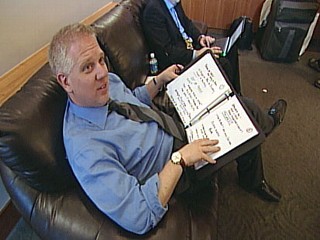
Glenn Beck beck behind scenes planning show

Glenn Beck preps backstage for his Fox News talk show. Despite its weekday-afternoon time slot, normally a ratings wasteland, the show now has a bigger audience than any prime time show on cable.

(ABC News)

He believes the word "jerk" would be the kindest way to describe him at that stage.

"I fired a guy one time for bringing me the wrong kind of pen," he said remorsefully. "I was beyond a jerk.

"I hated myself. Hated myself," he admitted. "I tried for two years to stop drinking. I'd look myself in the mirror and I'd say, 'You're not an alcoholic, you don't have a problem.'"

Beck didn't admit he had a drinking problem until one morning when he was unable to remember a bedtime story he had drunkenly told his children the night before. And so, that evening, he attended an Alcoholics Anonymous meeting.

"I don't know what I expected, but you guys don't look like alcoholics," Beck recalled telling the attendees. "This lady, she must've been 70 years old. She was wearing a sweater set and pearls. She was sitting right in front of me, and she just leaned back and she said, 'Oh, honey, we're all drunks in here.'"

In typical Glenn Beck fashion, however, he didn't stop his reformation there. He became a Mormon.

"I apologize, but guys will understand this. My wife is hot and she wouldn't have sex with me until we got married, and she wouldn't marry me unless we had a religion," he said. "I'm like, ah, you've got to be kidding me! I've got to go to church for this?"

But now he says that going to church has given him the faith to ground himself, and so he's grateful to his wife. Glenn and Tania Beck have been married now for nearly 10 years, after first meeting in a parking lot.

"I was a loser at local radio and she came up to me and she said, 'Are you Glenn Beck?'" he recalled of their first meeting. "She said, 'I used to listen to you when I was in high school. Thanks for the laughs,' and then she turned around and walked away."

Beck has been called an "idiot" who engages in a lot of "crazy talk." Does it bother his wife when people have hateful things to say about her husband?

Glenn Beck: A Big Target

"If I let every single thing bother me, you know, I would have jumped off a bridge a long time ago," she said.

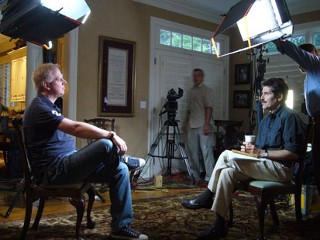
Glenn Beck with John Stossel

Glenn Beck talks with John Stossel about how he got his start in radio.

(Chris Kilmer / ABC News)

Beck has become a big target for comedians and commentators alike. Comedy Central's Stephen Colbert often mocks him, and Jon Stewart of "The Daily Show" once said of Beck, "Finally, a guy who says what people who aren't thinking are thinking."

"You can get rich making fun of me. I know. I've made a lot of money making fun of me," Beck said.

Beck is also criticized for crying on television.

"Somebody get this blubbering buffoon a Kleenex!" said journalist Tina Brown on her March 31 appearance on MSNBC's "Morning Joe." Others have accused Beck of faking the crying for entertainment purposes.

"I should be paid a lot more money if I were able to cry on will like that," he responded.

The criticism he receives from the media doesn't stop there. Al Franken wondered aloud on CNN whether Beck should be allowed on television. Keith Olbermann frequently names Beck the "Worst Person in the World."

Some even go as far as to charge that Beck's complaints about the government actually encourage violence.

"A man kills his own mother and nine others and turns out to have kept a hit list. And Glenn Beck is rationalizing it and blaming liberals for it," said Keith Olbermann on March 13.

But, does Beck actually encourage the anti-government violence of people like Timothy McVeigh?

"No. Timothy McVeigh was a coward," explained Beck. "Violence is the stupid way out. It'll discredit any real legitimate movement."

Beck added that most people who criticize him don't actually watch his show or listen to what he says.

Many in the media label Beck as a staunch Republican -- a label which he strongly disagrees with.

"Both parties only believe in the power of the party," he said. "Stand up. Throw off the shackles of the two-party system!"

He criticizes both parties for exercising more power than the Constitution intended and for abandoning what he considers to be common-sense ideas.

Glenn Beck: Freedom to...

"Look, the American experiment was about freedom," he explained. "Freedom. Freedom to be stupid. Freedom to fail. Freedom to succeed. Freedom to succeed.

"We just put General Motors in the hands of people who can't even run our own government," he added. "Our debt is -- just the interest -- a trillion dollars a year. You can't pay for that!"

Beck also compares himself to Howard Beale, the fictional anchorman from the 1976 film "Network" who famously exclaimed: "I'm as mad as hell, and I'm not going to take it anymore!"

"I am like Howard Beale," said Beck. "When he came out of the rain and he was like, none of this makes any sense. I am that guy."

And so Beck works constantly, on radio, TV and onstage, saying that a lot of life would be better if government -- Republicans and Democrats -- just left Americans alone.

"I believe that if we get out of people's way, the sky's the limit," he said. "The sky is the limit."

By JOHN STOSSEL and ANDREW KIRELL - June 10, 2009

Posted: Daily Thought Pad

Related Resources:

WATCH: Whoopi's Blow Up With Glenn Beck

Friday, February 13, 2009

WE Surround Them


We Surround Them-The Unveiling
 March 13th on FOX News 5pm ET


Share this page with your friends and family...

Do you watch the direction that America is being taken in and feel powerless to stop it?
Do you believe that your voice isn’t loud enough to be heard above the noise anymore?
Do you read the headlines everyday and feel an empty pit in your stomach…as if you’re completely alone?

If so, then you’ve fallen for the Wizard of Oz lie. While the voices you hear in the distance may sound intimidating, as if they surround us from all sides—the reality is very different. Once you pull the curtain away you realize that there are only a few people pressing the buttons, and their voices are weak. The truth is that they don’t surround us at all.
We surround them.

So, how do we show America what’s really behind the curtain? Below are nine simple principles. If you believe in at least seven of them, then we have something in common. I urge you to read the instructions at the end for how to help make your voice heard.

12 Values

  • Honesty
  • Reverence
  • Hope
  • Thrift
  • Humility
  • Charity
  • Sincerity
  • Moderation
  • Hard Work
  • Courage
  • Personal Responsibility
  • Friendship

The Nine Principles

1. America is good.
2. I believe in God and He is the Center of my Life.
3. I must always try to be a more honest person than I was yesterday.
4. The family is sacred. My spouse and I are the ultimate authority, not the government.
5. If you break the law you pay the penalty. Justice is blind and no one is above it.
6. I have a right to life, liberty and pursuit of happiness, but there is no guarantee of equal results.
7. I work hard for what I have and I will share it with who I want to. Government cannot force me to be charitable.
8. It is not un-American for me to disagree with authority or to share my personal opinion.
9. The government works for me. I do not answer to them, they answer to me.
You Are Not Alone

If you agree with at least seven of those principles, then you are not alone. Please send a digital version of your picture to: wesurroundthem@foxnews.comand then stay tuned to the radio and television shows over the coming weeks to see how we intend to pull back the curtain.

Picture updates...

Source:  Glen Beck


The 9/12 Project

You are not alone

Hope Now Doom and Gloom