Showing posts with label President George W. Bush. Show all posts

Thursday, April 30, 2009

Obama Outsources His Presidency

While officials in the Obama White House dismissed yesterday's "100 Days" anniversary as a "Hallmark Holiday," they understood it was what sociologist Daniel J. Boorstin called a "pseudo-event." By that, Boorstin meant an occasion that is not spontaneous but planned for the purpose of being reported -- an event that is important because someone says so, not because it is.

What happens in a president's first 100 days rarely characterizes the arc of the 1,361 that follow. Jimmy Carter had a very good first 100 days. Bill Clinton did not.

Still, a president would rather start well than poorly -- and Mr. Obama has a job approval of 63%. That leaves him tied with Mr. Carter, one point ahead of George W. Bush, and behind only Ronald Reagan's 67%. Four of the past six presidents had approval ratings that ranged between 62% and 67%, a statistically insignificant spread.

Mr. Obama is popular because he is a historic figure, has an attractive personality, has passed key legislation, and receives adoring press coverage.

However, there are cautionary signs. Mr. Obama's policies are less popular than his personality, the pace of polarization with Republicans has proceeded faster than ever in history, and independents are thinking more like Republicans on the issues and less like Democrats.

The first 100 days can reveal a pattern of behavior that comes to characterize a presidency. In this respect, there are two emerging habits of Team Obama worth watching.

One is the gap between what Mr. Obama said he would do and what he is doing. His administration is emphasizing in its official 100 days talking points steps he has taken to "deliver on the change he promised." During the campaign, Mr. Obama denounced the $2.3 trillion added to the national debt on Mr. Bush's watch as "deficits as far as the eye can see." But Mr. Obama's budget adds $9.3 trillion to the debt over the next 10 years. What happened to Obama the deficit hawk?

From Mr. Obama's Denver acceptance speech through the campaign, Mr. Obama did not publicly utter the phrase "universal health care." Instead, his campaign ran ads attacking "government-run health care" as "extreme." Now Mr. Obama is asking, as he did at a townhall meeting last month, "Why not do a universal health care system like the European countries?" Maybe because he was elected by intimating that would be "extreme"?

Another emphasis in the Obama 100 days talking points is that the president is a decisive leader. However, Mr. Obama is enormously deferential to Democrats in Congress and has outsourced formulation of key policies to them. He appears largely ambivalent about the contents of important legislation, satisfied to simply sign someone else's bill.

On the $787 billion stimulus package, he specified less than a quarter of the bill's spending and let House Appropriations Chairman Dave Obey decide the rest. On cap and trade, Mr. Obama is comfortable to let Democratic Reps. Henry Waxman and Edward Markey write that legislation with virtually no White House guidance. On health care, the White House is providing very little detail. Mr. Obama tees up an issue, but leaves its execution to congressional Democrats.

This leadership style may be a carryover from his Senate years, when he was unusually detached from the substance of legislation. Mr. Obama's focus on broad descriptions of a goal will produce laws, but handing over control of the process may produce deeply flawed products.

The stimulus bill turned into a liberal spending wish list that will retard, not hasten, recovery. Already, with mounting job losses the gap between the 3.675 million jobs he said he would create or protect in his first two years and the number of actual jobs in the economy has risen to nearly five million. Reaching his job target now requires creating 249,400 new jobs a month for the next 20 months. Democrats will not fare well in next year's elections if there is a yawning Obama "job gap."

Democratic congressional leaders are ecstatic about Mr. Obama's willingness to outsource major legislation to them. They thrive on sausage making and, with the president's popularity high, they appreciate that his strengths are not their strengths. Yet Mr. Obama clearly did not gain their respect for his legislative abilities during his Senate years.

Mr. Obama is a great face for the Democratic Party. He is its best salesman and most persuasive advocate. But he is beginning to leave the impression that he is more concerned with the aesthetics of policy rather than its contents. In the long run, substance and consequences define a presidency more than signing ceremonies and photo-ops. In his first 100 days, Mr. Obama has put the fate of his presidency in the hands of House Speaker Nancy Pelosi and Senate Majority Leader Harry Reid. He may come to regret that decision.

Mr. Rove is the former senior adviser and deputy chief of staff to President George W. Bush.

"This man has a mindset that is pre-9/11"
Length:2:48
  • Only 27% of viewers watched Obama's Prime Time Press Conference for the first 100 Days Mark.  47% watched the last one.

Wednesday, April 22, 2009

The CIA's Questioning Worked

In releasing highly classified documents on the CIA interrogation program last week, President Obama declared that the techniques used to question captured terrorists "did not make us safer." This is patently false. The proof is in the memos Obama made public -- in sections that have gone virtually unreported in the media.

Consider the Justice Department memo of May 30, 2005. It notes that "the CIA believes 'the intelligence acquired from these interrogations has been a key reason why al Qaeda has failed to launch a spectacular attack in the West since 11 September 2001.' . . . In particular, the CIA believes that it would have been unable to obtain critical information from numerous detainees, including [Khalid Sheik Mohammed] and Abu Zubaydah, without these enhanced techniques." The memo continues: "Before the CIA used enhanced techniques . . . KSM resisted giving any answers to questions about future attacks, simply noting, 'Soon you will find out.' " Once the techniques were applied, "interrogations have led to specific, actionable intelligence, as well as a general increase in the amount of intelligence regarding al Qaeda and its affiliates."

Specifically, interrogation with enhanced techniques "led to the discovery of a KSM plot, the 'Second Wave,' 'to use East Asian operatives to crash a hijacked airliner into' a building in Los Angeles." KSM later acknowledged before a military commission at Guantanamo Bay that the target was the Library Tower, the tallest building on the West Coast. The memo explains that "information obtained from KSM also led to the capture of Riduan bin Isomuddin, better known as Hambali, and the discovery of the Guraba Cell, a 17-member Jemmah Islamiyah cell tasked with executing the 'Second Wave.' " In other words, without enhanced interrogations, there could be a hole in the ground in Los Angeles to match the one in New York.

The memo notes that "[i]nterrogations of [Abu] Zubaydah -- again, once enhanced techniques were employed -- furnished detailed information regarding al Qaeda's 'organizational structure, key operatives, and modus operandi' and identified KSM as the mastermind of the September 11 attacks." This information helped the intelligence community plan the operation that captured KSM. It went on: "Zubaydah and KSM also supplied important information about al-Zarqawi and his network" in Iraq, which helped our operations against al-Qaeda in that country.

All this confirms information that I and others have described publicly. But just as the memo begins to describe previously undisclosed details of what enhanced interrogations achieved, the page is almost entirely blacked out. The Obama administration released pages of unredacted classified information on the techniques used to question captured terrorist leaders but pulled out its black marker when it came to the details of what those interrogations achieved.

Yet there is more information confirming the program's effectiveness. The Office of Legal Counsel memo states "we discuss only a small fraction of the important intelligence CIA interrogators have obtained from KSM" and notes that "intelligence derived from CIA detainees has resulted in more than 6,000 intelligence reports and, in 2004, accounted for approximately half of the [Counterterrorism Center's] reporting on al Qaeda." The memos refer to other classified documents -- including an "Effectiveness Memo" and an "IG Report," which explain how "the use of enhanced techniques in the interrogations of KSM, Zubaydah and others . . . has yielded critical information." Why didn't Obama officials release this information as well? Because they know that if the public could see the details of the techniques side by side with evidence that the program saved American lives, the vast majority would support continuing it.

Critics claim that enhanced techniques do not produce good intelligence because people will say anything to get the techniques to stop. But the memos note that, "as Abu Zubaydah himself explained with respect to enhanced techniques, 'brothers who are captured and interrogated are permitted by Allah to provide information when they believe they have reached the limit of their ability to withhold it in the face of psychological and physical hardship." In other words, the terrorists are called by their faith to resist as far as they can -- and once they have done so, they are free to tell everything they know. This is because of their belief that "Islam will ultimately dominate the world and that this victory is inevitable." The job of the interrogator is to safely help the terrorist do his duty to Allah, so he then feels liberated to speak freely.

This is the secret to the program's success. And the Obama administration's decision to share this secret with the terrorists threatens our national security. Al-Qaeda will use this information and other details in the memos to train its operatives to resist questioning and withhold information on planned attacks. CIA Director Leon Panetta said during his confirmation hearings that even the Obama administration might use some of the enhanced techniques in a "ticking time bomb" scenario. What will the administration do now that it has shared the limits of our interrogation techniques with the enemy? President Obama's decision to release these documents is one of the most dangerous and irresponsible acts ever by an American president during a time of war -- and Americans may die as a result.

By Marc A. Thiessen – Posted: Tuesday, April 21, 2009

The writer, a visiting fellow at the Hoover Institution, served in senior positions in the Pentagon and the White House from 2001 to 2009, most recently as chief speechwriter for President George W. Bush.

Related Articles:

 Posted:  Daily Thought Pad

Friday, April 10, 2009

Joe Biden - Serial Exaggerator or Liar Says Karl Rove

Karl Rove, Republican strategist in an interview on Fox News on Thursday, called Vice President Joe Biden a “liar” and a “serial exaggerator” for concocting a story about President George W. Bush “out of whole cloth”; Joe's latest media faux pas.

Rove's comment was in response to Biden's claim made in an interview with CNN on Tuesday where Biden claimed he allegedly counseled President Bush while in a meeting in the Oval Office.

“Well, Joe, he (President Bush) said, I’m a leader. And I (Joe) said, Mr. President, turn around and look behind you. No one’s following.”

When asked about the comments by Fox News' Megyn Kelly, sitting in for Greta von Sesteren on Thursday, Rove... a close adviser to Bush... said: “It didn’t happen. I hate to say it, but he’s a serial exaggerator. If I was being unkind, I’d say he’s a liar. But it is a habit he ought to drop".

“You’ll notice every one of these incidents has the same structure. Joe Biden courageously raises the impudent question. The president befuddledly answers, and Joe Biden drives home the dramatic response. And I mean, it just...  it’s his imagination. It’s a made-up, fictional world.”

Kelly then asked: “So you’re saying he just made this thing up 'out of whole cloth' with no basis in fact?”

Rove responded: “He’s making these things up out of whole cloth.”

Rove also disputed Biden’s claim that he had spent “a lot of hours alone with” Bush. "Joe Biden was never alone with the president for more than a few moments," Rove said. "There was staff in the room at all times… There would have been notes and Megyn Kelly said she'd already done the research and there weren't any.

"I think there are very few presidents who spend hours with somebody in the Oval Office, particularly a... with all due respect, a blowhard like Joe Biden."  

Rove also said: “These are the kinds of things you can get away with if you are a United States senator or a backbencher in the U.S. House of Representatives. You should not exaggerate and lie like this when you’re the vice president of the United States.”

Earlier this week Biden spokesman Jay Carney told Fox News : “The vice president stands by his remarks.”

Rove pointed out that Biden dropped out of the 1988 Presidential race because he was found to be plagiarizing a speech by Neil Kinnock, the leader of the British Labour Party, “and recounting an episode in Kinnock’s life as if it were in his own life.”

Biden was also criticized for claiming last July that he had been "shot at" during a trip to Iraq, Fox reported. He later amended that assertion, telling The Hill newspaper: "I was near where a shot landed."

It really makes you wonder... or should!  If our vice president lies and exaggerates about things like being shot at and advising the last president plus was caught plagiarizing for his campaign speeches what else is he lying about??

by Marion Algier/Ask Marion - Daily Thought Pad

Saturday, January 17, 2009

The Bush Legacy 
By Thomas Sowell, January 17, 2009

Whatever history's verdict on the Bush administration might be, it is likely to be very different from what we hear from the talking heads on television or read from the know-it-alls on editorial pages.

President Bush's number one achievement was also the number one function of government-- to protect its citizens. Nobody on September 11, 2001 believed that there would never be another such attack for more than seven years.

Unfortunately, people who are protected from dangers often conclude that there are no dangers. This is most painfully visible among those Americans who are hysterical over the government's intercepting international phone calls, in order to disrupt international terrorist networks.

Many, especially among the intelligentsia, are also obsessed with whether we are being nice enough to the cut-throats locked up at Guantanamo, some of whom have already been turned loose to resume a life of terrorism. The rights of the Geneva Convention do not apply to people who neither obey the Geneva Convention nor are covered by the Geneva Convention.

That a President of the United States protected us from deadly enemies may not seem like much of an accomplishment to some. But it may be more fully appreciated when we get a President who eases up on that protection, in order to curry favor at home and abroad.

We can only hope that it will not take the sight of an American city lying in radioactive ruins to wake people up to the dangers that George W. Bush protected us against, despite an unending chorus of carping.

No one in his right mind would say that the Bush administration was flawless. But many of their worst political mistakes were the kinds of mistakes that decent people often make when dealing with indecent people, both domestically and internationally.

The idea with which President Bush arrived in Washington, that he could gain bipartisan support by going along with the Democrats, and not vetoing any bills that Congress passed, ignored the fact that it takes two to tango.

Having proclaimed his goal as bipartisanship, it was he who was blamed when the bipartisanship failed to materialize. Wooing Ted Kennedy and going along with massive government spending did not stop Kennedy from getting up in the Senate and loudly proclaiming that Bush "lied, and lied and lied!" about Iraq.

Whatever the merits or demerits of going to war against Saddam Hussein, the question whether he had weapons of mass destruction immediately at hand makes a better talking point than a serious argument.

President Bush was not the only national leader who thought Saddam Hussein had such weapons, nor were such weapons the only reason why the Iraqi dictator posed a continuing danger that all diplomatic efforts, over more than a decade, had failed to extinguish.

This issue can be debated, and no doubt will be debated for years, if not generations, to come. But the irresponsible charge that "Bush lied" for some nefarious purpose-- to trade "blood for oil" or to generate business for Halliburton, for example-- is more than a slander against him. It undermines our whole nation and gives comfort to our enemies around the world.

Domestically, the Bush legacy leaves a lot to be desired. Going along with the McCain-Feingold bill restricting free speech was perhaps the Bush administration's biggest dereliction of duty. Maybe they figured that they could pass the problem along to the Supreme Court to stop it, since this bill so clearly violated the First Amendment to the Constitution.

But the Supreme Court was also guilty of a dereliction of its duty and let the McCain-Feingold bill stand.

Advocating amnesty for illegal aliens was another political disaster, especially when accompanied by denials of the obvious.

Although the Bush administration went along with the chorus of calls for promoting home ownership among people who could not afford home ownership, President Bush at least sounded a warning while others were still pushing lenders to lend to people who proved unable to repay their loans.

A mixed bag? Aren't we all? But an honorable man.

---

Thomas Sowell is a senior fellow at the Hoover Institution, Stanford University, Stanford, CA 94305. His Web site is www.tsowell.com.

COPYRIGHT 2009 CREATORS SYNDICATE, INC.

Tuesday, November 11, 2008

Thought For The Day on Veteran's Day

“No arsenal, no weapon in the  arsenals of the world, is so formidable as the will and moral courage of free men and women.”

…President Ronald Reagan

 International Picture of the Year in 2007


Here are two very touching photos honored that honor our troops and their families

First Place: 

Todd Heisler, The Rocky

 Mountain News


When 2nd Lt. James  Cathey's body arrived at the Reno Airport, Marines climbed into the cargo hold of the plane and draped the flag over his casket as passengers watched the  family gather on the tarmac. During the arrival of another Marine's casket  last year at Denver International Airport, Major Steve Beck described the  scene as so powerful: 'See the people in the windows? They sat right there in the plane, watching those  Marines. You gotta wonder what's going through their minds, knowing that  they're on the plane that brought him home,' he said  'They will remember being on that plane for the rest of their lives. They're going to remember bringing that  Marine home. And they should.'  

Second Place

Todd Heisler, The Rocky Mountain News


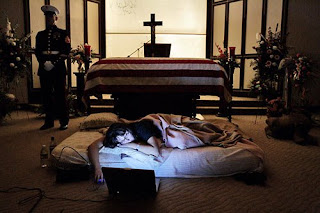
The night before the burial of her husband's body, Katherine Cathey refused to leave the casket, asking to sleep next to his body for the last time. The Marines made a bed for her, tucking in the sheets below the flag. Before she fell asleep, she opened her laptop computer and played songs that reminded her of 'Cat,' and one of the Marines asked if she wanted them to continue standing watch as she slept. 'I think it would be kind of nice if you kept doing it,' she said. 'I think that's what he would have wanted.'

God Bless America 

My family and I know that "Old Glory" does not wave by accident. We have lost loved ones to war; and luckily have many more family members and friends who served, but came home, therefore Veteran’s Day is very special.

Veteran’s Day is for remembering the sacrifices made by others - for us - for our continued freedom. But I believe the day should also be used to create new memories.

Having lost family to war and seeing the price that those who survived and all their families paid, I believe I am able to put this particular holiday in perspective. It is a day, in fact an entire weekend filled with activities throughout America, for us to accomplish two things: remembering and appreciating the sacrifice made by some and the ultimate sacrifice made by others and exercising those won freedoms in a way that creates fond memories with those we still have to love.

Veteran’s Day should certainly be more meaningful than simply a three day weekend or mini vacation, or an odd day off in the middle of the week (depending on your state and your situation). It is a sacred day of remembrance ...but it should also be a time for the living to celebrate each others company while time permits. I especially like to totally surround myself with family and friends on this day, or even on this entire weekend, to celebrate what we (still) have because of those who gave their lives.

Veteran’s Day was born out of the horror of wars and as a remembrance of all those who served. The purpose of this holiday may seem to be fading from some peoples' consciousness. Is it now simply a day off or a three day vacation? Somehow the original meaning of the day has been lost… even while we are a country again at war.

My family and I know that "Old Glory" does not continue to wave by accident. We take time throughout the Veteran’s Day weekend to remember the fallen. We go to the cemeteries and place the flags. Old Glory flies at half mast at home. We tell stories, some sad - some happy, about those that cannot be at our family party. We remember them with reverence.

Last words like: "Tell my family I love them. Tell them to live for me", spoken by a Cobra helicopter pilot as his bird was on fire and about to explode; sacrifices like years lost in captivity and enduring torture for all of us by troops like Senator John McCain; or unimaginable bravery by Michael Monsoor, who valiantly gave his life to save the lives of his fellow Navy Seals, touch our hearts as we share and remember.

So ...my family and I celebrate our freedom - and life. We live our lives together. We do this best by being together and enjoying great recipes and the food they create.

One of the things my family and I do is talk about how to support our troops today. We put together a "care package" or two or three or four. We send the packages to soldiers somewhere in this world. We don't care where they are stationed or what branch of the service they serve.

As one soldier wrote recently, "All soldiers need the simple knowledge of one thing...someone must want them to come home. If a soldier has that...they may be able to make it through anything!!!!"

After the package(s) are wrapped and sent, we do as ordered by our missing loved ones - we celebrate with food and beverage and memories - and we create new memories to be enjoyed forever. What a gift they have given us!


As President Bush said today from the deck of the USS Intrepid, now turned into a museum in New York Harbor, “Thank You for Standing Up!” when your nation needed you the most!!