Showing posts with label British Healthcare. Show all posts

Tuesday, August 11, 2009

Woman in Oregon Told Healthcare Would Not Pay for Cancer Treatment But Would Pay for Assisted Suicide… Welcome to Government Controlled Healthcare

On Fox News’s O'Reilly Factor 8/10/09 a story was put forward about a lady that had cervical cancer and was denied the cancer drugs by the state (they have universal healthcare) and she was told they would pay for the drugs that would terminate her life.

Say you got cancer. Say your doctor found a treatment that could prolong your life for years. It wouldn’t cure the cancer, but it would slow it down, giving you precious time. Say the state refused to pay for your treatment, yet told you they would pay for doctor-assisted suicide.

Welcome to the Oregon Health Plan.

Perhaps, in order to find out what we can look forward to under a single-payer plan, we should look to one of our very own states: Oregon. The Oregon Health Plan (OHP) is a government run health care system for low-income residents. To be included in the plan, you currently have to win a lottery — literally. Sounds relatively simple, right? Basic care is included with little to no co-payments.

But things aren’t all butterflies and flowers in the Oregon Health Plan, nor is the health care system in place in Oregon going well. Patients who are treated under the OHP or Medicaid get the joys of rationed health care. And if you are unlucky enough to be stricken with cancer, or need a major operation to save your life, the state’s response is to tell you to just die already. And they mean that literally.

Consider the case of Barbara Wagner. She is a lung cancer patient whose doctor prescribed her a revolutionary new chemotherapy treatment, one that slows the growth of the cancer and could possibly prolong her life by years. To most people, this would be good news. To the OHP, it meant just another drain on the system. They denied Ms. Wagner’s claim, and instead offered to pay for doctor-assisted suicide. Wagner, of course, was understandably outraged.

“Treatment of advanced cancer that is meant to prolong life, or change the course of this disease, is not a covered benefit of the Oregon Health Plan,” read the letter notifying Wagner of the health plan’s decision.

Wagner says she was shocked by the decision. “To say to someone, we’ll pay for you to die, but not pay for you to live, it’s cruel,” she told the Register-Guard. “I get angry. Who do they think they are?” An OHP doctor tried to explain:

Dr. Walter Shaffer, medical director of the state Division of Medical Assistance Programs, which administers the Oregon Health Plan, attempted to defend the health plan’s decision. “We can’t cover everything for everyone,” he said. “We try to come up with polices that provide the most good for the most people.” Shaffer then addressed a priority list that had been developed to ration health care. “There’s some desire on the part of the framers of this list to not cover treatments that are futile,” he said, “or where the potential benefit to the patient is minimal in relation to the expense of providing the care.”

Under Obama’s government run health care plan, could the rest of the country be headed the same way? Be sure to read the whole thing.

Source: American Issues Project

Video: Oregon says no to chemotherapy, offers assisted suicide instead
HotAir.com ^ | 8/3/09 | Ed Morrissey

We knew it would come to this when Oregon insisted on passing its assisted-suicide laws. It doesn’t take much for assisted suicide to go from a humane option to a cost-saving device, especially when the state pays for the medical care. One patient in Oregon got a letter that made this all too clear, when in the same letter rejecting her request for life-extending chemotherapy, Oregon offered her “physician-aid-in-dying”. In other words, Oregon offered their customer a heapin’ helping of death:

The doctor interviewed by the news station seems offended at the suggestion that Oregon would decide to save a few bucks by denying expensive health care and offering a case of hemlock in its place. However, saving money was the raison d’etreof single-payer systems, and the incentives all drive towards that decision. Single-payer systems have to handle medical services as a shortage market, rationing them by using “comparative effectiveness” paradigms to determine who gets medical attention, and who gets “physician-aid-in-dying” instead of it.

The woman who drew the short end of the stick in this case wonders who these people think they are. They think they know better than us who needs to live and die. Has that lesson still not been made clear?

Update: I got this link yesterday and the KATU page is undated, but this story is from 2008, which I didn’t realize until I got an e-mail about it. I wrote about this last June, and I simply didn’t recall it.

Posted on Mon Aug 03 2009 07:35:40 GMT-0700 (Pacific Daylight Time) by Crazieman

Related Posts:

Posted: Daily Thought Pad

Sunday, June 14, 2009

Obama challenges GOP healthcare critics

Will address the AMA with insurance plans

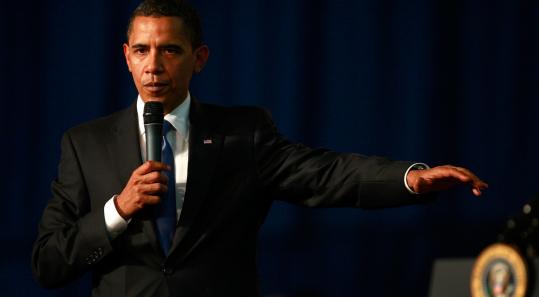
President Obama addressed healthcare issues during a town hall-style meeting yesterday in Green Bay, Wisc.

President Obama addressed healthcare issues during a town hall-style meeting yesterday in Green Bay, Wisc. (Scott Olson/Getty Images)

GREEN BAY, Wis. - Undertaking a new and aggressive push to enact a sweeping healthcare plan this year, President Obama bluntly challenged Republican critics yesterday to put forward their own plan to expand coverage to the uninsured and help struggling families afford care.

"To those who criticize our efforts, I ask them, 'What's the alternative?' " Obama said at a town hall-style meeting, surrounded by supportive citizens in the heartland.

"What else do we say to all those families who spend more on health care than on housing or on food? What do we tell those businesses that are choosing between closing their doors and letting their workers go?"

A dispute over Obama's desire to create a new government-sponsored health plan to compete with private insurers is forming a major obstacle to bipartisan consensus. There also remain major disagreements over how to pay for the $1.5 trillion it will cost over the next decade to cover uninsured Americans, and whether to require employers to offer coverage.

Obama described his critics as naysayers, saying, "I can assure you that doing nothing will cost us far more in the coming years." But he also said he won't run roughshod over Congress with a "my way or the highway" approach and is "happy to steal other people's ideas."

Green Bay resident Laura Klitzka, 35, a married mother of two who has breast cancer that has now spread to her bones, introduced Obama at the town hall. She carries about $12,000 in unpaid medical bills that continue to pile up as treatment continues that she said her family cannot afford.

The White House considers such emotional pleas critical to selling reform. Obama's political arm, the grass-roots machine known as Organizing for America, has collected hundreds of thousands of similar stories that could shame lawmakers who don't sign on.

But the brief ride from the airport to the high school where he spoke featured a rare sight for the new president: a large gathering of protesters.

Signs held among the several hundred demonstrators lining his route said "NObama" and "No to Socialism."

Back in Washington, Republicans assailed any inclusion of a public insurance option in a new system of expanded healthcare. "We see that as a slippery slope to having the government run everything," Senator Mike Enzi, a Wyoming Republican, said at a news conference.

But Obama, answering a question, said no one - "certainly not me" - is interested in a nationalized healthcare system, like that in Great Britain. "When you hear people saying socialized medicine, understand, I don't know anybody in Washington who is proposing that," he said.

Still, opposition is building to the direction of proposals from Obama and fellow Democrats.

The US Chamber of Commerce is convening business groups today to plot strategy. A chamber vice president, Randy Johnson, said that though business groups have been largely restrained to date about voicing opposition, it might be time for that to change. Johnson testified yesterday at a Senate hearing where he expressed strong opposition to Democratic proposals to require employers to purchase health care for their employees.

Obama will also face some foes to his healthcare proposals in Chicago on Monday, when he addresses the American Medical Association, the nation's largest doctors group, which is wary of a public insurance plan.

But the AMA now represents barely one-fourth of the nation's physicians, and just how much that body can sway Obama's health reform efforts will be a test of its once mighty clout.

Asked about the AMA's stand, White House spokesman Bill Burton told reporters yesterday: "He knew at the beginning of this process that people would oppose and support different elements that were on and off the table, and this is just one part of the process." He's going to talk to the AMA on Monday, and thinks that we'll be able to have an open and honest dialogue about the issues that we're all very concerned about."

By Philip Elliott - Globe Newspaper Company.

Kennedy Corpus, 10, holds a note President Obama gave to her Thursday.

Enlarge this photo

CORY DELLENBACH / AP

Photo: Kennedy Corpus, 10, holds a note President Obama gave to her Thursday.

Related Stories:

What a note: Kennedy Corpus, 10, has a rock-solid excuse for missing the last day of school: a personal note to her teacher from President Obama. Her father, John Corpus, of Green Bay, Wis., stood to ask Obama about health care and mentioned that his daughter was missing school to attend the event. "Do you need me to write a note?" Obama asked. He wrote: "To Kennedy's teacher: Please excuse Kennedy's absence. She's with me. Barack Obama." He stepped off the stage to hand-deliver the note. "It was like the best thing ever," the fourth-grader said later.

Thursday, June 11, 2009

How to Stop Socialized Health Care

Five arguments Republicans must make…

It was a sobering breakfast with one of the smartest Republicans on Capitol Hill. We can fix a lot of bad stuff President Barack Obama might do, he told me. But if Mr. Obama signs into law a "public option," government-run insurance program as part of health-care reform we won't be able to undo the damage.

I'd go the Republican member of Congress one further: If Democrats enact a public-option health-insurance program, America is on the way to becoming a European-style welfare state. To prevent this from happening, there are five arguments Republicans must make.

[Karl Rove]Getty Images

The first is it's unnecessary. Advocates say a government-run insurance program is needed to provide competition for private health insurance. But 1,300 companies sell health insurance plans. That's competition enough. The results of robust private competition to provide the Medicare drug benefit underscore this. When it was approved, the Congressional Budget Office estimated it would cost $74 billion a year by 2008. Nearly 100 providers deliver the drug benefit, competing on better benefits, more choices, and lower prices. So the actual cost was $44 billion in 2008 -- nearly 41% less than predicted. No government plan was needed to guarantee competition's benefits.

Second, a public option will undercut private insurers and pass the tab to taxpayers and health providers just as it does in existing government-run programs. For example, Medicare pays hospitals 71% and doctors 81% of what private insurers pay.

Who covers the rest? Government passes the bill for the outstanding balance to providers and families not covered by government programs. This cost-shifting amounts to a forced subsidy. Families pay about $1,800 more a year for someone else's health care as a result, according to a recent study by Milliman Inc. It's also why many doctors limit how many Medicare patients they take: They can afford only so much charity care.

Fixing prices at less than market rates will continue under any public option. Sen. Edward Kennedy's proposal, for example, has Washington paying providers what Medicare does plus 10%. That will lead to health providers offering less care.

Third, government-run health insurance would crater the private insurance market, forcing most Americans onto the government plan. The Lewin Group estimates 70% of people with private insurance -- 120 million Americans -- will quickly lose what they now get from private companies and be forced onto the government-run rolls as businesses decide it is more cost-effective for them to drop coverage. They'd be happy to shift some of the expense -- and all of the administration headaches -- to Washington. And once the private insurance market has been dismantled it will be gone.

Fourth, the public option is far too expensive. The cost of Medicare -- the purest form of a government-run "public choice" for seniors -- will start exceeding its payroll-tax "trust fund" in 2017. The Obama administration estimates its health reforms will cost as much as $1.5 trillion over the next 10 years. It is no coincidence the Obama budget nearly triples the national debt over that same period.

Medicare and Medicaid cost much more than estimated when they were adopted. One reason is there's no competition for these government-run insurance programs. In the same way, Americans can expect a public option to cost far more than the Obama administration's rosy estimates.

Fifth, the public option puts government firmly in the middle of the relationship between patients and their doctors. If you think insurance companies are bad, imagine what happens when government is the insurance carrier, with little or no competition and no concern you'll change to another company.

In other words, the public option is just phony. It's a bait-and-switch tactic meant to reassure people that the president's goals are less radical than they are. Mr. Obama's real aim, as some candid Democrats admit, is a single-payer, government-run health-care system.

Health care desperately needs far-reaching reforms that put patients and their doctors in charge, bring the benefits of competition and market forces to bear, and ensure access to affordable and portable health care for every American. Republicans have plans to achieve this, and they must make their case for reform in every available forum.

Defeating the public option should be a top priority for the GOP this year. Otherwise, our nation will be changed in damaging ways almost impossible to reverse.

By Karl Rove

About Karl Rove - Karl Rove served as Senior Advisor to President George W. Bush from 2000–2007 and Deputy Chief of Staff from 2004–2007. At the White House he oversaw the Offices of Strategic Initiatives, Political Affairs, Public Liaison, and Intergovernmental Affairs and was Deputy Chief of Staff for Policy, coordinating the White House policy making process.

Before Karl became known as "The Architect" of President Bush's 2000 and 2004 campaigns, he was president of Karl Rove + Company, an Austin-based public affairs firm that worked for Republican candidates, nonpartisan causes, and nonprofit groups. His clients included over 75 Republican U.S. Senate, Congressional and gubernatorial candidates in 24 states, as well as the Moderate Party of Sweden.

Karl writes a weekly op-ed for The Wall Street Journal, is a Newsweek columnist and is now writing a book to be published by Simon & Schuster. Email the author at Karl@Rove.com or visit him on the web at Rove.com.

Or, you can send him a Tweet @karlrove.

Posted: Daily Thought Pad

Related Articles:

Democrats Set to Rush Through Government-Run Healthcare

Senate Democrats announced plans Tuesday to begin committee work next week on health care legislation designed to assure coverage for millions of Americans who now lack it, a key objective of the Obama administration.

Obama Care

IBut Sen. Chris Dodd, D-Conn., said the measure that goes before the Senate Health, Education, Labor and Pensions Committee would contain gaps rather than include several controversial features included in a draft that circulated only last week. Among them are a proposed government-run insurance plan to compete with private companies -- vociferously opposed by nearly all Republicans -- and a requirement for employers to pay a penalty if they fail to provide coverage for their workforce.

Dodd said he would preside over the sessions in the place of Sen. Edward M. Kennedy, D-Mass., the committee chairman, who was diagnosed more than a year ago with brain cancer and has not been in the Capitol in recent days. The committee work will take about three weeks, he said.

Sen. Mike Enzi, R-Wyo., the top Republican on the health committee, responded dismissively to Dodd's comments about leaving gaps for GOP lawmakers to debate.

He said Democrats did so "because they know we're not going to like what they've written and they don't want us to have any time to comment," he said in an interview.

Enzi also said Democrats would have behaved differently if Kennedy were present.

"I've never worked a process on any bill with him that went like this where there was absolutely no input taken from the other party," Enzi said. "And I never treated him that way either."

"What the question is, is Senator Dodd in charge or is he just running the meeting, and we don't know yet," Enzi said.

Dodd's announcement signaled a quickening pace of activity on health care legislation, and came as senior House Democrats disclosed they are considering a new tax on employer-provided health benefits to help pay for expanding coverage to the 50 million uninsured. President Barack Obama opposed a tax on benefits during last year's campaign and aired numerous television commercials criticizing the idea when his Republican rival, Sen. John McCain, proposed it.

Several officials also said an outline of emerging legislation in the House envisions a requirement for all individuals to purchase affordable coverage, with an unspecified penalty for those who refuse and a waiver for those who cannot cover the cost.

"There's no sense having a mandate unless you have a contribution," Rep. Charles Rangel, D-N.Y., chairman of the House Ways and Means Committee, said Monday. He referred to the suggestion as "play or pay."

Rangel and other senior Democrats arranged to bring members of the party's rank and file up to date at a midday session Tuesday on the effort to draft health care legislation at the top of President Barack Obama's agenda.

The officials spoke on condition of anonymity, saying they did not want to pre-empt the presentation to rank-and-file Democrats on Tuesday.

Under an outline of the House Democratic plan, individuals and small businesses would be able to purchase coverage from a "health exchange" and the government would require all plans to contain a minimum benefit. No applicant could be rejected for pre-existing conditions, nor could one be charged a higher premium.

The outline shows Democrats want to provide subsidies to families up to about $88,000 a year to help them pay for insurance, and to require new policies to limit out-of-pocket spending as a way to prevent personal bankruptcies.

House Democrats also are considering a wide-ranging change for Medicaid that would provide a uniform benefit across all 50 states and increase payments to providers, according to several officials. Medicaid is a joint state-federal program of health coverage for the poor.

The measure also envisions several changes to Medicare, the government program that provides health care to seniors, although details are lacking.

According to the outline, the gap between primary care physician fees and those of specialists would be narrowed, and beneficiaries would not incur out-of-pocket costs for preventive services. The outline also mentions unspecified improvements in the prescription drug benefit. Democrats vociferously opposed that benefit when Republicans passed it, saying it provided billions in unnecessary subsidies to pharmaceutical companies.

The outline does not include an overall cost for the legislation, which is expected to exceed the $1.2 trillion, 10-year price tag Obama's proposal carried last winter.

Part of the cost would be covered in the form of cuts in the government payments under Medicare plans run by private insurance companies, which receive more per patient than the cost of traditional coverage.

Strikingly, the outline made no mention of the possible tax on health benefits, or of the proposed penalty for those refusing to purchase affordable insurance.

Several officials stressed that no final decisions would be made for several days on the possible tax on health benefits.

The idea has been gaining currency in recent weeks as Congress intensifies its search for more than $1 trillion to help pay for a health care overhaul.

America… Do your homework, contract your Representative and Senator (no matter which side you are on) and do not let them pass this legislation without reading it, without having ‘real’ funds to pay for it and a real plan, and without being satisfied that you will be receiving and will continue to receive the same or better health care treatment than you do today… which means better than the care in any country that now has socialized or nationalized healthcare. If not… do not let the government force you into a plan of worse healthcare that nobody can pay for!!

Source: Associated Press/MoneyNews.com

Monday, June 8, 2009

Healthcare: You Think Michael Moore Will Contribute? Don’t Hold Your Breath

The Gipper did it for the same reasons we do it; it isn’t any good.Michael Moore has become the champion of socialized medicine over the last year with his flop movie Sicko. Seems flops don’t seem to bother the Democrats, just look at what happened to Howard Dean.

Anyway, as an example of better living through socialized medicine, Moore took his cameras to England to highlight the joys of their National Health Service and presented a rosy picture of everyone getting everything they need without paying anything out of pocket. Sounds like Utopia, doesn’t it? Too bad it isn’t true.

You see, socialized medicine, or “free health care,” as Moore prefers to call it isn’t free at all, and it isn’t very good for your health. Aside from the oppressive taxes needed to fund it and their stagnating effect on the economy (higher unemployment is but one of the side effects of those taxes), the wait times and straight-up refusal to cover certain things make socialized medicine a great system just as long as you don’t get sick.

We’ve posted examples of the measures to which people stuck in these systems will go to obtain care they need rather than wait their turn, meaning suffer until they can be helped. Remember the woman who made up a batch of fake blood she claimed to vomit so she could skip the long lines where she was forced to wait and wait for a hernia operation, something done regularly and on an out-patient basis in the US? How about the 108 year old woman who was told she would have to wait 18 months for a new hearing aid, should arrive just in time to be buried with her.

Well, we now have another fine example of just what socialized medicine will do for us, or, to put it more accurately, to us.

Anthony Wilson, founder of Factory Records (the label that brought us Joy Division, The Happy Mondays and New Order, just to name a few) and television personality in England is going to die soon from cancer. It’s a shame, but it’s true.

Unfortunately for Wilson, it isn’t really the cancer that’s going to kill him, it’s the National Health Service. See, the NHS won’t pay for the drugs needed to help him fend off the cancer, a drug that has doubled the life expectancy of patients in clinical trials.

Why won’t they pay for it? Did you really think they paid for everything in socialized medicine? Well, they pay for everything they cover. If they don’t cover it, you’re kind of screwed. You either have to pay for it yourself, or go without. When the diagnosis is cancer, going without isn’t the best option.

A dirty little secret the Michael Moores of the world don’t want you to know about is the delay in introducing new drugs into a market with socialized medicine’s price controls. But it’s important to note. Check this out and see if you’re willing to wait an extra 6 months while the government haggles over prices.

In many socialize medicine countries it is illegal to purchase private insurance in order to avoid the long wait times and additional suffering single-payer health systems bring with them. Thankfully, that trend is changing, at least in Canada.

But private health insurance is legal in England, but Wilson has refused to buy it. See, he’s bought completely into the NHS. Now that he needs it he’s beginning to realize how big of a mistake that actually turned out to be.

“I’ve never paid for private healthcare because I’m a socialist. Now I find you can get tummy tucks and cosmetic surgery on the NHS but not the drugs I need to stay alive. It is a scandal.”

No, Mr. Wilson, it is not a scandal, it’s not even new, it’s exactly what you and people like Michael Moore have supported for years. It’s exactly what you’re refused to see while it was too late for others. Now it’s most likely too late for you.

It’s a shame, really. Maybe his friends and the people he’s made rich over the years (maybe even Michael Moore, though we doubt it) will come through with more money than just enough for 5 months worth of the drugs he needs. Maybe the “Big Pharmaceutical” companies will give him free drugs because, well, that’s what they do for people who can’t afford life-saving drugs (no matter how much they are demonized by the Left). Or maybe he die.

We don’t wish ill upon anyone, even a socialist, but this should serve as a lesson to everyone; be careful what you wish for because you just might get it.

By First Friday – First Friday Collective Podcast – Originally Posted Friday August 17, 2007

Source: True Health Is True Wealth

Related Resources and Articles:

Possibly related posts: (automatically generated)

Posted: Daily Thought Pad